
Little Shop of Coral
Yellow Boxfish (Ostracion cubicus)
Yellow Boxfish (Ostracion cubicus)
Couldn't load pickup availability
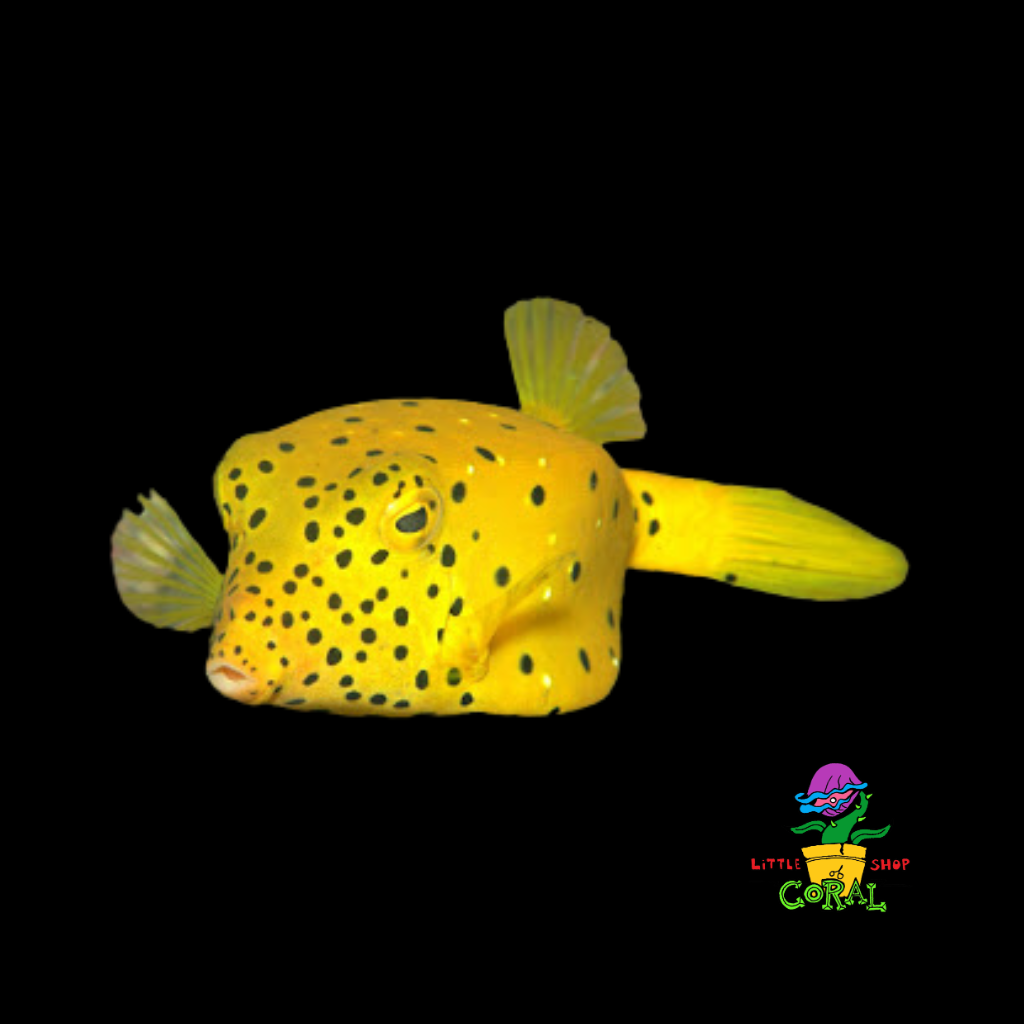
Few fish in the hobby stop people in their tracks quite like a juvenile Yellow Boxfish. Typically sold as juveniles at just a few inches in length, these boxfish are bright yellow with dark polka dots, and their interesting cube-shaped body and curious personality really make them stand out. The way they paddle around a tank, peering at everything with their high-set eyes, is genuinely one of the most endearing sights in the hobby. But the Yellow Boxfish demands full honesty in its listing, because this is a species that comes with real responsibilities and genuine risk. Too many impulsive hobbyists who succumb to the siren song of O. cubicus soon discover they have bitten off more than they can chew. This is a fish for experienced, well-prepared keepers only, and it rewards that preparation with a truly one-of-a-kind aquarium resident.
Why we love it
- One of the most visually unique and instantly recognizable fish in the hobby
- Endearing cube-shaped body, polka dot patterning, and oversized curious eyes
- Bold, engaging personality with genuine interactive behaviour toward its keeper
- A conversation piece that no other fish in the tank can match for sheer novelty
- Rewarding long-term challenge for experienced hobbyists who do their homework
Suggested parameters
- Temperature: 24 to 26°C (75 to 79°F)
- Salinity: 1.025 to 1.026 SG
- pH: 8.1 to 8.4
- Alkalinity: 8 to 10 dKH
- Calcium: 400 to 450 ppm
- Magnesium: 1250 to 1400 ppm
- Nitrate: Under 20 ppm; stability is critical
- Robust protein skimming, chemical filtration, and regular water changes are essential given this species' intolerance of poor water conditions and toxic tendencies
Care and temperament
- Difficulty: Advanced
- Temperament: Peaceful but slow-moving; must be kept with non-aggressive, non-boisterous tankmates only
- Reef safe: No (will nibble at tubeworms, sponges, and small invertebrates; not suitable for reef systems)
- Minimum tank size: 125 gallons for a juvenile; Yellow Boxfish can grow to almost 18 inches; a minimum of 250 gallons or larger is recommended for a long-term adult
- This species cannot manoeuvre in strong currents, especially when small; pay particular attention to pump inlets as these fish can become trapped
- Care must be taken when carrying out maintenance on the aquarium so as to keep the fish as calm as possible
- A tight-fitting lid is essential; this species can jump
The ostracitoxin risk: what you need to know
This is the single most important factor in keeping this species and cannot be overstated. O. cubicus is capable of exuding a deadly toxin called ostracitoxin when stressed; if released, this poison can kill all the fish in the tank, including the boxfish itself. Stress triggers can include aggressive tankmates, netting, sudden parameter shifts, poor water quality, or extreme fright. Keeping a relatively large supply of clean, heated, and aerated saltwater matching your display tank parameters on hand at all times is strongly recommended so that a massive emergency water change can be performed immediately if ostracitoxin release is suspected. Activated carbon will also help remove toxins from the water column and should always be running in a system housing this species. Never transport the boxfish in the same water as other fish, and never add the shipping water to your system.
Diet
O. cubicus is omnivorous, feeding on algae and a range of small invertebrate prey; specimens may be slow to accept foods in captivity and live foods may be needed initially to elicit a feeding response.
- Frozen mysis shrimp (staple once trained)
- Chopped shrimp, krill, clam, mussel, squid, and cockle
- Spirulina-enriched frozen brine shrimp
- Marine algae-based frozen formulations
- Quality sinking carnivore pellets once established
- Boxfish have very small mouths and stomachs; small amounts fed multiple times throughout the day are essential to prevent starvation, which may not be immediately apparent due to the rigid bony carapace
- Avoid floating foods; boxfish can accidentally ingest air at the surface causing serious buoyancy problems
- Feed at least 3 times daily
Compatibility and tankmates
- Keep only with calm, peaceful, non-aggressive fish of similar or larger size
- Any tankmates kept with O. cubicus must be non-aggressive and non-boisterous; stress from harassment is one of the most common triggers for ostracitoxin release
- Avoid triggerfish, aggressive puffers, large angelfish, and any fin-nipping species
- Not compatible with shrimp, crabs, snails, or most ornamental invertebrates
- Keep one per system; two boxfish in the same tank is not recommended
Health and acclimation notes
The Yellow Boxfish is sensitive to shipping stress and water quality fluctuations. Slow, careful drip acclimation is strongly recommended, and the shipping water must never be added to the display tank. A dedicated, well-established system with excellent filtration, consistently stable parameters, and zero aggressive tankmates gives this fish the best possible start. This species can be a shy feeder when first introduced; patience and live or highly palatable foods are often needed to establish a reliable feeding response.
What you are buying
- You will receive: 1 Yellow Boxfish (Ostracion cubicus)
- Juveniles are bright yellow with dark-brown polka dots; as specimens age the bright yellow gives way to a more subdued brownish yellow and the spots change in character
This species is recommended for experienced hobbyists only. Slow acclimation is essential, the shipping water must not enter your display system, and activated carbon should be running at all times.
Collapsible content
LIGHT
LOW: Place coral at the bottom of the tank. Depending on the type, coral may need to be placed off sand and therefore mounted on a ceramic disc of piece of rock.
MEDIUM: Place coral at mid-range of the tank. Best placed/glued on top of a rock scape at mid-range height.
HIGH: Place coral from mid range to just below water level. SPS coral are shallow growing so they require and are able to tolerate intense light.
FLOW
LOW: Most soft coral do well with a small, gentle pulse. There are certain corals that can even be placed in areas of indirect flow, meaning places aside a rock structure or set into a entrance to a cave style space.
MEDIUM: Many LPS types of coral prefer medium pulse current. Most Euphyllia or corals that have more tissue structure connected to their skeleton, don’t like to be in a high flow area like the direct flow of the wave pump.
HIGH: Similar to high light, SPS enjoy being in some heavy current. Most LPS and SPS that branch encrust or plate prefer high flow that simulates the top water waves.
SKILL
ENTRY: While some may say beginner level, "Entry" is a good term to be used when starting out in the world of corals and marine life. Prior to adding livestock, you want to ensure that your reef has the proper parameters including zero levels of ammonia and nitrite. Seeing traces of nitrate in your waters is a good sign - just keep them at a lower level of 2ppm to 10ppm. Maintaining correct temperature and salinity are a huge factor to stable parameters. Starting to monitor your PH, alkalinity, calcium and magnesium is a great habit to get into to keep a successful reef.
While some soft coral don’t require too much light, having a proper reef light that puts out the proper pars is very important. You'll also want to have a good amount of flow and protected rock areas, as placing corals in their happy spot is ideal for success.
ADVANCED: