

Little Shop of Coral
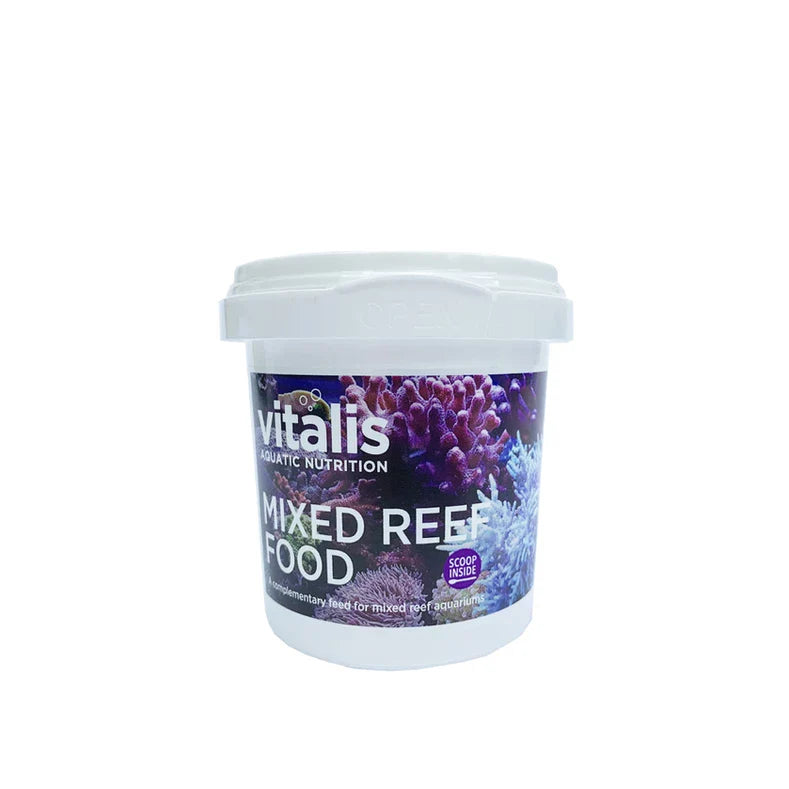
Vitalis Aquatic Nutrition Mixed Reef Food 50g
Vitalis Aquatic Nutrition Mixed Reef Food 50g
Couldn't load pickup availability
Vitalis Aquatic Nutrition Mixed Reef Food
Vitalis Mixed Reef Food is a specially formulated coral food designed to give your reef a little extra nutrition at feeding time. Rather than using large pieces of food, Vitalis uses a micronised flake that breaks down into tiny particles, similar to the suspended food particles corals naturally capture from the water.
It is formulated for SPS corals, soft corals, and other filter-feeding reef inhabitants, making it a great choice for mixed reef aquariums. The fine particles are easily distributed throughout the aquarium, allowing multiple corals to feed naturally.
Why use Mixed Reef Food?
-
Complete food designed for corals
-
Suitable for SPS, soft corals, and other filter feeders
-
Micronised flakes create tiny suspended food particles
-
Highly digestible
-
Helps encourage a natural feeding response
-
Made with fish, molluscs, crustaceans, vegetable ingredients, oils, fats, and minerals
How to use
Feed daily or every other day, depending on the amount of coral in your aquarium.
-
Start with approximately 1 level scoop per 50 L (13 US gal) of aquarium water.
-
For heavily stocked reef aquariums, up to 2 level scoops per 50 L can be used.
-
Mix the food with a small amount of aquarium water before adding it to the tank.
-
Add it to an area with good water movement so the fine particles can spread throughout the aquarium.
-
For more targeted feeding, use a pipette or turkey baster to gently distribute the food around your corals.
-
Avoid overfeeding, especially in smaller or low-nutrient systems.
For targeted feeding, turning off the main return pump for around 10–20 minutes while leaving circulation pumps running can help keep the food available to your corals for longer.
Why we love it
We love Mixed Reef Food because it makes feeding a whole reef simple. The tiny particles are easy for corals to capture, and you don't have to sit there feeding every coral individually. It's an easy way to add a little more nutrition to your reef while encouraging natural feeding behaviour and healthy coral growth.
Collapsible content
LIGHT
LOW: Place coral at the bottom of the tank. Depending on the type, coral may need to be placed off sand and therefore mounted on a ceramic disc of piece of rock.
MEDIUM: Place coral at mid-range of the tank. Best placed/glued on top of a rock scape at mid-range height.
HIGH: Place coral from mid range to just below water level. SPS coral are shallow growing so they require and are able to tolerate intense light.
FLOW
LOW: Most soft coral do well with a small, gentle pulse. There are certain corals that can even be placed in areas of indirect flow, meaning places aside a rock structure or set into a entrance to a cave style space.
MEDIUM: Many LPS types of coral prefer medium pulse current. Most Euphyllia or corals that have more tissue structure connected to their skeleton, don’t like to be in a high flow area like the direct flow of the wave pump.
HIGH: Similar to high light, SPS enjoy being in some heavy current. Most LPS and SPS that branch encrust or plate prefer high flow that simulates the top water waves.
SKILL
ENTRY: While some may say beginner level, "Entry" is a good term to be used when starting out in the world of corals and marine life. Prior to adding livestock, you want to ensure that your reef has the proper parameters including zero levels of ammonia and nitrite. Seeing traces of nitrate in your waters is a good sign - just keep them at a lower level of 2ppm to 10ppm. Maintaining correct temperature and salinity are a huge factor to stable parameters. Starting to monitor your PH, alkalinity, calcium and magnesium is a great habit to get into to keep a successful reef.
While some soft coral don’t require too much light, having a proper reef light that puts out the proper pars is very important. You'll also want to have a good amount of flow and protected rock areas, as placing corals in their happy spot is ideal for success.
ADVANCED: