

Little Shop of Coral
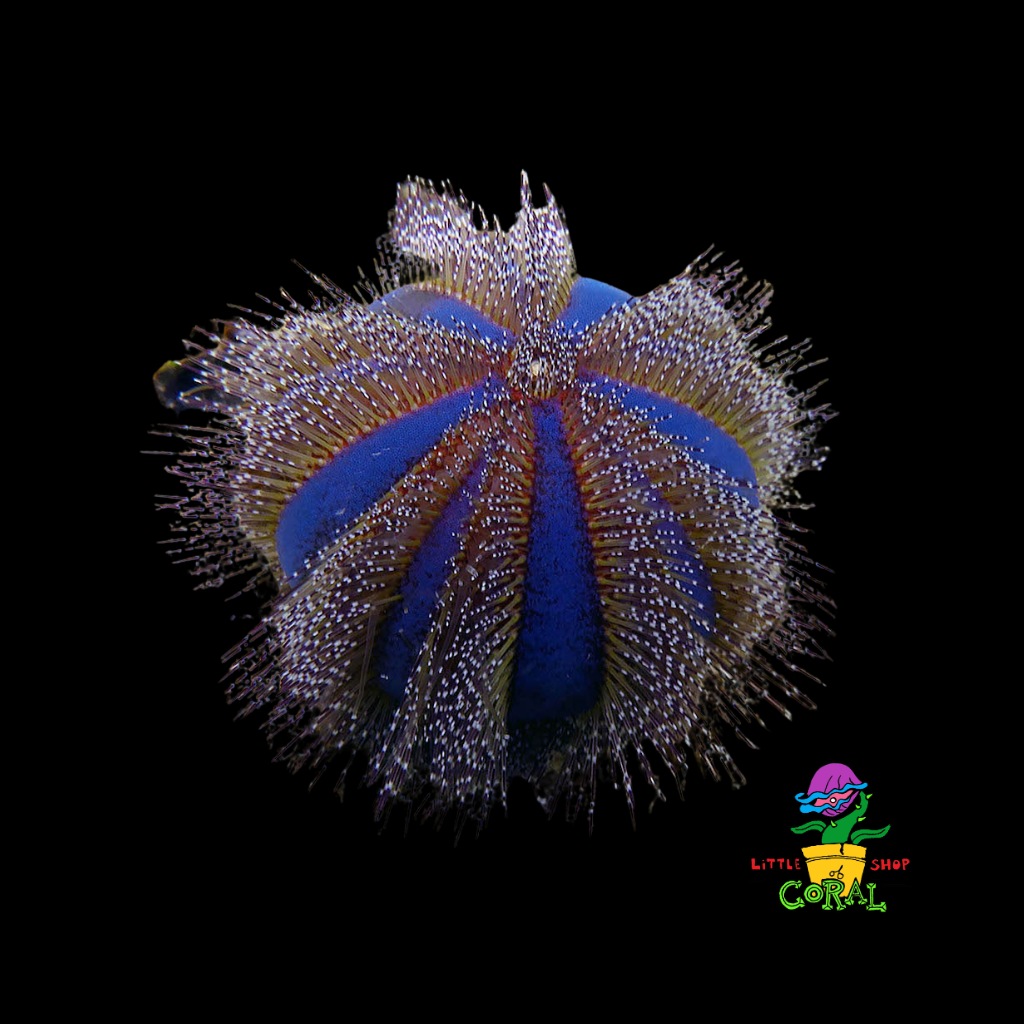
Tuxedo Urchin (Mespilia globulus)
Tuxedo Urchin (Mespilia globulus)
Couldn't load pickup availability
The Tuxedo Urchin is one of the most charming and useful cleanup crew animals available in the reef hobby, and one of the few invertebrates that looks as good as it works. Its spherical body features ten vertical spine-free zones of vivid velvety blue or blue-green, separated by rows of short, neat spines in dark red, brown, or black, creating the distinctive banded pattern that earns it its name. Sea urchins are considered by marine ecologists to be keystone species in tropical seas, promoting the development of reef-building corals through the intense grazing pressure they exert on benthic algae, and the Tuxedo brings that same ecological function to the home aquarium in a compact, reef-friendly, and genuinely beautiful package. It also has one of the most endearing behavioural quirks in the hobby: the charming habit of picking up shells, small stones, and even loose coral frags to wear as a form of camouflage, a behaviour that makes every Tuxedo Urchin its own unique, ever-changing little sculpture.
Why we love it
- Stunning velvety blue banding and short, manageable spines make this one of the most attractive urchin species available in the hobby
- Highly effective at eradicating filamentous algae and serving as an indispensable herbivore in any reef cleanup crew
- Compact adult size of approximately 5 to 7 cm makes it suitable for a wide range of system sizes from nano tanks upward
- Fully reef safe with corals of all types; will not eat or sting coral tissue
- A Tuxedo Urchin actively carrying shells and rubble on its back is a reliable indicator of good health, making its behaviour itself a useful health gauge
Suggested parameters
- Temperature: 24 to 26°C (75 to 79°F)
- Salinity: 1.025 to 1.026 SG; sea urchins are vulnerable to sudden salinity changes and must be acclimated slowly
- pH: 8.1 to 8.4
- Alkalinity: 8 to 10 dKH
- Calcium: 400 to 450 ppm; important for spine and test integrity
- Magnesium: 1250 to 1400 ppm
- Nitrate: 5 to 20 ppm
- Phosphate: 0.03 to 0.12 ppm
- Copper-based medications are immediately fatal to all echinoderms and must never be used
Care and temperament
- Difficulty: Easy
- Temperament: Peaceful toward all fish, corals, and most invertebrates
- Reef safe: Yes, with the practical note that while it will not eat corals, it can be a physical threat to small unsecured frags that it may pick up and carry as camouflage or accidentally dislodge while moving; all frags and small corals should be glued firmly to the rockwork before introduction
- Minimum tank size: 115 litres (30 gallons)
- More nocturnal than diurnal; the Tuxedo Urchin will often hide among live rock during the day and emerge at night to graze actively across the rockwork and glass
- Its teeth can potentially scratch acrylic tanks; glass systems are preferable, or keep this in mind if running an acrylic display
- One urchin per 30 to 50 gallons is a sensible stocking density depending on the algae load in the system
- Provide rubble, small shells, and small pieces of dried material in the aquascape for the urchin to pick up and carry; a Tuxedo without access to any covering material is a mildly stressed one
Diet
Tuxedo Urchins use their small conical ring of teeth to scrape algae, sponges, and other particulate foods from most tank surfaces, covering rockwork, glass, and equipment methodically during their nightly rounds.
- Grazes naturally on film algae, hair algae, coralline algae, and detritus throughout the tank
- In systems with lower algae levels, nori sheets weighted down with a small rock or rubble piece placed on the substrate provide essential supplemental nutrition
- Algae wafers and sinking herbivore pellets placed on the rockwork are also accepted
- Plaster-of-Paris feeding stones containing dried seaweed or algae can help extend lifespans in systems where benthic algae is minimal
- A well-established system with healthy natural algae growth on live rock is the ideal environment; a new or nearly algae-free system may not provide enough food to sustain it long-term
Compatibility and tankmates
- Excellent with all reef fish, corals, hermit crabs, shrimp, and ornamental invertebrates
- Avoid housing with known urchin predators including large triggerfish, pufferfish, and some large wrasses that will flip and eat it
- Compatible with other cleanup crew members including Trochus snails, hermit crabs, and Fighting Conchs; each covers different zones and algae types
- Can be kept as multiple individuals in larger systems with sufficient algae to sustain them
Health and acclimation notes
The Tuxedo Urchin is sensitive to rapid changes in salinity and water chemistry. Drip acclimation over at least 45 to 60 minutes is strongly recommended before introduction. A healthy Tuxedo Urchin will consistently carry shells, rubble, and small objects on its test; if an individual stops covering itself, this is often one of the first signs that something in its environment is not right and warrants a check of water parameters and available food. Copper-based medications must never be used in any system housing echinoderms.
What you are buying
- You will receive: 1 Tuxedo Urchin (Mespilia globulus)
- Available in blue and red colour forms; the blue Tuxedo carries broad velvety dark blue bands between rows of darker spines; the red variety displays the same banding pattern with reddish spine colouration
- Adult size is approximately 5 to 7 cm in diameter; maximum captive size is typically around 5 cm
Drip acclimation of at least 45 to 60 minutes is strongly recommended. All frags and small corals must be glued firmly in place before introduction. Copper-based medications must never be used in any system housing this animal.
Collapsible content
LIGHT
LOW: Place coral at the bottom of the tank. Depending on the type, coral may need to be placed off sand and therefore mounted on a ceramic disc of piece of rock.
MEDIUM: Place coral at mid-range of the tank. Best placed/glued on top of a rock scape at mid-range height.
HIGH: Place coral from mid range to just below water level. SPS coral are shallow growing so they require and are able to tolerate intense light.
FLOW
LOW: Most soft coral do well with a small, gentle pulse. There are certain corals that can even be placed in areas of indirect flow, meaning places aside a rock structure or set into a entrance to a cave style space.
MEDIUM: Many LPS types of coral prefer medium pulse current. Most Euphyllia or corals that have more tissue structure connected to their skeleton, don’t like to be in a high flow area like the direct flow of the wave pump.
HIGH: Similar to high light, SPS enjoy being in some heavy current. Most LPS and SPS that branch encrust or plate prefer high flow that simulates the top water waves.
SKILL
ENTRY: While some may say beginner level, "Entry" is a good term to be used when starting out in the world of corals and marine life. Prior to adding livestock, you want to ensure that your reef has the proper parameters including zero levels of ammonia and nitrite. Seeing traces of nitrate in your waters is a good sign - just keep them at a lower level of 2ppm to 10ppm. Maintaining correct temperature and salinity are a huge factor to stable parameters. Starting to monitor your PH, alkalinity, calcium and magnesium is a great habit to get into to keep a successful reef.
While some soft coral don’t require too much light, having a proper reef light that puts out the proper pars is very important. You'll also want to have a good amount of flow and protected rock areas, as placing corals in their happy spot is ideal for success.
ADVANCED: