

Little Shop of Coral
Tunze Turbelle nanostream 6095 HUB Edition
Tunze Turbelle nanostream 6095 HUB Edition
Couldn't load pickup availability
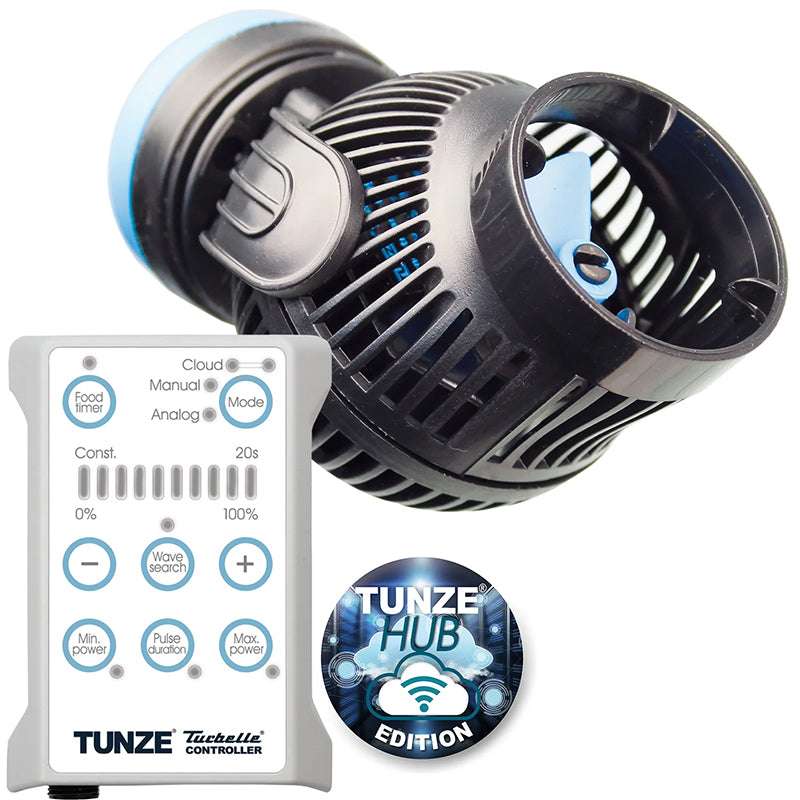
The TUNZE® HUB EDITION pumps can be controlled electronically and have been provided with a fish-care function. These pumps are equipped with the Turbelle® Controller 7020 to adjust the pump performance and for access to the TUNZE® HUB. Using this cloud solution, many devices from TUNZE® can be clearly controlled and regulated via WiFi and the Internet. An integrated real-time clock prevents time shifts due to power failure.
nanostream® design
Turbelle® nanostream® electronic are speed-controlled pumps with a Turbelle® controller operating on safety extra-low voltage, to be employed ideally in every aquarium from 40 to >1,000 liters (10 to >265 USgal.) for simulation of lapping waves or tidal currents. They contain a microprocessor-controlled motor and a Turbelle® controller. The electronic motor adapts its speed automatically to the pump load and always seeks the best efficiency at the lowest possible consumption of energy. The pumps will be stopped immediately in case of blockage. After the blockage has been removed, the pumps will start up automatically after a delay of 20 seconds. The pump driver has been provided with a fish care function, which causes a revolution of the propeller every twenty seconds when the pump is at a standstill. Apart from that, the pumps can also connect to devices controlled by the SmartController via the TUNZE® HUB.
High-tech cable especially for demanding aquaristics
With remarkably high abrasion resistance, seawater resistance and extreme resistance to mechanical impact. As a result, it does not harden in water like PVC cables. With an extra high-contrast intermediate cable sheathing to detect damage at an early stage. Produced in Bavaria by MEDI Kabel.
5 years warranty
"Built to last" according to our highest standards. Our exclusive service is automatically included. Without registration and without hidden hurdles. And of course always accommodating instead of petty-minded.
TUNZE® HUB EDITION WIDE FLOW
- For aquariums from 100 to 1,000 liters (25 to 265 USgal.).
- Flow rate: 2,000 to about 9,500 l/h (550 to about 2,500 USgal./h) with Turbelle® Controller
- Energy consumption: 5 - 21 W
- Power supply unit: 100-240V / 50-60Hz
- Cable length: 3 m (118”)
- Dimensions: ø70 mm (2.7”)
- Output: ø50/10 mm (2/.4”)
- Magnet Holder with Silence clamp up to a glass thickness of 15 mm (2/3”).
Collapsible content
LIGHT
LOW: Place coral at the bottom of the tank. Depending on the type, coral may need to be placed off sand and therefore mounted on a ceramic disc of piece of rock.
MEDIUM: Place coral at mid-range of the tank. Best placed/glued on top of a rock scape at mid-range height.
HIGH: Place coral from mid range to just below water level. SPS coral are shallow growing so they require and are able to tolerate intense light.
FLOW
LOW: Most soft coral do well with a small, gentle pulse. There are certain corals that can even be placed in areas of indirect flow, meaning places aside a rock structure or set into a entrance to a cave style space.
MEDIUM: Many LPS types of coral prefer medium pulse current. Most Euphyllia or corals that have more tissue structure connected to their skeleton, don’t like to be in a high flow area like the direct flow of the wave pump.
HIGH: Similar to high light, SPS enjoy being in some heavy current. Most LPS and SPS that branch encrust or plate prefer high flow that simulates the top water waves.
SKILL
ENTRY: While some may say beginner level, "Entry" is a good term to be used when starting out in the world of corals and marine life. Prior to adding livestock, you want to ensure that your reef has the proper parameters including zero levels of ammonia and nitrite. Seeing traces of nitrate in your waters is a good sign - just keep them at a lower level of 2ppm to 10ppm. Maintaining correct temperature and salinity are a huge factor to stable parameters. Starting to monitor your PH, alkalinity, calcium and magnesium is a great habit to get into to keep a successful reef.
While some soft coral don’t require too much light, having a proper reef light that puts out the proper pars is very important. You'll also want to have a good amount of flow and protected rock areas, as placing corals in their happy spot is ideal for success.
ADVANCED: