

Little Shop of Coral
Tomato Clownfish (Amphiprion frenatus)
Tomato Clownfish (Amphiprion frenatus)
Couldn't load pickup availability
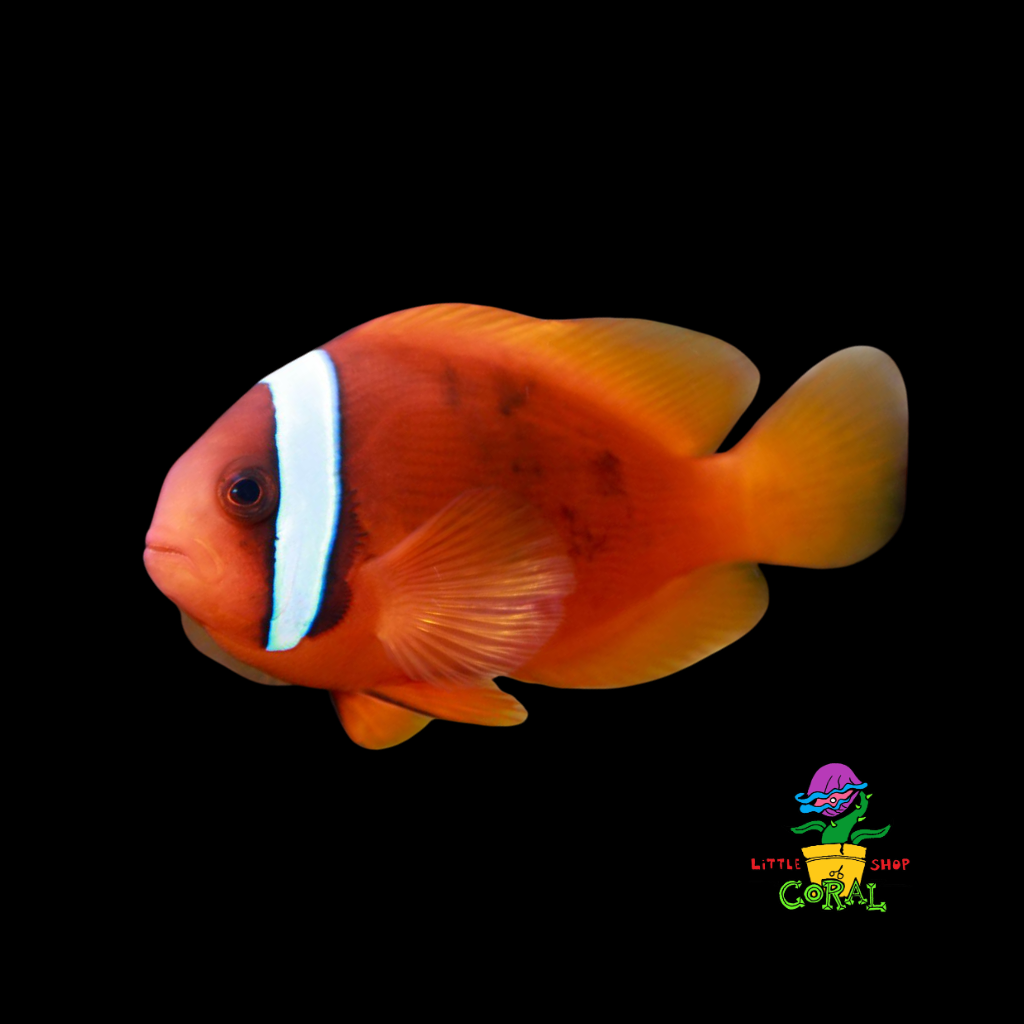
The Tomato Clownfish is one of the hobby's most instantly recognisable fish, and for good reason. That deep, saturated red-orange body with a single bold white bar just behind the eye is as clean and striking a look as any clownfish carries. Unlike some of its more popular cousins, the Tomato Clown comes with serious personality to match: this is a confident, assertive fish that knows exactly where its territory ends and will make that clear to anything that crosses the line. Juveniles show additional white markings that fade as the fish matures, and females darken to a richer, deeper red while remaining the dominant presence in any pair. Hardy, long-lived, and one of the easier marine fish to keep, the Tomato Clown is an excellent choice for both newcomers to the saltwater hobby and experienced reef keepers who want a fish with character.
Why we love it
- Rich tomato-red colouration with a clean single white bar makes for one of the boldest, most classic clownfish looks available
- Among the hardiest and most forgiving clownfish in the hobby, with a strong tolerance for minor parameter swings
- An enthusiastic and unfussy eater that rarely needs coaxing onto prepared foods
- Pairs readily, breeds willingly in captivity, and will often spawn in a well-maintained reef tank with minimal intervention
- A natural host for bubble tip anemones, but fully capable of thriving without one and will often adopt LPS corals as a surrogate host in captivity
- Captive-bred specimens are widely available, making this an easy species to source responsibly
Suggested parameters
- Temperature: 22–26°C (72–78°F)
- Salinity: 1.020–1.025 SG
- pH: 8.1–8.4
- Alkalinity: 8–12 dKH
- Ammonia/Nitrite: 0
- Nitrate: Under 20 ppm
Care and temperament
- Difficulty: Easy
- Temperament: Semi-aggressive. The Tomato Clown is one of the bolder, more assertive clownfish species. Females in particular will defend their territory vigorously, and mature fish may nip at a keeper's hand during tank maintenance
- Reef safe: Yes. Safe with corals and invertebrates; will not harm sessile reef inhabitants
- Minimum tank size: 30 gallons for a pair, though a larger system is always preferred when adding additional tankmates
Diet
The Tomato Clown is an omnivore and one of the least fussy eaters in the hobby.
- Frozen mysis shrimp and vitamin-enriched brine shrimp
- High-quality marine flake and pellet foods accepted readily
- Spirulina, nori, and marine algae to round out the diet
- Feed 2 to 3 times per day in small portions
Compatibility and tankmates
- Generally peaceful with fish that are not clownfish; works well with gobies, blennies, dartfish, small wrasses, chromis, and most peaceful reef inhabitants
- Will aggressively defend territory against other clownfish species; keep only one clownfish species per system unless the tank is very large and well structured
- Keep as a single specimen or a bonded male-female pair; adding a second Tomato Clown to an established individual is likely to result in aggression
- Avoid large predatory tankmates including lionfish, groupers, triggers, and moray eels
- If hosting in an anemone, aggression around the anemone will intensify; ensure any tankmates have adequate space to avoid the clown's core territory
- Compatible with most reef invertebrates including cleaner shrimp, snails, and hermit crabs
Health and acclimation notes
The Tomato Clown is a protandrous hermaphrodite: all individuals are born male, and the dominant fish in a pair transitions to female. The female will always be the larger and more boldly coloured of the pair. This species is one of the most durable clownfish available and adapts quickly to aquarium conditions with minimal fuss. Captive-bred specimens are strongly preferred over wild-caught for their hardiness and reduced disease risk, and are widely available in the trade. This fish can live 6 to 8 years on average under good care, with exceptional individuals reaching considerably longer. Breeding in the home aquarium is achievable without significant intervention; eggs are laid on a flat surface near the host and guarded actively by the male, hatching in 6 to 11 days depending on temperature.
What you are buying
- You will receive: 1 Tomato Clownfish (Amphiprion frenatus)
- Females are typically larger and darker in colouration; males are smaller and brighter orange
- Juveniles may display additional faint white markings that fade as the fish matures
- Colouring and size can vary between individuals; captive-bred specimens may initially appear slightly darker than wild fish but develop full colour with time
Collapsible content
LIGHT
LOW: Place coral at the bottom of the tank. Depending on the type, coral may need to be placed off sand and therefore mounted on a ceramic disc of piece of rock.
MEDIUM: Place coral at mid-range of the tank. Best placed/glued on top of a rock scape at mid-range height.
HIGH: Place coral from mid range to just below water level. SPS coral are shallow growing so they require and are able to tolerate intense light.
FLOW
LOW: Most soft coral do well with a small, gentle pulse. There are certain corals that can even be placed in areas of indirect flow, meaning places aside a rock structure or set into a entrance to a cave style space.
MEDIUM: Many LPS types of coral prefer medium pulse current. Most Euphyllia or corals that have more tissue structure connected to their skeleton, don’t like to be in a high flow area like the direct flow of the wave pump.
HIGH: Similar to high light, SPS enjoy being in some heavy current. Most LPS and SPS that branch encrust or plate prefer high flow that simulates the top water waves.
SKILL
ENTRY: While some may say beginner level, "Entry" is a good term to be used when starting out in the world of corals and marine life. Prior to adding livestock, you want to ensure that your reef has the proper parameters including zero levels of ammonia and nitrite. Seeing traces of nitrate in your waters is a good sign - just keep them at a lower level of 2ppm to 10ppm. Maintaining correct temperature and salinity are a huge factor to stable parameters. Starting to monitor your PH, alkalinity, calcium and magnesium is a great habit to get into to keep a successful reef.
While some soft coral don’t require too much light, having a proper reef light that puts out the proper pars is very important. You'll also want to have a good amount of flow and protected rock areas, as placing corals in their happy spot is ideal for success.
ADVANCED: