

Little Shop of Coral
Tiger Wardi Sleeper Goby (Valenciennea wardii)
Tiger Wardi Sleeper Goby (Valenciennea wardii)
Couldn't load pickup availability
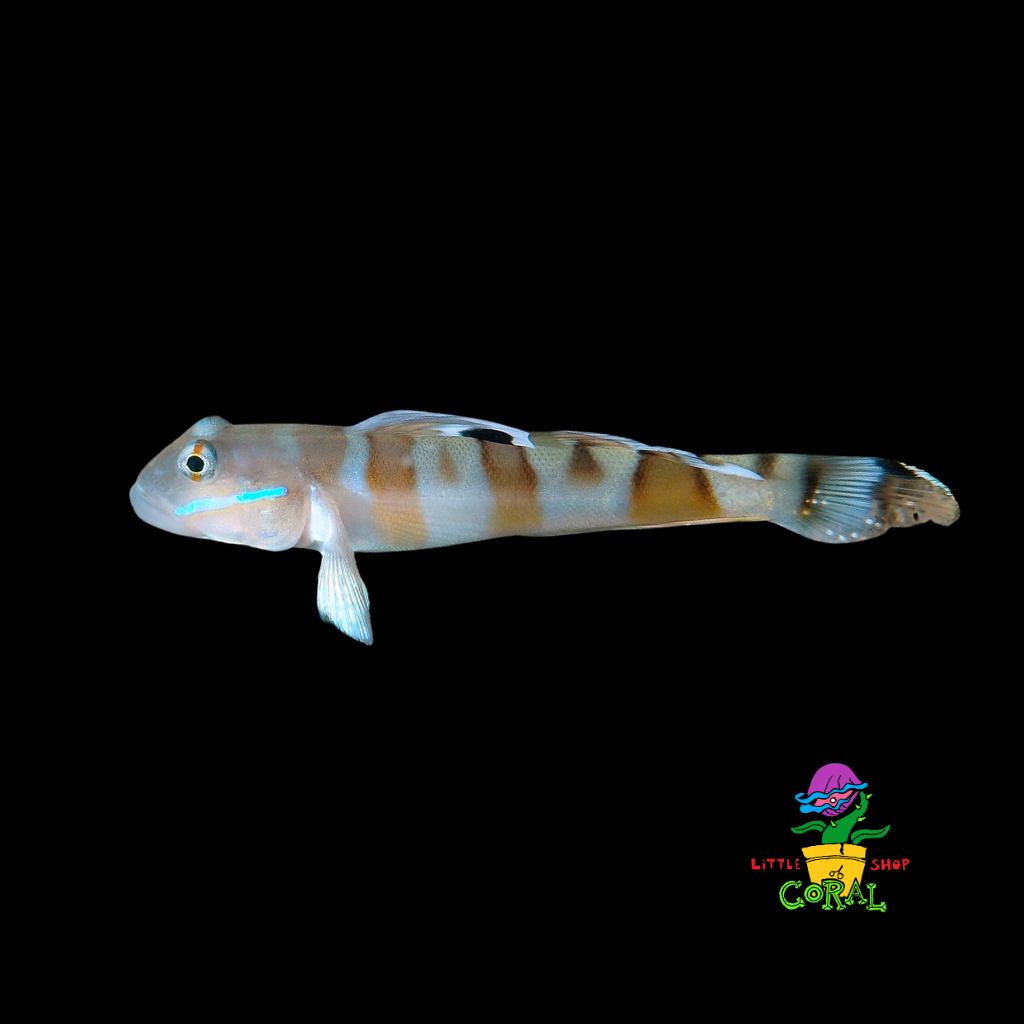
The Tiger Wardi Sleeper Goby is one of the most striking and functional sand-sifting fish available in the hobby. A beautiful cream-coloured body is marked with three wide brown-orange barred stripes, while the first dorsal fin carries a distinctive false eyespot and an electric blue band runs beneath each eye, making this one of the most visually impressive gobies in the Valenciennea genus. Beyond its good looks, the Tiger Wardi earns its keep as a tireless sand bed worker, constantly sifting substrate and helping manage nuisance cyanobacteria and detritus accumulation. For a reef keeper who wants a fish that is beautiful, peaceful, useful, and full of personality all at once, this is a standout choice.
Why we love it
- Bold tiger-striped patterning with an eyespot dorsal fin and electric blue facial markings
- Dedicated sand-sifter that actively aerates the substrate and manages cyanobacteria
- Peaceful and reef safe, compatible with a wide range of community fish
- Forms symbiotic relationships with pistol shrimp, creating shared burrows where both species benefit
- Fascinating burrowing and den-building behaviour makes for endlessly entertaining observation
Suggested parameters
- Temperature: 24 to 26°C (75 to 79°F)
- Salinity: 1.025 to 1.026 SG
- pH: 8.1 to 8.4
- Alkalinity: 8 to 10 dKH
- Calcium: 400 to 450 ppm
- Magnesium: 1250 to 1400 ppm
- Nitrate: 5 to 20 ppm
- Phosphate: 0.03 to 0.12 ppm
Care and temperament
- Difficulty: Moderate
- Temperament: Peaceful toward most tankmates; territorial toward conspecifics and similarly shaped bottom-dwelling fish in smaller systems
- Reef safe: Yes, fully compatible with corals and most ornamental invertebrates
- Minimum tank size: 55 gallons with a fine-grained open sandbed
- Best maintained in well-established reef or fish-only aquariums with wide-open, fine-grained (1 to 2 mm) sandy areas along with some small rubble; these fish are burrow dwellers and will normally seek protection under low overhanging rocks or burrow underneath rock to form a secure home
- Be aware that in smaller systems this species can significantly deplete the microfauna population in the substrate; a well-stocked sandbed or connected refugium helps sustain a natural food supply
- A tight-fitting lid is essential; this species will jump when startled
Diet
The Tiger Wardi is a carnivore that feeds primarily by sifting mouthfuls of sand and extracting small organisms, but supplemental feeding is essential in most aquarium systems.
- Frozen mysis shrimp (staple)
- Frozen brine shrimp, calanus, and enriched artemia
- Finely chopped meaty marine foods including krill, scallop, and squid
- Small sinking enriched shrimp meal pellets are an excellent way of keeping them well fed; they also take a wide variety of flake foods
- Soaking frozen foods in vitamin and fatty acid supplements is encouraged; multiple small feedings per day rather than one large feeding mirrors natural foraging behaviour
- Live adult fortified brine shrimp, glass shrimp, and blackworms are excellent options if having difficulty enticing a feeding response in new arrivals
- Feed three to four times daily; consistent supplemental feeding is critical since most systems cannot supply enough sandbed microfauna alone
Compatibility and tankmates
- Excellent with clownfish, tangs, angelfish, wrasses, dartfish, and most peaceful reef community fish
- Only one Tiger Wardi is recommended per aquarium unless a confirmed mated pair; this species is not compatible with other members of the Valenciennea genus
- May show territoriality in smaller aquariums toward similarly shaped bottom-dwelling fish such as firefish, blennies, and other gobies
- Should not be housed with aggressive or fin-nipping fish such as groupers, dottybacks, triggerfish, or angelfish
- Pairs beautifully with a pistol shrimp for the full symbiotic burrow-building experience
Health and acclimation notes
This species can be very shy when first introduced into a new aquarium; more assertive tankmates are better added after it has had time to acclimatize and establish a burrow site. Consistent and frequent feeding is the most important factor in long-term success with this species. Some specimens waste away despite appearing well fed, which can be a sign of intestinal worms; sourcing healthy, established individuals is important. A populated refugium connected to the display system significantly improves the chances of long-term thriving by supplementing the natural microfauna supply in the sandbed.
What you are buying
- You will receive: 1 Tiger Wardi Sleeper Goby (Valenciennea wardii)
- Colour intensity and bar definition can vary between individuals; kept in ideal conditions the striping and blue facial accents become more vivid with time
Slow acclimation is strongly recommended. A tight-fitting lid is essential, as this species will jump when startled.
Collapsible content
LIGHT
LOW: Place coral at the bottom of the tank. Depending on the type, coral may need to be placed off sand and therefore mounted on a ceramic disc of piece of rock.
MEDIUM: Place coral at mid-range of the tank. Best placed/glued on top of a rock scape at mid-range height.
HIGH: Place coral from mid range to just below water level. SPS coral are shallow growing so they require and are able to tolerate intense light.
FLOW
LOW: Most soft coral do well with a small, gentle pulse. There are certain corals that can even be placed in areas of indirect flow, meaning places aside a rock structure or set into a entrance to a cave style space.
MEDIUM: Many LPS types of coral prefer medium pulse current. Most Euphyllia or corals that have more tissue structure connected to their skeleton, don’t like to be in a high flow area like the direct flow of the wave pump.
HIGH: Similar to high light, SPS enjoy being in some heavy current. Most LPS and SPS that branch encrust or plate prefer high flow that simulates the top water waves.
SKILL
ENTRY: While some may say beginner level, "Entry" is a good term to be used when starting out in the world of corals and marine life. Prior to adding livestock, you want to ensure that your reef has the proper parameters including zero levels of ammonia and nitrite. Seeing traces of nitrate in your waters is a good sign - just keep them at a lower level of 2ppm to 10ppm. Maintaining correct temperature and salinity are a huge factor to stable parameters. Starting to monitor your PH, alkalinity, calcium and magnesium is a great habit to get into to keep a successful reef.
While some soft coral don’t require too much light, having a proper reef light that puts out the proper pars is very important. You'll also want to have a good amount of flow and protected rock areas, as placing corals in their happy spot is ideal for success.
ADVANCED: