
Little Shop of Coral
Spotted Trapeze Crab (Trapezia rufopunctata)
Spotted Trapeze Crab (Trapezia rufopunctata)
Couldn't load pickup availability
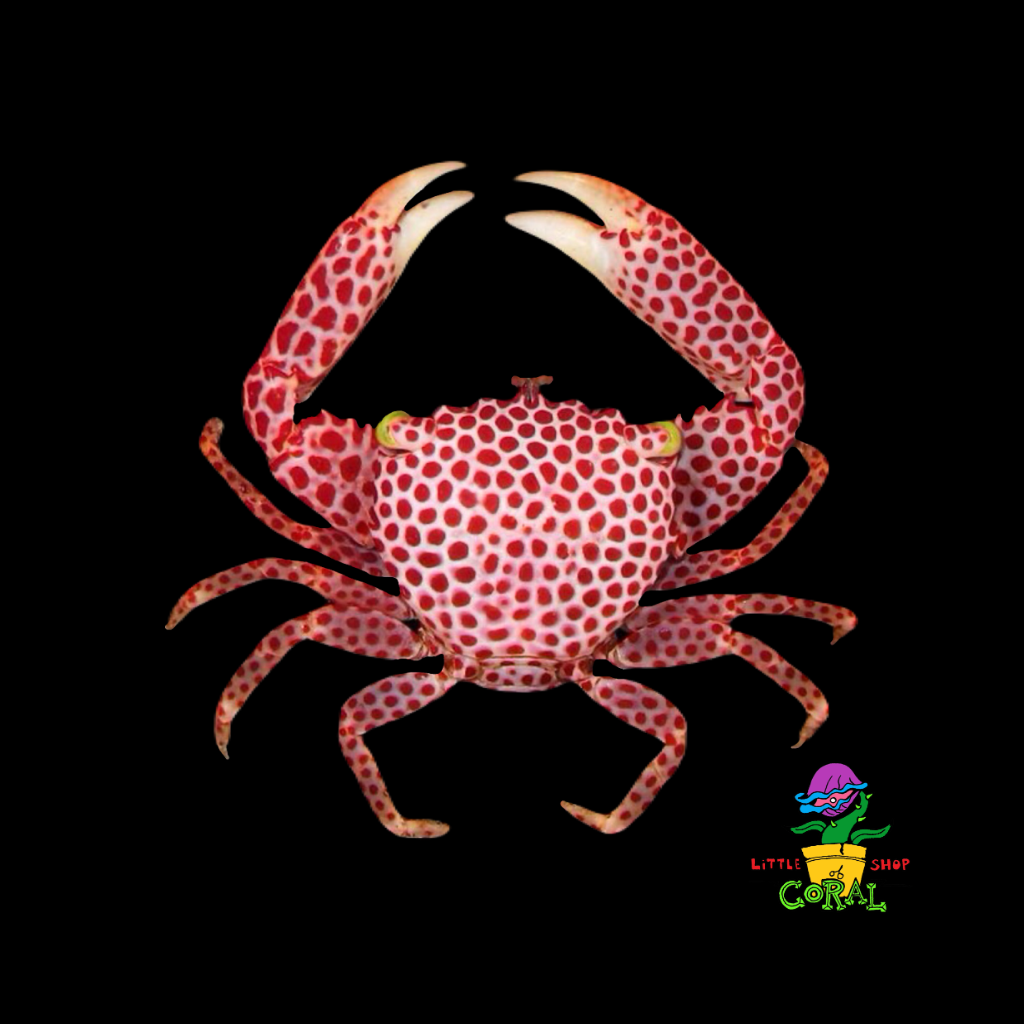
The Spotted Trapeze Crab is one of the reef hobby's most fascinating and genuinely beneficial invertebrates, and one that far too many hobbyists overlook. Its trapezoidal carapace carries a unique mottled pattern of around 100 to 200 reddish or orange spots on a white or pink background, and its eyes are a contrasting shade of vivid green, making it a strikingly beautiful little animal that is practically invisible inside the coral branches it calls home. This is a true commensal species, meaning its entire life is lived in intimate association with its host coral, and that relationship is a genuinely symbiotic one: the crab benefits from shelter and food, and the coral benefits from an active, dedicated bodyguard that works around the clock. For SPS keepers, this is one of the most rewarding and useful additions the hobby has to offer.
Why we love it
- Actively protects its host coral from predators such as crown-of-thorns starfish and other invertebrate threats, providing genuine defence that benefits the coral's long-term survival
- Constantly cleans the coral's surface of detritus and maintains water flow between branches, directly supporting coral health
- Spotted camouflage pattern is believed to help it blend into the colourful coral polyps it inhabits, making it one of the most beautifully adapted animals in the reef
- Fully reef safe and completely peaceful toward fish and other invertebrates outside its immediate territory
- A living piece of reef ecology that brings genuine scientific fascination to any SPS system
Suggested parameters
- Temperature: 24 to 26°C (75 to 79°F)
- Salinity: 1.025 to 1.026 SG
- pH: 8.1 to 8.4
- Alkalinity: 8 to 10 dKH
- Calcium: 400 to 450 ppm
- Magnesium: 1250 to 1400 ppm
- Nitrate: 5 to 20 ppm
- Phosphate: 0.03 to 0.12 ppm
- Copper-based medications are toxic to all crustaceans and invertebrates and must never be used
Care and temperament
- Difficulty: Easy, provided a suitable host coral is present
- Temperament: Peaceful toward all tankmates outside its host coral; territorial within and immediately around the host
- Reef safe: Yes, fully compatible with corals and ornamental invertebrates
- Minimum tank size: 20 gallons, provided a suitable host coral colony is present
- Primary host corals are Pocillopora and Stylophora; it will also inhabit Acropora if no pocilloporid corals are available
- Only one individual should be kept per coral colony unless a confirmed mated pair; this species is territorial within its host
- Very shy and seldom ventures out of the coral; do not expect to see much of it during the day, though pairs can occasionally be spotted at the colony's edges during feeding
Diet
The Spotted Trapeze Crab is thought to feed on particulates trapped by the coral's polyps, fallen detritus settling within the branches, and the coral's secreted mucus. In the aquarium it is entirely self-sufficient when housed with an appropriate host coral.
- No supplemental target feeding is required in a system with a healthy, established pocilloporid or Acropora host colony
- Will opportunistically consume fine particulate foods and coral mucus produced by the host during normal feeding events
- Broadcast feeding the tank as a whole provides incidental nutrition
Compatibility and tankmates
- Peaceful and fully compatible with all reef fish, corals, and ornamental invertebrates outside its immediate host coral
- Not aggressive toward neighbours but will actively and fearlessly defend its host coral against threats, including starfish and other invertebrate predators
- Avoid aggressive fish species such as triggers or large wrasses that may target small crustaceans
- Keep one per coral colony unless a known mated pair; a second individual introduced to an occupied colony will be evicted or fought
Health and acclimation notes
The Spotted Trapeze Crab is easy to keep when its one non-negotiable requirement is met: a suitable, established host coral that is large enough to shelter it comfortably. Without an appropriate host colony already in the tank, this species cannot thrive and will become stressed and exposed. It lives harmoniously within colonies of branching corals and contributes to coral health by keeping the surface clean of detritus and defending against small parasites and predatory invertebrates. Drip acclimation is recommended as with all invertebrates, and copper-based medications must never be used in any system housing crustaceans.
What you are buying
- You will receive: 1 Spotted Trapeze Crab (Trapezia rufopunctata)
- Carapace colouration is white to pale pink with 100 to 200 reddish-orange spots and vivid green eyes; colouration may vary slightly between individuals and collection regions
- Size at time of sale can vary; maximum carapace width is approximately 2 to 2.5 cm
Drip acclimation is recommended. A suitable established host coral must be present before introduction. Copper-based medications must never be used in any system housing this animal.
Collapsible content
LIGHT
LOW: Place coral at the bottom of the tank. Depending on the type, coral may need to be placed off sand and therefore mounted on a ceramic disc of piece of rock.
MEDIUM: Place coral at mid-range of the tank. Best placed/glued on top of a rock scape at mid-range height.
HIGH: Place coral from mid range to just below water level. SPS coral are shallow growing so they require and are able to tolerate intense light.
FLOW
LOW: Most soft coral do well with a small, gentle pulse. There are certain corals that can even be placed in areas of indirect flow, meaning places aside a rock structure or set into a entrance to a cave style space.
MEDIUM: Many LPS types of coral prefer medium pulse current. Most Euphyllia or corals that have more tissue structure connected to their skeleton, don’t like to be in a high flow area like the direct flow of the wave pump.
HIGH: Similar to high light, SPS enjoy being in some heavy current. Most LPS and SPS that branch encrust or plate prefer high flow that simulates the top water waves.
SKILL
ENTRY: While some may say beginner level, "Entry" is a good term to be used when starting out in the world of corals and marine life. Prior to adding livestock, you want to ensure that your reef has the proper parameters including zero levels of ammonia and nitrite. Seeing traces of nitrate in your waters is a good sign - just keep them at a lower level of 2ppm to 10ppm. Maintaining correct temperature and salinity are a huge factor to stable parameters. Starting to monitor your PH, alkalinity, calcium and magnesium is a great habit to get into to keep a successful reef.
While some soft coral don’t require too much light, having a proper reef light that puts out the proper pars is very important. You'll also want to have a good amount of flow and protected rock areas, as placing corals in their happy spot is ideal for success.
ADVANCED: