
Little Shop of Coral
Rock Flower Anemone (Epicystis crucifer)
Rock Flower Anemone (Epicystis crucifer)
Couldn't load pickup availability
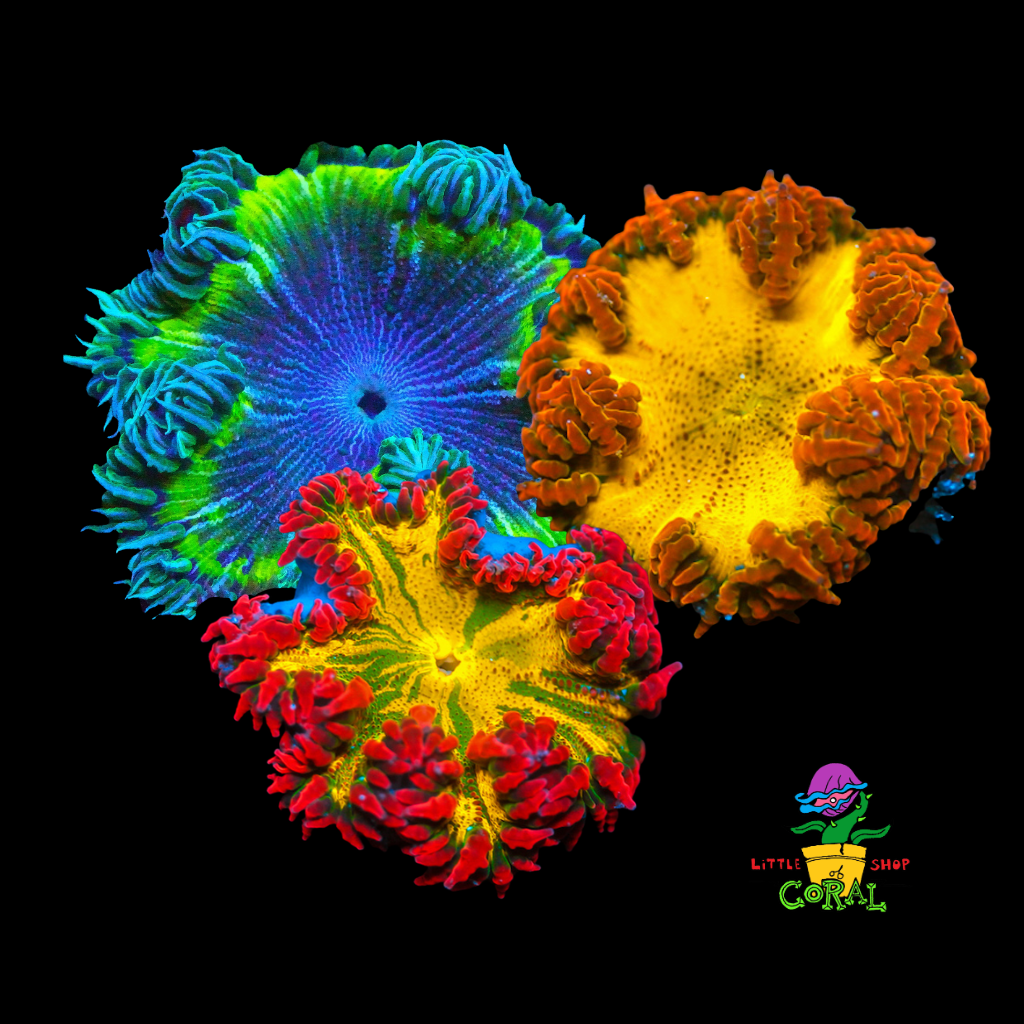
The Rock Flower Anemone (Epicystis crucifer) is one of the most colourful and beginner friendly anemones in the hobby. Found in shallow, sandy areas of the Caribbean and western Atlantic, it shows off a flat oral disc ringed with short, beaded tentacles that come in an incredible range of colours, from oranges and greens to pinks, purples, and wild ultra combinations. Unlike wandering anemones, rock flowers tend to pick a spot and settle in, which makes them a much more predictable choice for a mixed reef.
Why we love it
- One of the most colourful nems available, with endless morph variety that pops under blue light
- Hardier and more forgiving than most host anemones, a great entry point into keeping anemones
- Tends to stay put once settled instead of roaming the tank like a bubble tip
- Safe to keep in groups, since rock flowers will not sting one another
Suggested parameters
- Temperature: 24 to 26°C (75 to 79°F)
- Salinity: 1.025 to 1.026 SG
- pH: 8.1 to 8.4
- Alkalinity: 8 to 10 dKH
- Ammonia/Nitrite: 0
- Nitrate and phosphate: low and stable, since swings stress them more than the actual numbers
Care and placement
- Difficulty: Easy to moderate (hardy for an anemone, but wants stable, mature water)
- Temperament: Mostly peaceful, but will eat small fish or shrimp that wander into the tentacles
- Reef safe: Yes, with caution, give it space from corals and other anemones
- Placement: On the sand near the base of the rockwork, or wedged into a rocky crevice where it can anchor its foot
- Lighting: Low to moderate (roughly 150 to 250 PAR), acclimate slowly to brighter light
- Flow: Low to moderate, enough to carry food to it without blasting the disc
- Minimum tank size: 30 gallons recommended, in an established system
Feeding
Rock flowers are photosynthetic and pull a lot of their energy from light, but they respond very well to direct feeding and will colour up and grow faster for it.
- Spot feed meaty foods 1 to 2 times per week
- Mysis shrimp, chopped shrimp or fish, scallop, and krill are all good choices
- Match the food size to the anemone and target feed gently with tongs or a pipette
- A shrinking or gaping anemone is often just hungry, so offer a little more if you see that
Compatibility and tankmates
- Generally reef safe, but treat it as a predator toward very small or weak fish and ornamental shrimp
- Give it room from corals and from other species of anemone, which it can sting
- Multiple rock flowers can be grouped together, since they will not sting each other
- Note that clownfish will not host in rock flower anemones, so do not buy it as a clownfish host
Health and acclimation notes
Rock flowers are sensitive to copper and to sudden swings in salinity, temperature, or nutrients, so they do best in a stable, mature tank. Drip acclimate slowly, place the anemone where it can anchor, and ramp it into your lighting over a couple of weeks. Once it picks a spot and settles, it is one of the more trouble free anemones you can keep.
What you are buying
- You will receive: 1 Rock Flower Anemone (Epicystis crucifer)
- Colour and pattern will vary between individuals, since these are natural collected morphs and this listing is not WYSIWYG
Collapsible content
LIGHT
LOW: Place coral at the bottom of the tank. Depending on the type, coral may need to be placed off sand and therefore mounted on a ceramic disc of piece of rock.
MEDIUM: Place coral at mid-range of the tank. Best placed/glued on top of a rock scape at mid-range height.
HIGH: Place coral from mid range to just below water level. SPS coral are shallow growing so they require and are able to tolerate intense light.
FLOW
LOW: Most soft coral do well with a small, gentle pulse. There are certain corals that can even be placed in areas of indirect flow, meaning places aside a rock structure or set into a entrance to a cave style space.
MEDIUM: Many LPS types of coral prefer medium pulse current. Most Euphyllia or corals that have more tissue structure connected to their skeleton, don’t like to be in a high flow area like the direct flow of the wave pump.
HIGH: Similar to high light, SPS enjoy being in some heavy current. Most LPS and SPS that branch encrust or plate prefer high flow that simulates the top water waves.
SKILL
ENTRY: While some may say beginner level, "Entry" is a good term to be used when starting out in the world of corals and marine life. Prior to adding livestock, you want to ensure that your reef has the proper parameters including zero levels of ammonia and nitrite. Seeing traces of nitrate in your waters is a good sign - just keep them at a lower level of 2ppm to 10ppm. Maintaining correct temperature and salinity are a huge factor to stable parameters. Starting to monitor your PH, alkalinity, calcium and magnesium is a great habit to get into to keep a successful reef.
While some soft coral don’t require too much light, having a proper reef light that puts out the proper pars is very important. You'll also want to have a good amount of flow and protected rock areas, as placing corals in their happy spot is ideal for success.
ADVANCED: