

Little Shop of Coral
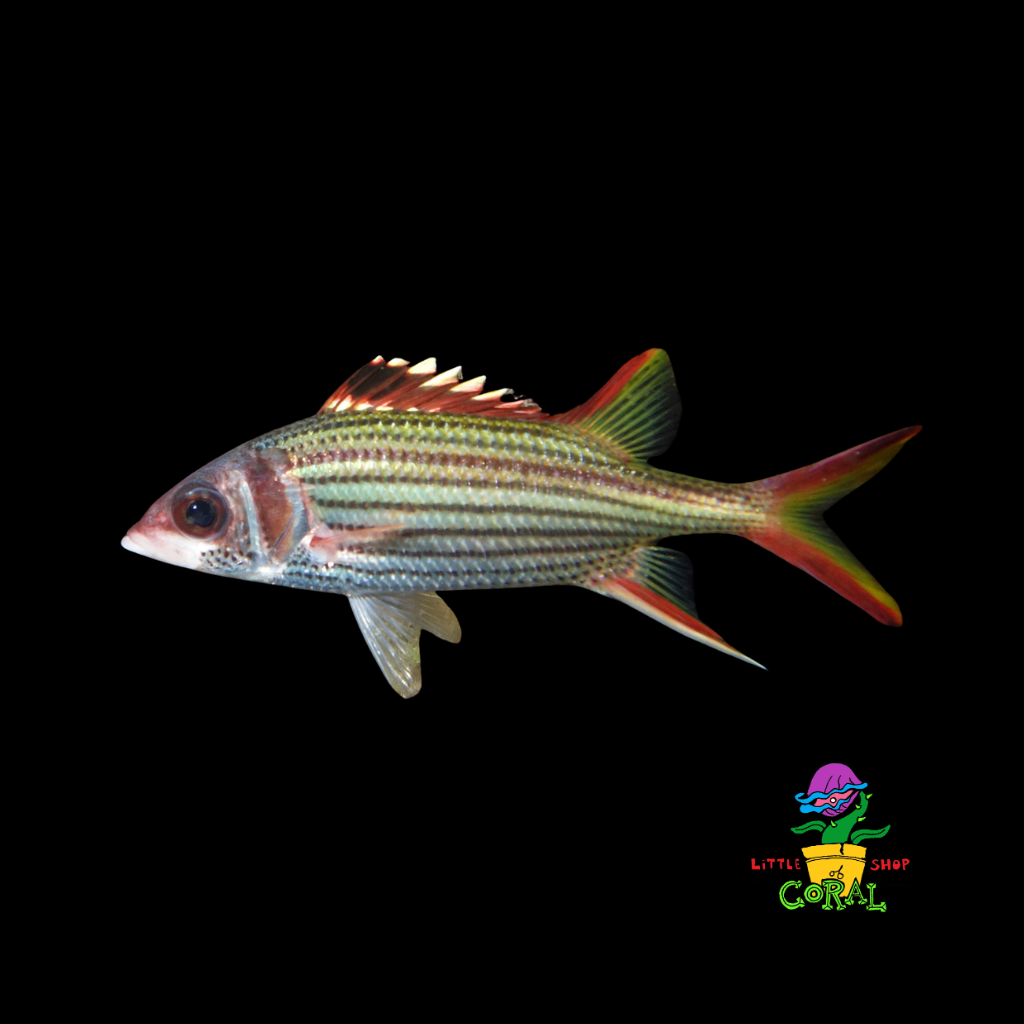
Red Squirrelfish (Neoniphon sammara)
Red Squirrelfish (Neoniphon sammara)
Couldn't load pickup availability
The Red Squirrelfish, also known as the Sammara, Bloodspot, or Spotfin Squirrelfish, is one of the most visually distinctive fish available in the marine hobby. Its silver body is layered with fine red-to-black horizontal stripes running along each scale row, a bold red blotch sits on the operculum, and a striking dark spot anchors the centre of the spiny dorsal fin. Wide, expressive eyes built for low-light hunting give this species an almost otherworldly appearance that looks particularly dramatic under blue-heavy aquarium lighting. A naturally nocturnal ambush predator from reef flats and lagoons throughout the Indo-Pacific, the Red Squirrelfish is a rewarding fish for hobbyists who appreciate something a little different: less flashy than the typical reef display fish, but full of personality once it settles in and feels secure.
Why we love it
- Striking red-striped silver body with large eyes and a bold dorsal spot that stands out in any display
- Naturally associated with Acropora corals in the wild, making it a visually compelling fish in a mixed reef or SPS-focused FOWLR system
- Peaceful with fish too large to be considered prey, and can be kept in small groups with adequate space and rockwork
- A nocturnal fish that adds life and movement to a tank after the lights dim, rewarding keepers who observe their tanks in the evening
- Wide Indo-Pacific range means well-conditioned specimens are reliably available in the trade
Suggested parameters
- Temperature: 23–26°C (72–78°F)
- Salinity: 1.020–1.025 SG
- pH: 8.1–8.4
- Alkalinity: 8–12 dKH
- Ammonia/Nitrite: 0
- Nitrate: Under 20 ppm; stable water quality is important for long-term health
Care and temperament
- Difficulty: Easy to moderate
- Temperament: Peaceful with appropriately sized tankmates; will predate anything small enough to fit in its mouth, including small fish, ornamental shrimp, worms, crustaceans, and serpent stars
- Reef safe: With caution. Corals are safe, but motile invertebrates and small fish are at significant risk
- Minimum tank size: 70 gallons, with an abundance of live rock, caves, and overhangs for shelter
Diet
The Red Squirrelfish is a dedicated carnivore with feeding habits shaped by its nocturnal lifestyle.
- Frozen mysis shrimp, krill, chopped clams, and other meaty marine preparations form the core diet
- Live saltwater feeder shrimp are often essential to trigger feeding in newly introduced or reluctant specimens; transitioning off live food should happen gradually
- High-quality carnivore pellets can be introduced over time once the fish is eating reliably
- Feed at dusk or with the display lights dimmed; this species is far more likely to come out and feed actively in low-light conditions
- Feed once to twice daily, with evening feeding sessions strongly preferred
Compatibility and tankmates
- Works well alongside larger, peaceful fish including tangs, angelfish, hawkfish, larger wrasses, and other non-predatory FOWLR species
- Will eat small fish, ornamental shrimp, small crabs, bristle worms, and serpent stars without hesitation; stock accordingly
- Can be kept in small groups of three or more if the tank is large enough and rockwork provides plenty of individual shelter zones; pairs may bicker, making odd numbers preferable
- Avoid housing with highly aggressive or boisterous species that will outcompete it at feeding time or prevent it from emerging at dusk
- Not suitable for tanks housing small gobies, dartfish, small wrasses, or other diminutive species that may be targeted
Health and acclimation notes
The Red Squirrelfish carries a venomous preopercular spine, and this is worth knowing before handling or netting. Use a container rather than a net when moving or transporting this fish, as its spines catch easily in netting and can cause painful wounds. The spine can also damage the fish's fins and eyes during handling. This species has a large swim bladder that is sensitive to loud sounds, so avoid tapping on the glass near this fish. Once settled and feeding, the Red Squirrelfish is a durable, long-lived aquarium animal. The initial transition to frozen foods is the main challenge; patience and low-light feeding sessions are the most reliable path to success. Quarantine is always recommended before introduction to an established display.
What you are buying
- You will receive: 1 Red Squirrelfish (Neoniphon sammara)
- Colouring and stripe intensity can vary between individuals and by region of origin
- Size and exact patterning may vary; please see size options at checkout
Collapsible content
LIGHT
LOW: Place coral at the bottom of the tank. Depending on the type, coral may need to be placed off sand and therefore mounted on a ceramic disc of piece of rock.
MEDIUM: Place coral at mid-range of the tank. Best placed/glued on top of a rock scape at mid-range height.
HIGH: Place coral from mid range to just below water level. SPS coral are shallow growing so they require and are able to tolerate intense light.
FLOW
LOW: Most soft coral do well with a small, gentle pulse. There are certain corals that can even be placed in areas of indirect flow, meaning places aside a rock structure or set into a entrance to a cave style space.
MEDIUM: Many LPS types of coral prefer medium pulse current. Most Euphyllia or corals that have more tissue structure connected to their skeleton, don’t like to be in a high flow area like the direct flow of the wave pump.
HIGH: Similar to high light, SPS enjoy being in some heavy current. Most LPS and SPS that branch encrust or plate prefer high flow that simulates the top water waves.
SKILL
ENTRY: While some may say beginner level, "Entry" is a good term to be used when starting out in the world of corals and marine life. Prior to adding livestock, you want to ensure that your reef has the proper parameters including zero levels of ammonia and nitrite. Seeing traces of nitrate in your waters is a good sign - just keep them at a lower level of 2ppm to 10ppm. Maintaining correct temperature and salinity are a huge factor to stable parameters. Starting to monitor your PH, alkalinity, calcium and magnesium is a great habit to get into to keep a successful reef.
While some soft coral don’t require too much light, having a proper reef light that puts out the proper pars is very important. You'll also want to have a good amount of flow and protected rock areas, as placing corals in their happy spot is ideal for success.
ADVANCED: