

Red Sea
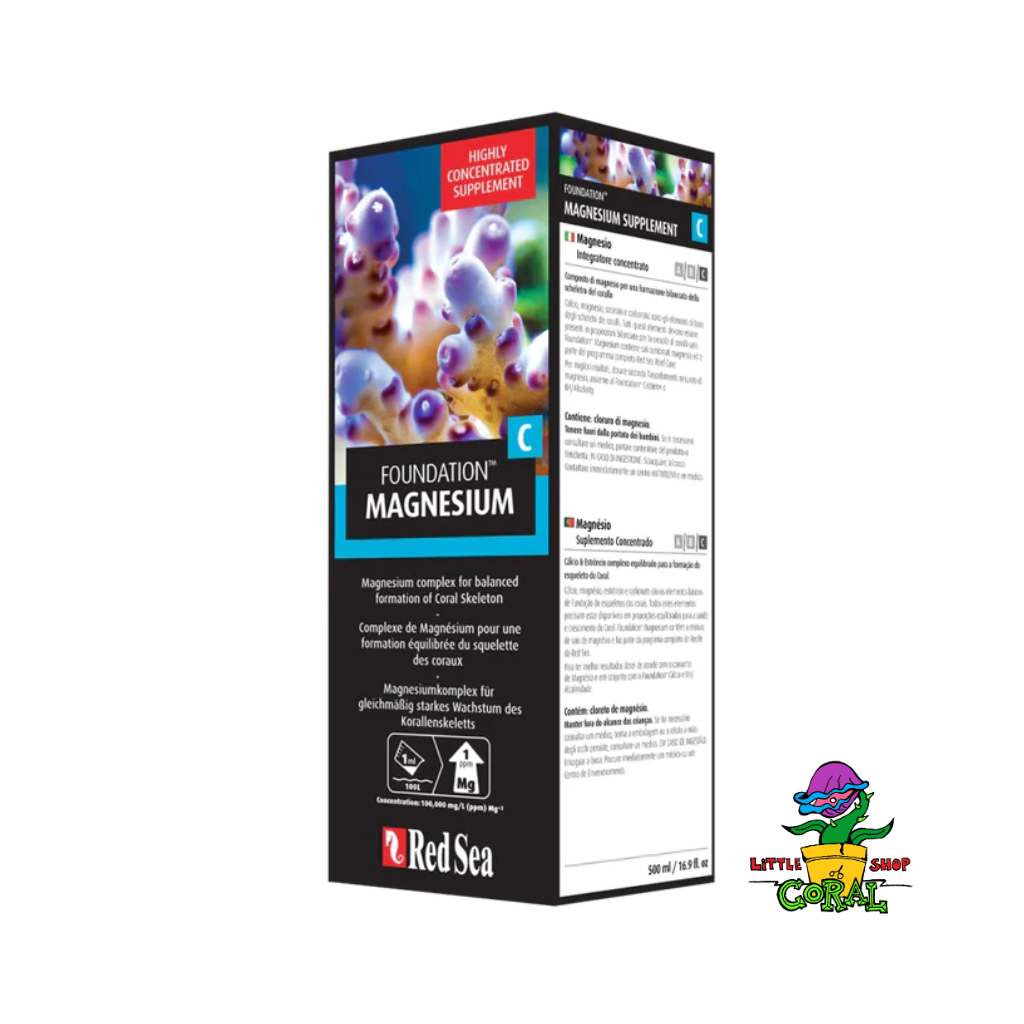
Red Sea Reef Foundation C (Magnesium)
Red Sea Reef Foundation C (Magnesium)
Couldn't load pickup availability
Red Sea Reef Foundation C is a concentrated magnesium supplement formulated to maintain the magnesium levels that keep your reef chemistry stable and balanced. Magnesium is the most abundant major element in natural seawater after sodium and chloride, and it plays a critical behind-the-scenes role in reef keeping. Without adequate magnesium, calcium and alkalinity are nearly impossible to hold stable, as low magnesium allows calcium and carbonate ions to precipitate out of solution before corals can use them. Keeping magnesium in the correct range is what allows the rest of your dosing routine to actually work.
Foundation C is designed to be used as part of Red Sea's complete Reef Foundation system alongside Foundation A (calcium) and Foundation B (alkalinity) for structured, predictable water chemistry management.
Why we love it
- Addresses the most commonly overlooked major parameter in reef chemistry
- Stabilises calcium and alkalinity by preventing unwanted precipitation
- Concentrated formula that works efficiently in systems of all sizes
- Clean and clear in solution with no unwanted additives
- Compatible with manual dosing or any standard dosing pump
Dosage guide
Dose per 100 L (25 gal) to raise magnesium by approximately 4 ppm. Adjust based on regular testing and your tank's consumption rate:
| Tank Type | Dose per 100 L |
|---|---|
| Soft coral / low demand | 1 mL |
| Mixed reef | 2 mL |
| SPS dominant / high demand | 3 to 4 mL |
Target magnesium level is 1250 to 1350 ppm for most reef systems. Test before starting and retest after the first week to establish your baseline consumption.
How to use
Add directly to a high-flow area of your sump or dose via a dosing pump on a timed schedule. If magnesium is significantly depleted, raise it gradually over several days rather than correcting it all at once. Large single doses can stress corals and affect other parameters. Once at your target level, switch to a maintenance dose based on your tank's daily consumption.
Storage
Store in a cool, dry location away from direct sunlight. Keep the lid tightly sealed between uses. No refrigeration required.
Available sizes
- 500 mL
Collapsible content
LIGHT
LOW: Place coral at the bottom of the tank. Depending on the type, coral may need to be placed off sand and therefore mounted on a ceramic disc of piece of rock.
MEDIUM: Place coral at mid-range of the tank. Best placed/glued on top of a rock scape at mid-range height.
HIGH: Place coral from mid range to just below water level. SPS coral are shallow growing so they require and are able to tolerate intense light.
FLOW
LOW: Most soft coral do well with a small, gentle pulse. There are certain corals that can even be placed in areas of indirect flow, meaning places aside a rock structure or set into a entrance to a cave style space.
MEDIUM: Many LPS types of coral prefer medium pulse current. Most Euphyllia or corals that have more tissue structure connected to their skeleton, don’t like to be in a high flow area like the direct flow of the wave pump.
HIGH: Similar to high light, SPS enjoy being in some heavy current. Most LPS and SPS that branch encrust or plate prefer high flow that simulates the top water waves.
SKILL
ENTRY: While some may say beginner level, "Entry" is a good term to be used when starting out in the world of corals and marine life. Prior to adding livestock, you want to ensure that your reef has the proper parameters including zero levels of ammonia and nitrite. Seeing traces of nitrate in your waters is a good sign - just keep them at a lower level of 2ppm to 10ppm. Maintaining correct temperature and salinity are a huge factor to stable parameters. Starting to monitor your PH, alkalinity, calcium and magnesium is a great habit to get into to keep a successful reef.
While some soft coral don’t require too much light, having a proper reef light that puts out the proper pars is very important. You'll also want to have a good amount of flow and protected rock areas, as placing corals in their happy spot is ideal for success.
ADVANCED: