

Little Shop of Coral
Pistol Shrimp (Alpheidae)
Pistol Shrimp (Alpheidae)
Couldn't load pickup availability
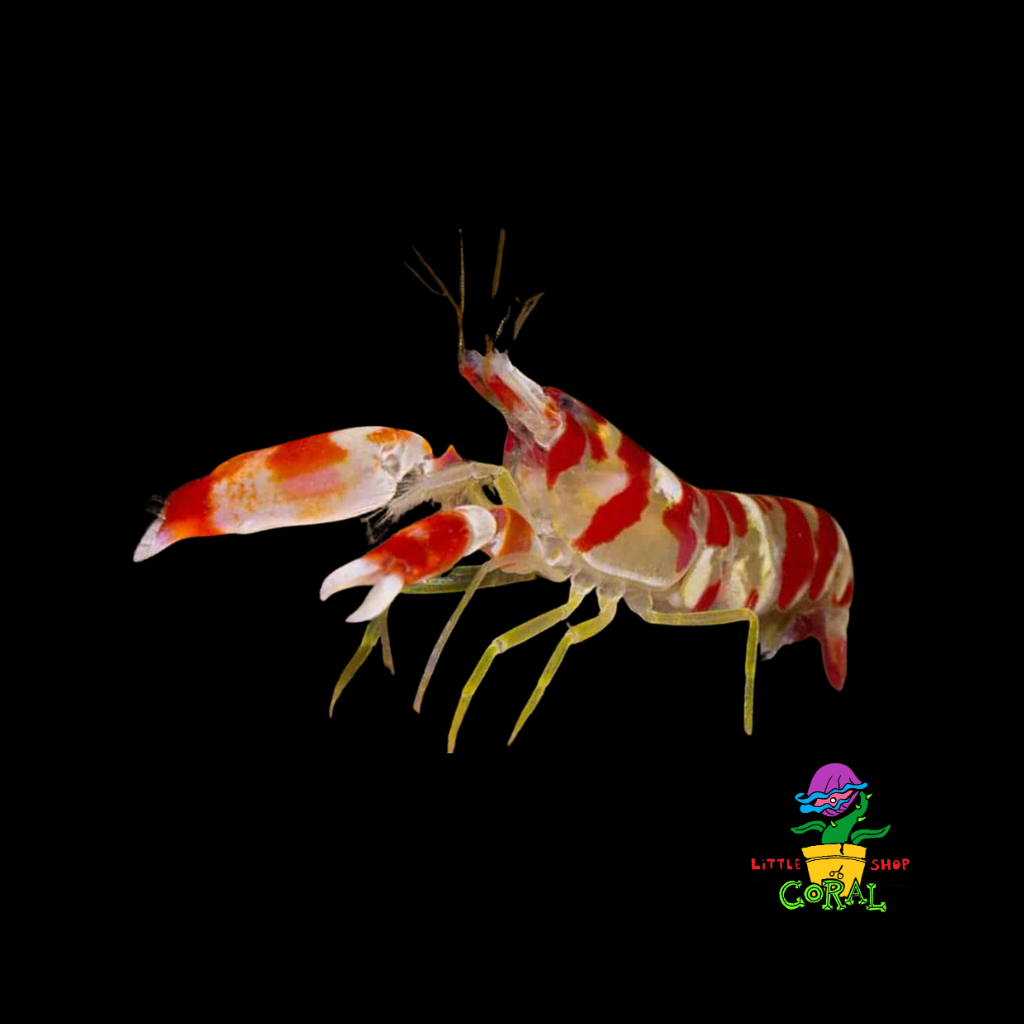
The Red Pistol Shrimp is one of the most fascinating and characterful invertebrates available to reef keepers, packing an outsized personality and a genuinely remarkable ability into a small, strikingly coloured package. Its body is bright red marked with several white spots, the base of the tail and claws are banded in white, and its antennae carry red and white banding, making it one of the more visually appealing members of a genus that is usually better known for what it does than how it looks. Also known as the Japanese Pistol Shrimp, Japanese Snapping Shrimp, and Red Snapping Shrimp, A. bisincisus gets its common name from its single, disproportionately large snapping claw. When snapped shut at speed, this claw produces a cavitation bubble that collapses with a shock wave powerful enough to stun or kill small prey, the cracking sound of which is loud enough to be clearly heard through aquarium glass, and occasionally loud enough to wake a light-sleeping hobbyist. For many reefers, that snap is half the appeal.
Why we love it
- Vivid red and white colouration that stands out beautifully against a sandy substrate and live rock
- One of the most fascinating symbiotic partnerships in the hobby: when paired with a compatible shrimp goby, the shrimp maintains and excavates the shared burrow while the goby stands guard at the entrance, warning the nearly blind shrimp of danger through physical contact
- Constant burrowing and sand-sifting activity makes it an excellent and natural substrate aerator
- Hardy, easy to feed, and suitable for a wide range of system sizes including nano tanks
- The snapping behaviour is endlessly entertaining and one of the most unique sensory experiences in the hobby
Suggested parameters
- Temperature: 24 to 26°C (75 to 79°F)
- Salinity: 1.025 to 1.026 SG
- pH: 8.1 to 8.4
- Alkalinity: 8 to 10 dKH
- Calcium: 400 to 450 ppm
- Magnesium: 1250 to 1400 ppm; magnesium is extremely important for healthy molting in this species
- Nitrate: 5 to 20 ppm
- Phosphate: 0.03 to 0.12 ppm
- Copper-based medications are immediately fatal to all shrimp and invertebrates and must never be used
Care and temperament
- Difficulty: Easy
- Temperament: Peaceful toward fish and most invertebrates; may target very small shrimp or other tiny invertebrates, and is capable of stunning small prey with its snap; well-fed individuals are far less likely to bother tankmates
- Reef safe: Yes with corals; use caution with very small ornamental shrimp and micro-crustaceans
- Minimum tank size: 20 gallons; suitable for nano systems
- Best maintained in reef or fish-only aquariums with plenty of rockwork, caves, crevices, and a fine sandy substrate for burrowing; the sandbed is essential for natural digging and burrow-building behaviour
- Rarely seen during daytime under bright lighting; primarily active at dusk, dawn, and during lower-light periods
- Iodine levels in the water, replenished through regular water changes, are vital to support proper molting
Diet
The Red Pistol Shrimp is a carnivorous opportunist and an active scavenger.
- Will scavenge meaty foods, frozen mysis shrimp, krill, brine shrimp, and sinking pellets that settle near its burrow
- Late evening target feeding with small strips of fresh fish or shrimp flesh, sinking shrimp pellets, or meaty freeze-dried foods placed near the burrow entrance is the most effective feeding strategy and can also help reduce night-time snapping activity
- A goby partner will share food brought back to the burrow, ensuring the shrimp is well supplied even if it rarely ventures out
- Feed two to three times per week; a well-fed pistol shrimp is a peaceful and content tankmate
Compatibility and tankmates
- Excellent with most reef fish, clownfish, tangs, blennies, dartfish, and peaceful wrasses
- Pairs beautifully with shrimp gobies from the genera Amblyeleotris and Stonogobiops; the shrimp and goby will quickly establish a shared burrow, with the goby warning its partner of danger through antenna contact at the burrow entrance
- Avoid triggerfish, pufferfish, large hawkfish, and aggressive wrasse species that will hunt and eat shrimp
- Use caution with very small ornamental shrimp species that may be targeted
- The snapping sound can be confused with mantis shrimp activity; unlike mantis shrimp, pistol shrimp pose no threat to glass or larger tankmates
Health and acclimation notes
Alpheus shrimp are very sensitive to specific gravity and salinity changes; acclimation must be done slowly, adding small amounts of aquarium water to the bag every few minutes over at least 15 to 30 minutes. Drip acclimation is strongly recommended. During molting, the shrimp will become reclusive and may not be seen for several days; the shed exoskeleton should be left in the tank as a calcium-rich food source. If the shrimp loses a claw, it will simply regrow at the next molt, a reassuring resilience that makes this species very forgiving in the long run.
What you are buying
- You will receive: 1 Red Pistol Shrimp (Alpheus bisincisus)
- Colouration is bright red with white spots on the body, white banding on the tail base and claws, and red and white banded antennae
- Size can vary between individuals; maximum size is approximately 5 to 6 cm
Drip acclimation is strongly recommended. A fine sandy substrate and ample rockwork must be present before introduction. Copper-based medications must never be used in any system housing this animal.
Collapsible content
LIGHT
LOW: Place coral at the bottom of the tank. Depending on the type, coral may need to be placed off sand and therefore mounted on a ceramic disc of piece of rock.
MEDIUM: Place coral at mid-range of the tank. Best placed/glued on top of a rock scape at mid-range height.
HIGH: Place coral from mid range to just below water level. SPS coral are shallow growing so they require and are able to tolerate intense light.
FLOW
LOW: Most soft coral do well with a small, gentle pulse. There are certain corals that can even be placed in areas of indirect flow, meaning places aside a rock structure or set into a entrance to a cave style space.
MEDIUM: Many LPS types of coral prefer medium pulse current. Most Euphyllia or corals that have more tissue structure connected to their skeleton, don’t like to be in a high flow area like the direct flow of the wave pump.
HIGH: Similar to high light, SPS enjoy being in some heavy current. Most LPS and SPS that branch encrust or plate prefer high flow that simulates the top water waves.
SKILL
ENTRY: While some may say beginner level, "Entry" is a good term to be used when starting out in the world of corals and marine life. Prior to adding livestock, you want to ensure that your reef has the proper parameters including zero levels of ammonia and nitrite. Seeing traces of nitrate in your waters is a good sign - just keep them at a lower level of 2ppm to 10ppm. Maintaining correct temperature and salinity are a huge factor to stable parameters. Starting to monitor your PH, alkalinity, calcium and magnesium is a great habit to get into to keep a successful reef.
While some soft coral don’t require too much light, having a proper reef light that puts out the proper pars is very important. You'll also want to have a good amount of flow and protected rock areas, as placing corals in their happy spot is ideal for success.
ADVANCED: