
Little Shop of Coral
Ornate Leopard Wrasse (Macropharyngodon ornatus)
Ornate Leopard Wrasse (Macropharyngodon ornatus)
Couldn't load pickup availability
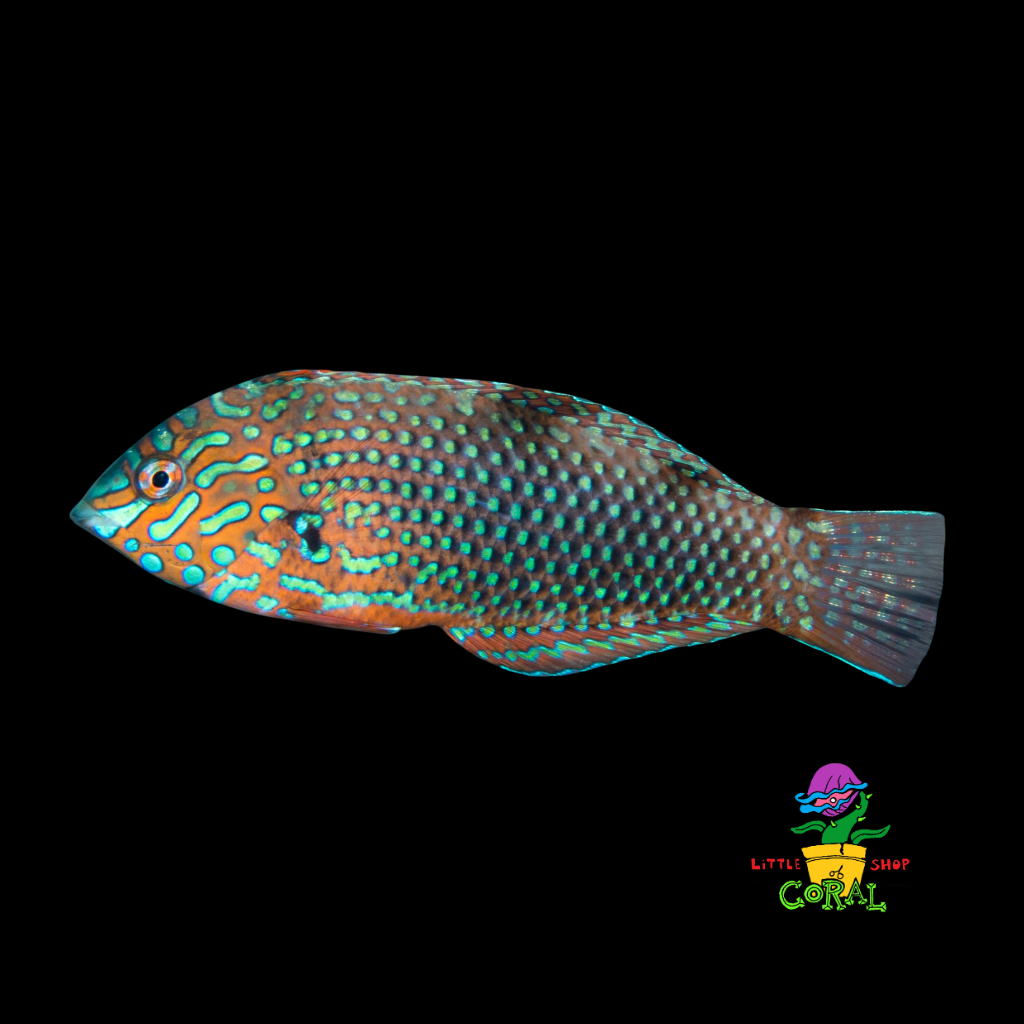
The Ornate Leopard Wrasse is one of the most breathtakingly patterned fish available in the reef hobby, and one of the most demanding. The body carries a smaller, denser speckled pattern of various colours including vibrant greens, blues, reds, and gold across a dark base, with a greater accent of red in its body than the more commonly kept Leopard Wrasse (M. meleagris), producing a mosaic of colour that earns the common name without any exaggeration. Also known as the False Leopard Wrasse and Ornate Leopard Coris, this species is not for the uninitiated. The Macropharyngodon genus requires exceptional dedication and attention from the hobbyist in order to thrive, and the Ornate Leopard is correctly listed as an expert-only species by most reputable vendors. In the right hands and the right system, it is one of the most rewarding and visually spectacular fish in the entire hobby.
Why we love it
- An extraordinary living mosaic of colour and pattern that draws the eye immediately in any reef display
- Not as readily available in the aquarium trade as other leopard wrasse species, making it a genuinely special and unusual find
- One of the few wrasse species that can be successfully housed with others of its own kind; a group of one dominant male with multiple females is the ideal social structure
- Active, graceful daytime swimmer that spends the day hunting across the rockwork in a way that brings constant natural movement and foraging behaviour to the display
- Known to perform a distinctive swaying "dance" when confronted by potential predators, an endearing and unique behavioural trait
Suggested parameters
- Temperature: 24 to 26°C (75 to 79°F)
- Salinity: 1.025 to 1.026 SG
- pH: 8.1 to 8.4
- Alkalinity: 8 to 10 dKH
- Calcium: 400 to 450 ppm
- Magnesium: 1250 to 1400 ppm
- Nitrate: 5 to 20 ppm; pristine, stable water quality is non-negotiable for this species
- Phosphate: 0.03 to 0.12 ppm
Care and temperament
- Difficulty: Expert only; not recommended for hobbyists without extensive experience keeping delicate reef fish
- Temperament: Peaceful toward virtually all tankmates; will not bother fish, corals, or most invertebrates
- Reef safe: Yes, fully compatible with corals and most invertebrates; will hunt small crustaceans, so micro-invertebrates, small ornamental shrimp, and tiny crabs may be at risk
- Minimum tank size: 200 litres (55 gallons), though larger is strongly preferred
- A fine sandy substrate of at least 5 to 8 cm depth is an absolute non-negotiable requirement; this species buries itself every night and at the first sign of stress during the day, and without adequate sandbed depth it cannot engage in this essential behaviour, leading to chronic stress and rapid decline
- A well-matured reef system with an established microfauna population, copepods, amphipods, and natural prey organisms in the rockwork and sandbed is strongly preferred over a bare or newer system
- Introduce the Ornate Leopard Wrasse to the display aquarium before larger, more active, or more competitive fish; giving it time to settle in and begin feeding on prepared foods before facing competition is critical to long-term success
- A tight-fitting lid is essential; wrasses are confirmed and capable jumpers
Diet
Feeding is the greatest challenge and the most critical daily responsibility when keeping this species.
- Frozen mysis shrimp (primary staple target food once accepted)
- Frozen enriched brine shrimp, copepods, and cyclops
- LRS Nano blend and similar fine meaty reef food blends
- Quality small marine pellets once trained
- This species naturally hunts small crustaceans throughout the day in the wild; a mature reef system with a living sandbed and copepod-rich rockwork provides essential supplemental nutrition between scheduled feedings
- A connected refugium cultivating copepods and amphipods provides critical live food support and dramatically improves long-term outcomes with this species
- Multiple small feedings per day; target feeding near the fish's foraging zone is the most effective approach
- Live fortified brine shrimp and blackworms can be used to entice feeding in reluctant new arrivals before transitioning to frozen foods
Compatibility and tankmates
- Peaceful and excellent with tangs, clownfish, gobies, dartfish, anthias, and most reef community fish
- Can be kept as a group of one dominant male with multiple females; introduce all individuals simultaneously for the smoothest social outcome
- Avoid boisterous, aggressive, or fast-moving fish that will compete for food or stress this relatively timid species; the Ornate Leopard must be able to forage at its own pace without competition
- Avoid large dottybacks, aggressive wrasses, and triggerfish
- Compatible with corals and most ornamental invertebrates; caution with very small crustaceans
Health and acclimation notes
The Ornate Leopard Wrasse is one of the more challenging species to acclimate successfully; it is very common for a newly introduced individual to immediately bury itself upon release into the aquarium. This is normal and expected behaviour and should not be cause for alarm. The fish will typically emerge and begin exploring within one to two days. Slow, careful drip acclimation over at least one hour is essential before introduction. Inspect the specimen carefully before purchase, particularly the area around the mouth, as transport-related mouth injuries are a common issue with wrasses and severely impact the ability to feed. Purchasing a specimen that is already established, eating, and quarantined before sale dramatically improves the odds of long-term success.
What you are buying
- You will receive: 1 Ornate Leopard Wrasse (Macropharyngodon ornatus)
- Colouration is a dense mosaic of green, blue, red, and gold spots on a dark body; terminal phase males are generally more vivid, particularly in the red tones, while females and initial phase fish carry a slightly more subdued version of the same pattern
- Size, phase, and colour intensity can vary between individuals
A tight-fitting lid is essential. A deep fine sandy substrate must be in place before introduction. Slow drip acclimation of at least one hour is strongly recommended. This is an expert-only species best suited to experienced, well-prepared reef keepers.
Collapsible content
LIGHT
LOW: Place coral at the bottom of the tank. Depending on the type, coral may need to be placed off sand and therefore mounted on a ceramic disc of piece of rock.
MEDIUM: Place coral at mid-range of the tank. Best placed/glued on top of a rock scape at mid-range height.
HIGH: Place coral from mid range to just below water level. SPS coral are shallow growing so they require and are able to tolerate intense light.
FLOW
LOW: Most soft coral do well with a small, gentle pulse. There are certain corals that can even be placed in areas of indirect flow, meaning places aside a rock structure or set into a entrance to a cave style space.
MEDIUM: Many LPS types of coral prefer medium pulse current. Most Euphyllia or corals that have more tissue structure connected to their skeleton, don’t like to be in a high flow area like the direct flow of the wave pump.
HIGH: Similar to high light, SPS enjoy being in some heavy current. Most LPS and SPS that branch encrust or plate prefer high flow that simulates the top water waves.
SKILL
ENTRY: While some may say beginner level, "Entry" is a good term to be used when starting out in the world of corals and marine life. Prior to adding livestock, you want to ensure that your reef has the proper parameters including zero levels of ammonia and nitrite. Seeing traces of nitrate in your waters is a good sign - just keep them at a lower level of 2ppm to 10ppm. Maintaining correct temperature and salinity are a huge factor to stable parameters. Starting to monitor your PH, alkalinity, calcium and magnesium is a great habit to get into to keep a successful reef.
While some soft coral don’t require too much light, having a proper reef light that puts out the proper pars is very important. You'll also want to have a good amount of flow and protected rock areas, as placing corals in their happy spot is ideal for success.
ADVANCED: