

Little Shop of Coral
Lunar Wrasse (Thalassoma lunare)
Lunar Wrasse (Thalassoma lunare)
Couldn't load pickup availability
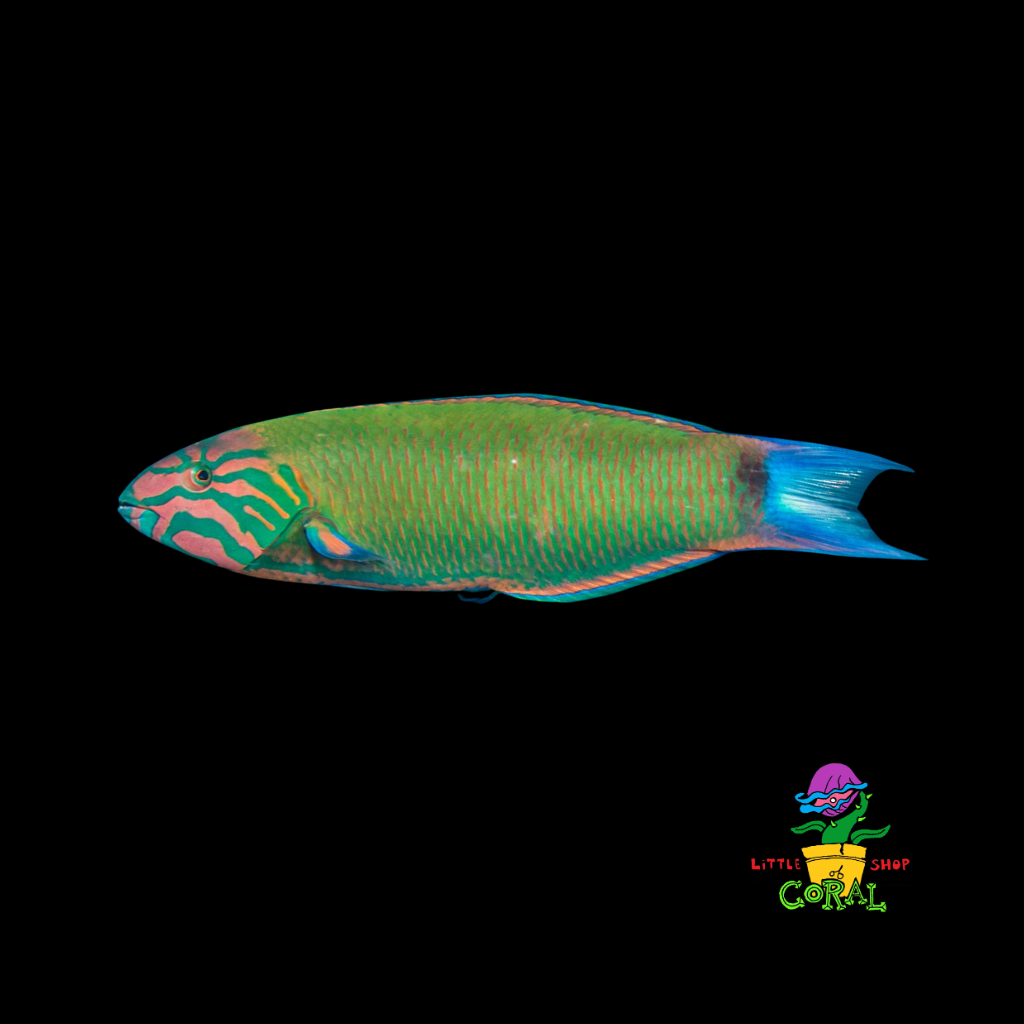
The Lunar Wrasse, also known as the Moon Wrasse or Lyretail Wrasse, is one of the most striking and bulletproof wrasses available in the hobby. Terminal phase males are a riot of colour: a vivid blue-green body overlaid with intricate pink and violet facial markings, bright accents on the pectoral fins, and the fish's most iconic feature, a brilliant yellow crescent-shaped caudal fin that gives it both its common names. Juveniles are more subdued, showing a green and blue body with a dark dorsal spot and a black blotch at the tail base that transforms into that yellow crescent as the fish matures. Hardy, active, and endlessly entertaining to watch, the Lunar Wrasse is a natural choice for larger FOWLR systems, but it demands respect: this is an assertive, high-energy fish that will run the show in any tank it calls home.
Why we love it
- One of the most vividly coloured wrasses in the trade, with a colour transformation from juvenile to adult that rivals any fish in the hobby
- Exceptionally hardy once established, with a strong tolerance for the kind of water fluctuations that would stress more delicate species
- A known hunter of bristleworms and mantis shrimp, making it genuinely useful in systems where these pests are a concern
- High metabolic rate and constant motion make it one of the most engaging and active display fish available
- Wide natural distribution across the Indo-Pacific means healthy, well-conditioned specimens are regularly available in the trade
Suggested parameters
- Temperature: 23–26°C (72–78°F)
- Salinity: 1.020–1.025 SG
- pH: 8.1–8.4
- Alkalinity: 8–12 dKH
- Ammonia/Nitrite: 0
- Nitrate: Under 30 ppm; strong biological filtration is essential given this species' high bioload
Care and temperament
- Difficulty: Easy to moderate
- Temperament: Aggressive. Once established, the Lunar Wrasse will defend its territory assertively and may harass new additions to the tank
- Reef safe: No. Will actively hunt ornamental shrimp, small crabs, hermit crabs, and other motile invertebrates. Corals are generally left alone, but this fish is not suitable for stocked reef systems
- Minimum tank size: 125 gallons, with generous open swimming space being as important as raw volume; 150 gallons or larger is preferred for long-term keeping
Diet
The Lunar Wrasse is an enthusiastic, unfussy carnivore with a high metabolism that needs to be matched with regular, substantial feeding.
- Frozen mysis shrimp and vitamin-enriched brine shrimp as the dietary foundation
- Chopped clams, krill, squid, and other meaty marine preparations
- High-quality carnivore pellets and flake foods accepted readily once settled
- Soaking frozen foods in a vitamin and HUFA supplement is recommended given the species' activity level and fast metabolism
- Feed 2 to 3 times per day; this is not a fish that should be fed lightly
Compatibility and tankmates
- Best kept alongside bold, assertive fish that can hold their own: triggerfish, pufferfish, larger angelfish, lionfish, and robust tangs are all suitable
- Should be the last fish added to the aquarium; once established it will aggressively challenge any new introductions and may make life very difficult for newcomers
- Only one male per system; males will fight intensely with other terminal phase males
- Not suitable for tanks with ornamental shrimp, small crabs, hermit crabs, or similarly sized peaceful fish that may be bullied or predated
- Juvenile specimens are considerably less aggressive than adults, but boldness increases steadily with size
Health and acclimation notes
The Lunar Wrasse is one of the most durable wrasses in the hobby and typically begins feeding within hours of introduction. It does not need a sand bed to thrive, unlike many wrasse species, though it will occasionally use one for sleeping or when startled. A tight-fitting lid is absolutely non-negotiable: this is a fast, powerful swimmer and an accomplished jumper. Strong circulation and efficient protein skimming are important given its high metabolic output and bioload. Quarantine is always recommended before introduction into an established display. Because this species can live close to a decade in captivity with proper care, it pays to invest in setup conditions that support long-term health from the start.
What you are buying
- You will receive: 1 Lunar Wrasse (Thalassoma lunare)
- Colour and pattern vary considerably between individuals and by region of origin; terminal phase males display the brightest colouration and the characteristic yellow crescent tail
- Juveniles and initial phase fish will develop more intense colouration as they mature and settle into stable conditions
- Please see size options at checkout
Collapsible content
LIGHT
LOW: Place coral at the bottom of the tank. Depending on the type, coral may need to be placed off sand and therefore mounted on a ceramic disc of piece of rock.
MEDIUM: Place coral at mid-range of the tank. Best placed/glued on top of a rock scape at mid-range height.
HIGH: Place coral from mid range to just below water level. SPS coral are shallow growing so they require and are able to tolerate intense light.
FLOW
LOW: Most soft coral do well with a small, gentle pulse. There are certain corals that can even be placed in areas of indirect flow, meaning places aside a rock structure or set into a entrance to a cave style space.
MEDIUM: Many LPS types of coral prefer medium pulse current. Most Euphyllia or corals that have more tissue structure connected to their skeleton, don’t like to be in a high flow area like the direct flow of the wave pump.
HIGH: Similar to high light, SPS enjoy being in some heavy current. Most LPS and SPS that branch encrust or plate prefer high flow that simulates the top water waves.
SKILL
ENTRY: While some may say beginner level, "Entry" is a good term to be used when starting out in the world of corals and marine life. Prior to adding livestock, you want to ensure that your reef has the proper parameters including zero levels of ammonia and nitrite. Seeing traces of nitrate in your waters is a good sign - just keep them at a lower level of 2ppm to 10ppm. Maintaining correct temperature and salinity are a huge factor to stable parameters. Starting to monitor your PH, alkalinity, calcium and magnesium is a great habit to get into to keep a successful reef.
While some soft coral don’t require too much light, having a proper reef light that puts out the proper pars is very important. You'll also want to have a good amount of flow and protected rock areas, as placing corals in their happy spot is ideal for success.
ADVANCED: