
Little Shop of Coral
Lettuce Sea Slug (Elysia spp.)
Lettuce Sea Slug (Elysia spp.)
Couldn't load pickup availability
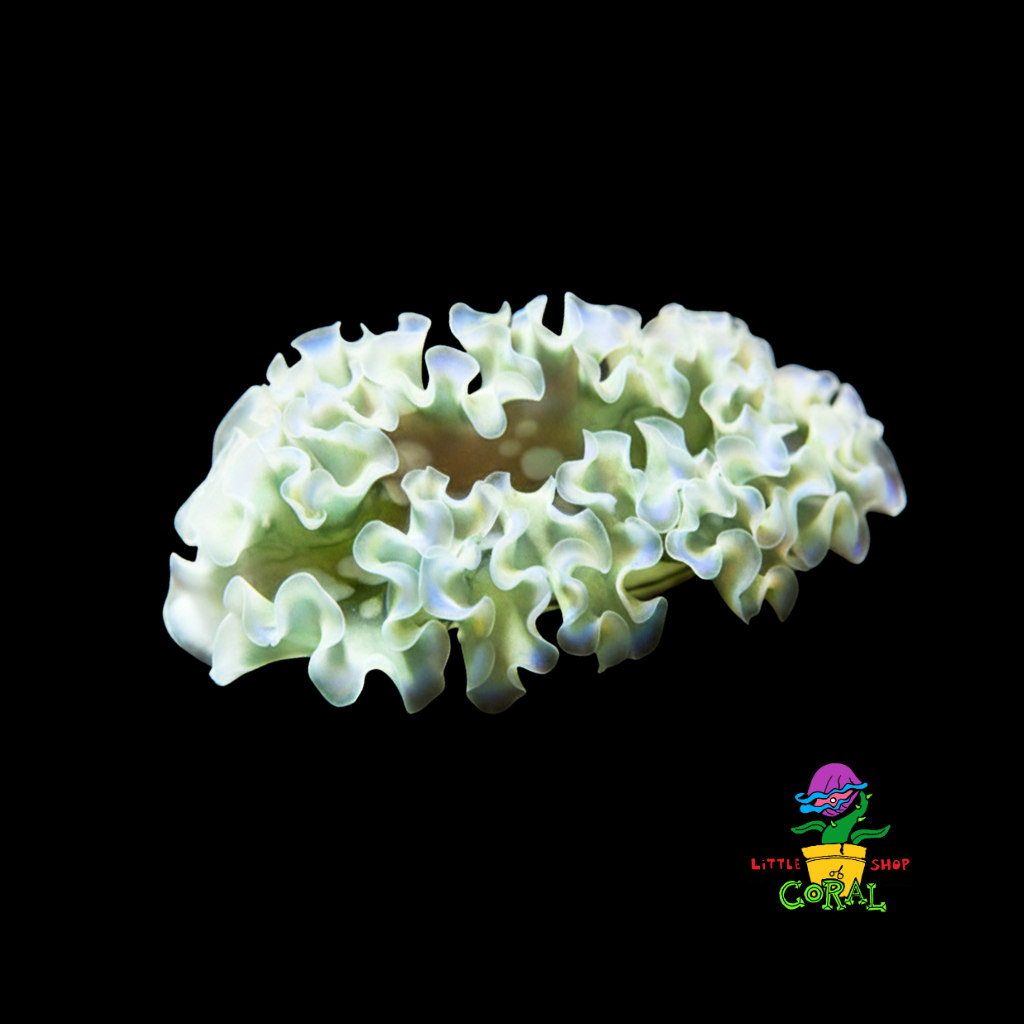
The Lettuce Sea Slug (Elysia spp.), also sold as the lettuce nudibranch, is a peaceful, reef safe grazer named for the ruffled, leaf-like folds along its body that really do look like green lettuce. Collected from the Caribbean and Gulf of Mexico, it is a fantastic natural algae control option, especially for tanks battling hair algae and bryopsis. It is also one of the few sea slugs well suited to reef life, since it grazes a range of green algae rather than one fussy species.
Why we love it
- Hard working, natural grazer that targets nuisance green algae including hair algae and bryopsis
- Peaceful and completely reef safe, it will not bother corals or other livestock
- Genuinely fun to watch, with a ruffled lettuce look and a surprising amount of movement
- Solar powered, it stores chloroplasts from the algae it eats and photosynthesizes, a trick called kleptoplasty
Suggested parameters
- Temperature: 24 to 26°C (75 to 79°F)
- Salinity: 1.024 to 1.026 SG
- pH: 8.1 to 8.4
- Alkalinity: 8 to 10 dKH
- Nitrate: keep low and stable, these slugs are sensitive to high nitrate
- Never expose them to copper based medications
Care and placement
- Difficulty: Easy to moderate, the main requirement is a steady food supply
- Best in an established tank with live rock and a healthy growth of green algae to graze
- Lighting and flow: any reef lighting is fine, with low to moderate flow suiting it best
- Screen powerheads and overflows, since slugs can be drawn into uncovered intakes
Feeding
Lettuce sea slugs feed by piercing algae cells and sucking out the contents, working slowly across rock and glass. They do best when there is enough algae in the system to sustain them.
- Grazes green hair algae, bryopsis, and other soft green algae such as Halimeda and Penicillus
- No supplemental feeding is needed if the tank has a good algae supply
- In a very clean tank, target it onto algae patches or run a refugium to keep it fed
- If algae runs out it can slowly starve, so plan for a steady food source
Compatibility and tankmates
- Peaceful and reef safe with corals, inverts, and most fish
- Avoid keeping it with fish or inverts that pick at slugs
- Multiple slugs can be kept together and will often reproduce in a stable tank
Health and acclimation notes
Drip acclimate slowly, since sea slugs are sensitive to swings in salinity and to poor water quality. They will not tolerate copper, so never use copper based treatments in a tank that houses them. Note that despite the nudibranch nickname, this is technically a sacoglossan sea slug, not a true nudibranch.
What you are buying
- You will receive: 1 Lettuce Sea Slug (Elysia spp.)
- Size, colour, and exact species (commonly Elysia crispata or Elysia clarki) can vary between individuals
Collapsible content
LIGHT
LOW: Place coral at the bottom of the tank. Depending on the type, coral may need to be placed off sand and therefore mounted on a ceramic disc of piece of rock.
MEDIUM: Place coral at mid-range of the tank. Best placed/glued on top of a rock scape at mid-range height.
HIGH: Place coral from mid range to just below water level. SPS coral are shallow growing so they require and are able to tolerate intense light.
FLOW
LOW: Most soft coral do well with a small, gentle pulse. There are certain corals that can even be placed in areas of indirect flow, meaning places aside a rock structure or set into a entrance to a cave style space.
MEDIUM: Many LPS types of coral prefer medium pulse current. Most Euphyllia or corals that have more tissue structure connected to their skeleton, don’t like to be in a high flow area like the direct flow of the wave pump.
HIGH: Similar to high light, SPS enjoy being in some heavy current. Most LPS and SPS that branch encrust or plate prefer high flow that simulates the top water waves.
SKILL
ENTRY: While some may say beginner level, "Entry" is a good term to be used when starting out in the world of corals and marine life. Prior to adding livestock, you want to ensure that your reef has the proper parameters including zero levels of ammonia and nitrite. Seeing traces of nitrate in your waters is a good sign - just keep them at a lower level of 2ppm to 10ppm. Maintaining correct temperature and salinity are a huge factor to stable parameters. Starting to monitor your PH, alkalinity, calcium and magnesium is a great habit to get into to keep a successful reef.
While some soft coral don’t require too much light, having a proper reef light that puts out the proper pars is very important. You'll also want to have a good amount of flow and protected rock areas, as placing corals in their happy spot is ideal for success.
ADVANCED: