
Little Shop of Coral
Leopard Goby (Amblyeleotris diagonalis)
Leopard Goby (Amblyeleotris diagonalis)
Couldn't load pickup availability
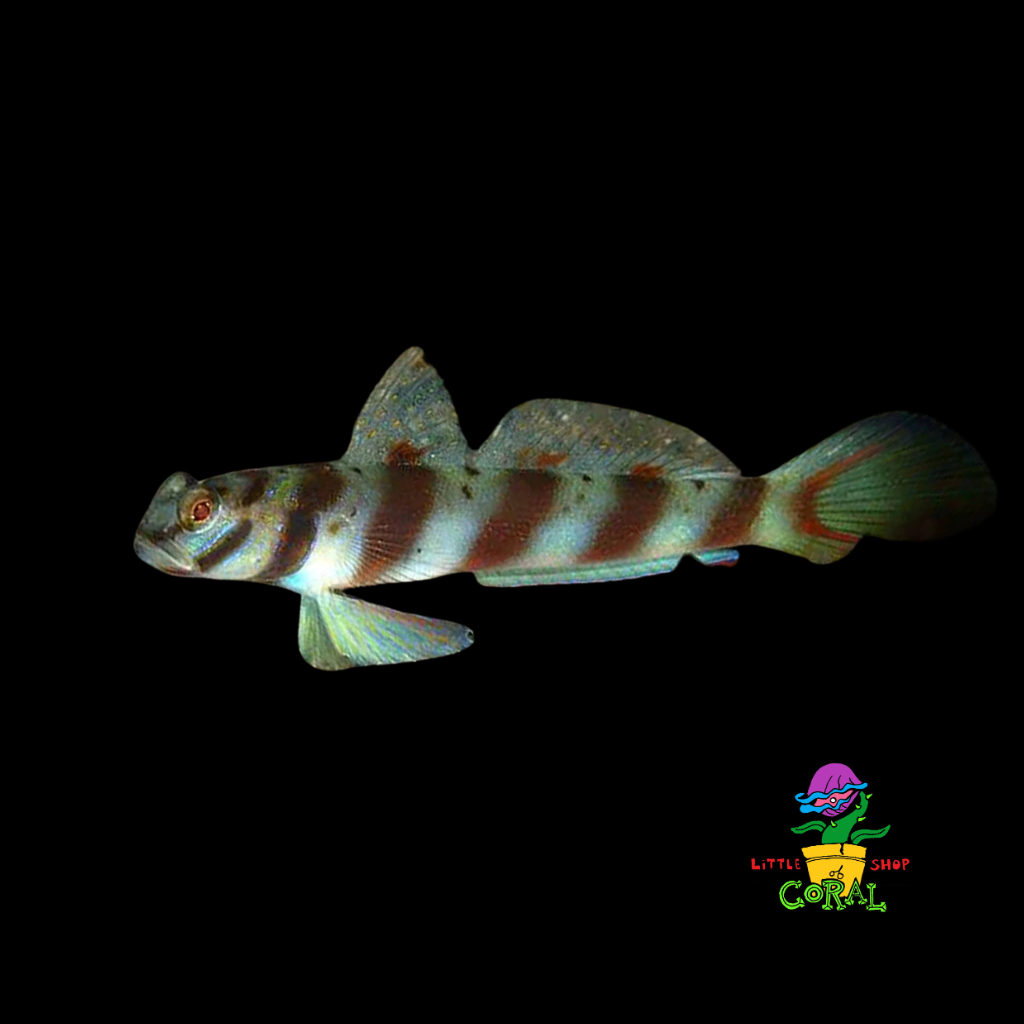
The Leopard Goby, also known as the Diagonal Shrimp Goby or Diagonal Bar Prawn Goby, is a beautifully marked, personality-packed little fish that brings both visual interest and genuine behavioural fascination to reef aquariums. This species is elongated in shape, adorned with bold diagonal brown bars, and its fins are speckled in brown and blue, creating an intricate pattern that lives up to its common name. What makes this fish truly special in the aquarium is its symbiotic relationship with pistol shrimp, one of the most captivating partnerships in the reef keeping hobby.
Why we love it
- Stunning diagonal banding and speckled fins, endlessly interesting up close
- One of the most rewarding fish to watch, especially when paired with a pistol shrimp
- The goby keeps watch while the shrimp digs and maintains their shared burrow, a fascinating association to observe in an aquarium
- Peaceful, reef safe, and beginner friendly
- Compact size makes it suitable for a wide range of system sizes
Suggested parameters
- Temperature: 24 to 27°C (75 to 80°F)
- Salinity: 1.025 to 1.026 SG
- pH: 8.1 to 8.4
- Alkalinity: 8 to 10 dKH
- Calcium: 400 to 450 ppm
- Magnesium: 1250 to 1400 ppm
- Nitrate: 5 to 20 ppm
- Phosphate: 0.03 to 0.12 ppm
- Moderate water flow to maintain water quality without disturbing its benthic lifestyle
Care and temperament
- Difficulty: Easy
- Temperament: Peaceful
- Reef safe: Yes, fully compatible with corals and ornamental invertebrates
- Minimum tank size: 30 gallons
- Best maintained in well-established reef or fish-only aquariums with wide-open, coarse-grained (2 to 4 mm) deep sandy areas along with some small rubble for burrow building
- A tight-fitting lid is essential; this species is a confirmed jumper
Diet
Target feeding is necessary when there is not enough naturally occurring live food in the aquarium; the diet should consist of finely chopped fresh or frozen meaty foods including krill, marine fish flesh, mysis shrimp, shrimp, scallops, squid, and clams, with some algae-containing foods included as well
- Frozen mysis shrimp (staple)
- Finely chopped frozen meaty foods
- Quality carnivore pellets once trained
- If reluctant to feed initially, live adult fortified brine shrimp and blackworms can be used to entice feeding
- Feed twice daily; target feeding near the burrow entrance is most effective
Compatibility and tankmates
- Excellent with clownfish, dartfish, small wrasses, other peaceful reef gobies, and most reef community fish
- Should not be housed with aggressive or fin-nipping fish such as groupers, dottybacks, triggerfish, or angelfish, as this is a shy species that prefers to live in and near its burrow
- Other animals that dig in the sand, such as wrasses, can stress this species if the aquarium is not spacious enough
- Keep singly or as a mated pair; if keeping a pair, introduce both individuals simultaneously
- Highly recommended to pair with an Alpheus pistol shrimp for the full symbiotic experience
Health and acclimation notes
The Leopard Goby is a hardy, adaptable species that settles in well once it has claimed a suitable burrow site with stable, peaceful surroundings. Ensure the sandbed is deep enough and coarse enough to allow natural burrowing behaviour, and keep flow moderate near the substrate so the burrow is not constantly disrupted. New arrivals may be shy for the first few days while establishing a territory; target feeding near the burrow entrance helps build confidence and feeding response quickly.
What you are buying
- You will receive: 1 Leopard Goby (Amblyeleotris diagonalis)
- Colour patterning and bar intensity can vary slightly between individuals
Slow acclimation is recommended. A tight-fitting lid is essential, as this species will jump.
Collapsible content
LIGHT
LOW: Place coral at the bottom of the tank. Depending on the type, coral may need to be placed off sand and therefore mounted on a ceramic disc of piece of rock.
MEDIUM: Place coral at mid-range of the tank. Best placed/glued on top of a rock scape at mid-range height.
HIGH: Place coral from mid range to just below water level. SPS coral are shallow growing so they require and are able to tolerate intense light.
FLOW
LOW: Most soft coral do well with a small, gentle pulse. There are certain corals that can even be placed in areas of indirect flow, meaning places aside a rock structure or set into a entrance to a cave style space.
MEDIUM: Many LPS types of coral prefer medium pulse current. Most Euphyllia or corals that have more tissue structure connected to their skeleton, don’t like to be in a high flow area like the direct flow of the wave pump.
HIGH: Similar to high light, SPS enjoy being in some heavy current. Most LPS and SPS that branch encrust or plate prefer high flow that simulates the top water waves.
SKILL
ENTRY: While some may say beginner level, "Entry" is a good term to be used when starting out in the world of corals and marine life. Prior to adding livestock, you want to ensure that your reef has the proper parameters including zero levels of ammonia and nitrite. Seeing traces of nitrate in your waters is a good sign - just keep them at a lower level of 2ppm to 10ppm. Maintaining correct temperature and salinity are a huge factor to stable parameters. Starting to monitor your PH, alkalinity, calcium and magnesium is a great habit to get into to keep a successful reef.
While some soft coral don’t require too much light, having a proper reef light that puts out the proper pars is very important. You'll also want to have a good amount of flow and protected rock areas, as placing corals in their happy spot is ideal for success.
ADVANCED: