
Little Shop of Coral
Lavender Tang (Acanthurus nigrofuscus)
Lavender Tang (Acanthurus nigrofuscus)
Couldn't load pickup availability
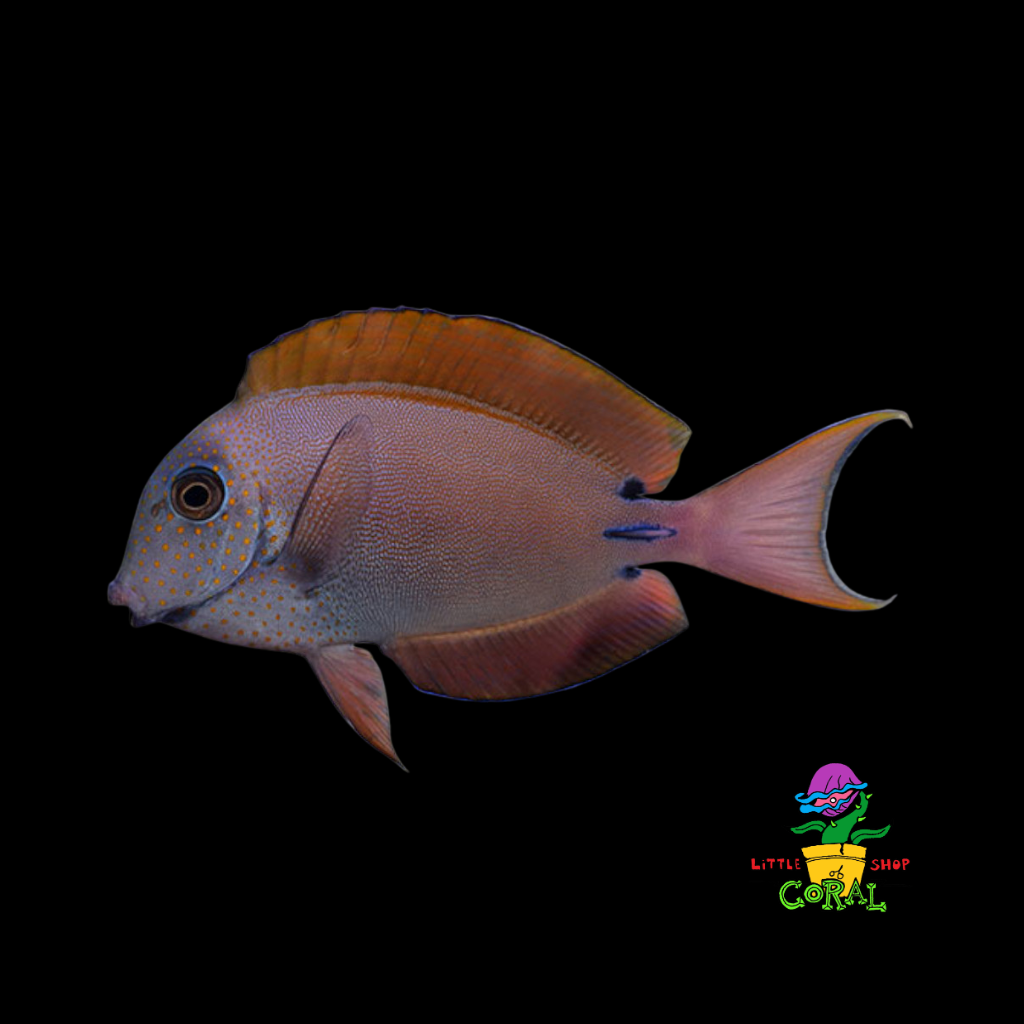
The Lavender Tang is one of those fish that quietly wins over every keeper who gives it a proper chance. Also known as the Spot-Cheeked Surgeonfish or Brown Surgeonfish, Acanthurus nigrofuscus is not the most immediately flashy tang on the shelf, and that is precisely the point. Its colouration is sophisticated rather than loud: a warm brown to grey-brown body with a soft, unmistakable lavender wash across the fins, a scattering of bright orange spots dotting the face and cheeks, and a crisp forked caudal fin that becomes more defined with age. When stressed or asserting dominance, the dorsal fin and upper back lighten dramatically, sometimes taking on a distinctly yellow tone, giving this fish a visual communication ability that is fascinating to observe in a multi-tang system. Juveniles are darker, showing a deep brown to bluish-black body with vivid orange scribbles on the head that gradually break into spots as the fish matures. A diligent, tireless grazer with a wide Indo-Pacific distribution and a reputation for durability, the Lavender Tang is a natural fit for the reef keeper who appreciates understated elegance and genuinely useful algae management in equal measure.
Why we love it
- Sophisticated lavender and warm brown colouration with vivid orange facial spotting is subtle, refined, and genuinely striking under blue-heavy reef lighting
- One of the most effective film algae and hair algae grazers available in the tang family, working rock surfaces and the glass persistently throughout the day
- Hardy and adaptable once established, with a stronger tolerance for the kind of minor parameter fluctuations that challenge more delicate Acanthurus species
- Juveniles display attractive orange head scribbles that evolve into the distinctive spotted adult pattern, making this a fish with a rewarding visual transformation over time
- A wide natural distribution across the Indo-Pacific, Red Sea, and Australian waters means healthy, well-conditioned specimens are regularly available in the trade
Suggested parameters
- Temperature: 22–26°C (72–78°F)
- Salinity: 1.020–1.025 SG
- pH: 8.1–8.4
- Alkalinity: 8–12 dKH
- Ammonia/Nitrite: 0
- Nitrate: Under 15 ppm; stable, established water chemistry with strong surface agitation and high dissolved oxygen is important for long-term health and HLLE prevention
Care and temperament
- Difficulty: Moderate
- Temperament: Semi-aggressive. Despite its relatively modest size and understated appearance, the Lavender Tang can be one of the more assertive Acanthurus species in a multi-tang system; it will defend its territory and feeding zones actively and should not be underestimated
- Reef safe: Yes. Completely safe with corals and sessile invertebrates; an excellent algae-management partner in a mature reef system
- Minimum tank size: 125 gallons, with generous open swimming lanes and an abundance of live rock for continuous grazing; tank length matters as much as volume for this active species
Diet
The Lavender Tang is a dedicated herbivore whose long-term health, colouration, and temperament are directly tied to the quality and consistency of its plant-based diet.
- Nori and dried seaweed sheets on a clip, offered daily or as close to daily as possible; consistent access to greens is the single most important factor in maintaining health and reducing aggression
- Spirulina-based pellets and high-quality herbivore flakes
- Frozen herbivore and reef blends
- Will graze on film algae, diatoms, and hair algae from live rock throughout the day; a mature system with established algae growth is a genuine advantage
- Feed small portions 2 to 3 times per day; a diet that leans heavily toward algae-based offerings will support immune function, vibrant colouration, and a calmer temperament in multi-fish systems
Compatibility and tankmates
- A solid community reef fish when stocked thoughtfully, compatible with clownfish, wrasses, gobies, blennies, basslets, angelfish, and most other peaceful to semi-aggressive reef species
- Semi-aggressive toward other tangs, particularly other Acanthurus species and those of similar body shape and feeding behaviour; only one Lavender Tang per system is strongly recommended
- If keeping alongside other tang genera such as Zebrasoma, Ctenochaetus, or Naso, introduce all tangs simultaneously in a sufficiently large system to reduce territorial establishment conflicts
- Should be introduced before or alongside other Acanthurus species; introducing it into a tank where an Acanthurus tang is already established is likely to result in sustained aggression
- Avoid highly boisterous or aggressive tankmates that will outcompete it at feeding time or prevent it from grazing freely across the rockwork
Health and acclimation notes
Like all Acanthurus tangs, the Lavender Tang carries a sharp caudal spine and should be handled with a container rather than a net to avoid injury to both fish and keeper. This species is moderately susceptible to Head and Lateral Line Erosion (HLLE), which is almost always diet-related; a robust, algae-heavy feeding regimen and stable, high-quality water are the best prevention. Marine ich and velvet are the primary disease risks, and quarantine before introduction to an established display is strongly recommended. One notable behavioural trait worth understanding: the Lavender Tang will visibly lighten along the dorsal surface and upper back when stressed, asserting dominance, or during inter-tang displays, which can cause alarm in keepers who are not familiar with this species. This is normal communication behaviour and not a sign of illness. Once settled and feeding well in a mature system with established algae growth, this is a durable, long-lived tang capable of thriving for 8 to 12 years with proper care.
What you are buying
- You will receive: 1 Lavender Tang (Acanthurus nigrofuscus)
- Adult colouring is a warm brown to grey-brown body with a lavender fin wash, vivid orange facial spots, and a forked caudal fin; juveniles show a deeper brown to bluish-black body with orange head scribbles that evolve into spots with maturity
- Colouring intensity and the prominence of the lavender wash vary between individuals and will deepen and refine as the fish matures in a stable, algae-rich system
- Size and exact patterning may vary; please see size options at checkout
Collapsible content
LIGHT
LOW: Place coral at the bottom of the tank. Depending on the type, coral may need to be placed off sand and therefore mounted on a ceramic disc of piece of rock.
MEDIUM: Place coral at mid-range of the tank. Best placed/glued on top of a rock scape at mid-range height.
HIGH: Place coral from mid range to just below water level. SPS coral are shallow growing so they require and are able to tolerate intense light.
FLOW
LOW: Most soft coral do well with a small, gentle pulse. There are certain corals that can even be placed in areas of indirect flow, meaning places aside a rock structure or set into a entrance to a cave style space.
MEDIUM: Many LPS types of coral prefer medium pulse current. Most Euphyllia or corals that have more tissue structure connected to their skeleton, don’t like to be in a high flow area like the direct flow of the wave pump.
HIGH: Similar to high light, SPS enjoy being in some heavy current. Most LPS and SPS that branch encrust or plate prefer high flow that simulates the top water waves.
SKILL
ENTRY: While some may say beginner level, "Entry" is a good term to be used when starting out in the world of corals and marine life. Prior to adding livestock, you want to ensure that your reef has the proper parameters including zero levels of ammonia and nitrite. Seeing traces of nitrate in your waters is a good sign - just keep them at a lower level of 2ppm to 10ppm. Maintaining correct temperature and salinity are a huge factor to stable parameters. Starting to monitor your PH, alkalinity, calcium and magnesium is a great habit to get into to keep a successful reef.
While some soft coral don’t require too much light, having a proper reef light that puts out the proper pars is very important. You'll also want to have a good amount of flow and protected rock areas, as placing corals in their happy spot is ideal for success.
ADVANCED: