
Little Shop of Coral
Hairy Hermit Crab (Dardanus megistos)
Hairy Hermit Crab (Dardanus megistos)
Couldn't load pickup availability
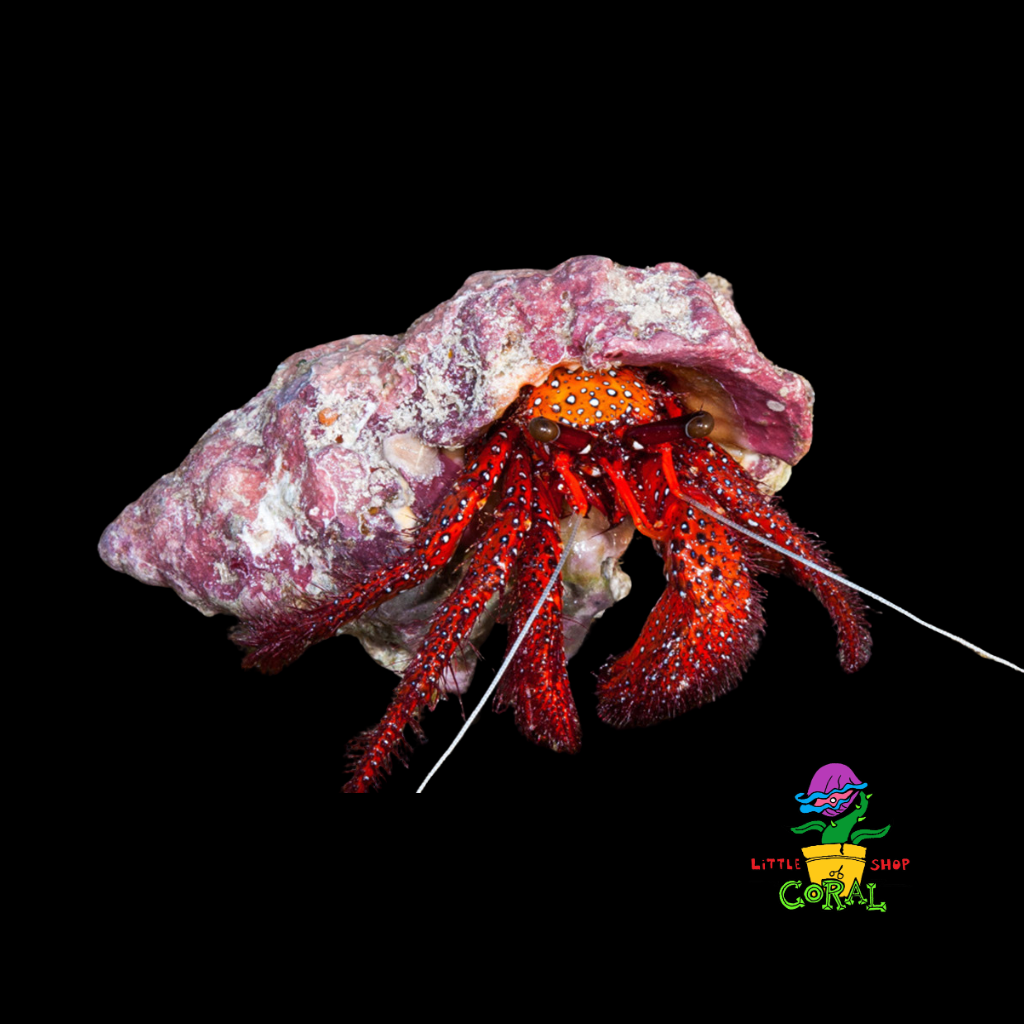
The Hairy Hermit Crab is one of the most visually striking and characterful invertebrates in the marine hobby. Its bold red body is covered in fine hairs and decorated with white spots outlined in black, while its eyestalks are a vivid yellow, making it look like something out of a fantasy reef rather than a real aquarium. One of its claws is typically noticeably larger than the other, adding to its distinctive, lopsided charm. Known under several common names including the White-spotted Hermit Crab, Strawberry Hermit Crab, and Shell-Breaking Reef Hermit, D. megistos is a fascinating and rewarding animal for the right system, but it demands full honesty: this is a large, predatory species that is not reef safe and requires a thoughtfully planned setup to thrive and coexist peacefully.
Why we love it
- Genuinely stunning colouration with vivid red, white-spotted hairy legs and yellow eyestalks
- Known to carry sea anemones on its shell in the wild, forming a fascinating symbiotic relationship that adds extra visual drama
- Bold, active, and highly entertaining to observe as it scavenges and patrols the tank
- Hardy and adaptable, one of the easier large invertebrates to keep once properly set up
- A true conversation piece that nothing else in the hobby quite matches
Suggested parameters
- Temperature: 24 to 26°C (75 to 79°F)
- Salinity: 1.025 to 1.026 SG
- pH: 8.1 to 8.4
- Alkalinity: 8 to 10 dKH
- Calcium: 400 to 450 ppm
- Magnesium: 1250 to 1400 ppm
- Nitrate: Under 20 ppm; stable water quality is important for long-term health
- Copper-based medications are toxic to all crustaceans and must never be used
Care and temperament
- Difficulty: Easy to moderate
- Temperament: Semi-aggressive; predatory toward smaller invertebrates, snails, tubeworms, mollusks, and potentially slow-moving or small fish as it grows
- Reef safe: No (will consume soft corals, small invertebrates, mollusks, and tubeworms; not suitable for reef systems)
- Minimum tank size: 75 gallons; larger is strongly preferred given its growth potential
- Ample secure rockwork and a thick sandy substrate are essential to mimic its natural habitat and provide shelter
- Keep one per aquarium; this species is aggressive toward other hermit crabs
- A collection of empty shells in graduated sizes must always be available; this species grows quickly and a hermit crab without a suitable shell to move into is a stressed and vulnerable animal
Diet
D. megistos is an omnivore in feeding habit, consuming algae, detritus, mollusks, tubeworms, and meaty seafood. In the aquarium it functions primarily as a carnivorous scavenger.
- Frozen meaty foods including mysis, krill, chopped shrimp, clam, mussel, and squid
- Quality sinking carnivore pellets
- Will scavenge leftover fish food and detritus from the substrate
- A varied protein-rich diet supports optimal health and the rich colouration this species is known for
- Feed every one to two days; this species is an opportunistic feeder rather than a constant grazier
Compatibility and tankmates
- Best suited to large fish-only or FOWLR systems with robust, larger fish
- Best housed with larger, peaceful fish that can coexist without feeling threatened; avoid small or slow-moving fish that may be targeted as it grows
- Not compatible with smaller hermit crabs, snails, shrimp, or most ornamental invertebrates
- Avoid aggressive species such as large triggers or puffers that may target the crab between shell changes
- Keep one per system; multiple individuals will fight
Health and acclimation notes
Dardanus megistos is hardy and generally adapts well to aquarium life given stable parameters and a secure, well-furnished environment. The single most important ongoing care requirement is maintaining a selection of empty shells in appropriate sizes at all times. This species can grow quickly, and a hermit crab forced to stay in a too-small shell or, worse, left without a shell during molting, is dangerously vulnerable. Like all crustaceans, it benefits from regular water changes to maintain mineral levels that support a healthy, hard exoskeleton. Drip acclimation is recommended before introduction, and the tank should be fully cycled and stable before adding this animal.
What you are buying
- You will receive: 1 Hairy Hermit Crab (Dardanus megistos)
- Colouration is red with white-spotted, hairy legs outlined in black and vivid yellow eyestalks; one claw is typically larger than the other
- Size can vary between individuals
Drip acclimation is recommended. A selection of progressively larger empty shells must be maintained in the system at all times. Copper-based medications must never be used in any system housing this animal.
Collapsible content
LIGHT
LOW: Place coral at the bottom of the tank. Depending on the type, coral may need to be placed off sand and therefore mounted on a ceramic disc of piece of rock.
MEDIUM: Place coral at mid-range of the tank. Best placed/glued on top of a rock scape at mid-range height.
HIGH: Place coral from mid range to just below water level. SPS coral are shallow growing so they require and are able to tolerate intense light.
FLOW
LOW: Most soft coral do well with a small, gentle pulse. There are certain corals that can even be placed in areas of indirect flow, meaning places aside a rock structure or set into a entrance to a cave style space.
MEDIUM: Many LPS types of coral prefer medium pulse current. Most Euphyllia or corals that have more tissue structure connected to their skeleton, don’t like to be in a high flow area like the direct flow of the wave pump.
HIGH: Similar to high light, SPS enjoy being in some heavy current. Most LPS and SPS that branch encrust or plate prefer high flow that simulates the top water waves.
SKILL
ENTRY: While some may say beginner level, "Entry" is a good term to be used when starting out in the world of corals and marine life. Prior to adding livestock, you want to ensure that your reef has the proper parameters including zero levels of ammonia and nitrite. Seeing traces of nitrate in your waters is a good sign - just keep them at a lower level of 2ppm to 10ppm. Maintaining correct temperature and salinity are a huge factor to stable parameters. Starting to monitor your PH, alkalinity, calcium and magnesium is a great habit to get into to keep a successful reef.
While some soft coral don’t require too much light, having a proper reef light that puts out the proper pars is very important. You'll also want to have a good amount of flow and protected rock areas, as placing corals in their happy spot is ideal for success.
ADVANCED: