

Little Shop of Coral
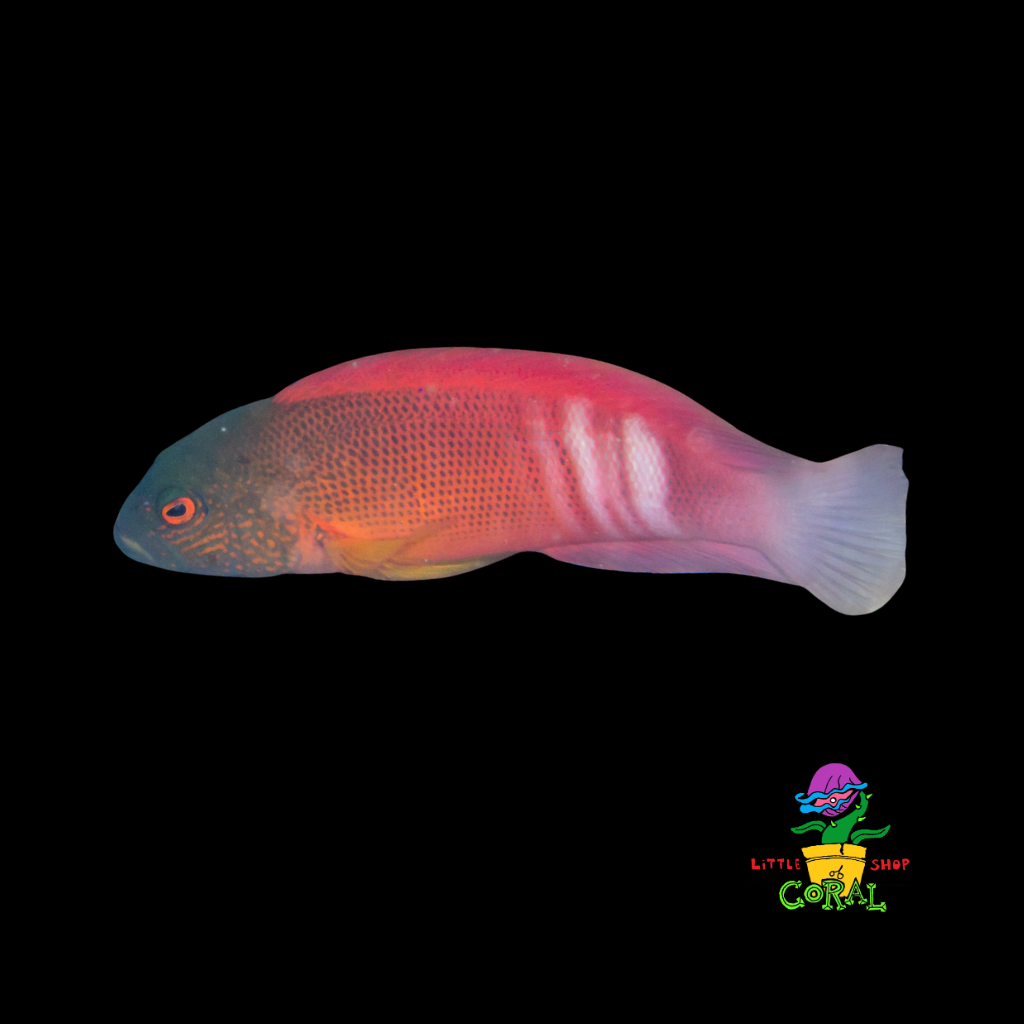
Firetail Dottyback (Labracinus cyclophthalmus)
Firetail Dottyback (Labracinus cyclophthalmus)
Couldn't load pickup availability
The Firetail Dottyback, also known as the Fire-tail Devil, Red Dottyback, or Dampiera Dottyback, is not a fish for the faint-hearted, and that is precisely why serious hobbyists love it. One of the largest dottybacks available in the trade, Labracinus cyclophthalmus wears its reputation honestly: a deep, rich reddish-brown body marked with fine longitudinal scale lines, a bold red eye, and the species' most dramatic feature, a vivid flame-red tail that blazes in contrast to the darker body and earns every part of its common name. Blue fin edging adds a final refined touch that rewards close inspection under reef lighting. Rarely seen and rarely stocked, this is an uncommon fish that attracts immediate attention both for its striking appearance and its formidable personality. It is best suited to experienced keepers running large, robust systems where its aggression can be managed through careful stocking rather than contained.
Why we love it
- One of the most visually dramatic dottybacks available, with deep reddish-brown body colouring, a vivid red eye, and the distinctive flame-red tail that gives the species its name
- An uncommon fish in the trade that turns heads immediately and generates genuine interest from anyone who sees it
- Hardy, robust, and unfussy about food once settled; one of the easier large dottybacks to maintain in a well-matched system
- An ambush predator with the instincts and attitude of a fish twice its size, making it a fascinating and behaviorally engaging display animal
- Despite its reputation, can be kept successfully in large FOWLR or robust reef systems when tankmates are chosen carefully and sized appropriately
Suggested parameters
- Temperature: 22–26°C (72–78°F)
- Salinity: 1.020–1.025 SG
- pH: 8.1–8.4
- Alkalinity: 8–12 dKH
- Ammonia/Nitrite: 0
- Nitrate: Under 20 ppm; stable conditions support long-term health and reduce stress-driven aggression
Care and temperament
- Difficulty: Moderate
- Temperament: Aggressive. This is one of the most assertive dottybacks available and will actively harass, injure, or kill smaller or more passive fish. Despite this, it can be notably shy and cave-dwelling in its own right, particularly when first introduced
- Reef safe: With caution. Corals are generally left alone. Ornamental shrimp, small crabs, and small fish are at serious risk of predation. Larger, robust invertebrates are typically safe
- Minimum tank size: 75 gallons, with an abundance of caves, overhangs, and crevices to allow the fish to establish a territory and retreat when not actively hunting
Diet
The Firetail Dottyback is a dedicated carnivore and a confident, eager feeder once settled.
- Frozen mysis shrimp and vitamin-enriched brine shrimp as the foundation
- Chopped marine meats including clam, squid, krill, and crustacean flesh
- High-quality carnivore pellets accepted readily by most individuals
- Will hunt and consume polychaete worms, small crabs, and any small fish or crustacean it can overpower within the tank
- Feed once to twice daily; this species is a bold, assertive feeder and will not be outcompeted at the surface once established
Compatibility and tankmates
- Suitable only for systems housing large, robust, assertive fish that are not easily bullied: large angelfish, tangs, squirrelfish, groupers, triggers, eels, rabbitfish, and similarly sized or larger species are the appropriate companions
- Will attack, harass, and potentially kill smaller, passive, or timid fish without hesitation; never house with firefish, dartfish, small gobies, basslets, small wrasses, or any fish that cannot defend itself or escape effectively
- Only one Firetail Dottyback per system; conspecific aggression is intense and will almost certainly result in the death of one fish
- Not suitable for reef tanks housing ornamental shrimp, small crabs, or any crustacean small enough to be considered prey
- Can coexist with large, assertive fish that hold their own, particularly when the Firetail is introduced last into an already-established community
Health and acclimation notes
Despite its aggressive reputation, the Firetail Dottyback is genuinely shy when newly introduced and will spend its first days, and sometimes weeks, deep inside rockwork, emerging only to feed. This is completely normal behaviour and should not be mistaken for illness. An aquascape with multiple cave systems, overhangs, and connected crevices is important both for the fish's comfort during settling and for its long-term confidence and wellbeing. This species is a protogynous hermaphrodite: all individuals begin as females, with the dominant fish in a social group transitioning to male. It is hardy and disease-resistant once established, tolerating the kind of minor parameter fluctuations that stress more delicate species. Quarantine before introduction to an established display is always recommended. A tight-fitting lid is essential, as this species is capable of jumping.
What you are buying
- You will receive: 1 Firetail Dottyback (Labracinus cyclophthalmus)
- Colouring can vary considerably between individuals and by region of origin; body tone ranges from deep reddish-brown to darker burgundy, with the flame-red tail and red eye consistent across all specimens
- Blue fin edging intensity varies between individuals and may become more pronounced as the fish settles and feeds well
- This is an infrequently available species; size and exact patterning at time of sale may vary
Collapsible content
LIGHT
LOW: Place coral at the bottom of the tank. Depending on the type, coral may need to be placed off sand and therefore mounted on a ceramic disc of piece of rock.
MEDIUM: Place coral at mid-range of the tank. Best placed/glued on top of a rock scape at mid-range height.
HIGH: Place coral from mid range to just below water level. SPS coral are shallow growing so they require and are able to tolerate intense light.
FLOW
LOW: Most soft coral do well with a small, gentle pulse. There are certain corals that can even be placed in areas of indirect flow, meaning places aside a rock structure or set into a entrance to a cave style space.
MEDIUM: Many LPS types of coral prefer medium pulse current. Most Euphyllia or corals that have more tissue structure connected to their skeleton, don’t like to be in a high flow area like the direct flow of the wave pump.
HIGH: Similar to high light, SPS enjoy being in some heavy current. Most LPS and SPS that branch encrust or plate prefer high flow that simulates the top water waves.
SKILL
ENTRY: While some may say beginner level, "Entry" is a good term to be used when starting out in the world of corals and marine life. Prior to adding livestock, you want to ensure that your reef has the proper parameters including zero levels of ammonia and nitrite. Seeing traces of nitrate in your waters is a good sign - just keep them at a lower level of 2ppm to 10ppm. Maintaining correct temperature and salinity are a huge factor to stable parameters. Starting to monitor your PH, alkalinity, calcium and magnesium is a great habit to get into to keep a successful reef.
While some soft coral don’t require too much light, having a proper reef light that puts out the proper pars is very important. You'll also want to have a good amount of flow and protected rock areas, as placing corals in their happy spot is ideal for success.
ADVANCED: