
Little Shop of Coral
Eibli Angel (Centropyge eibli)
Eibli Angel (Centropyge eibli)
Couldn't load pickup availability
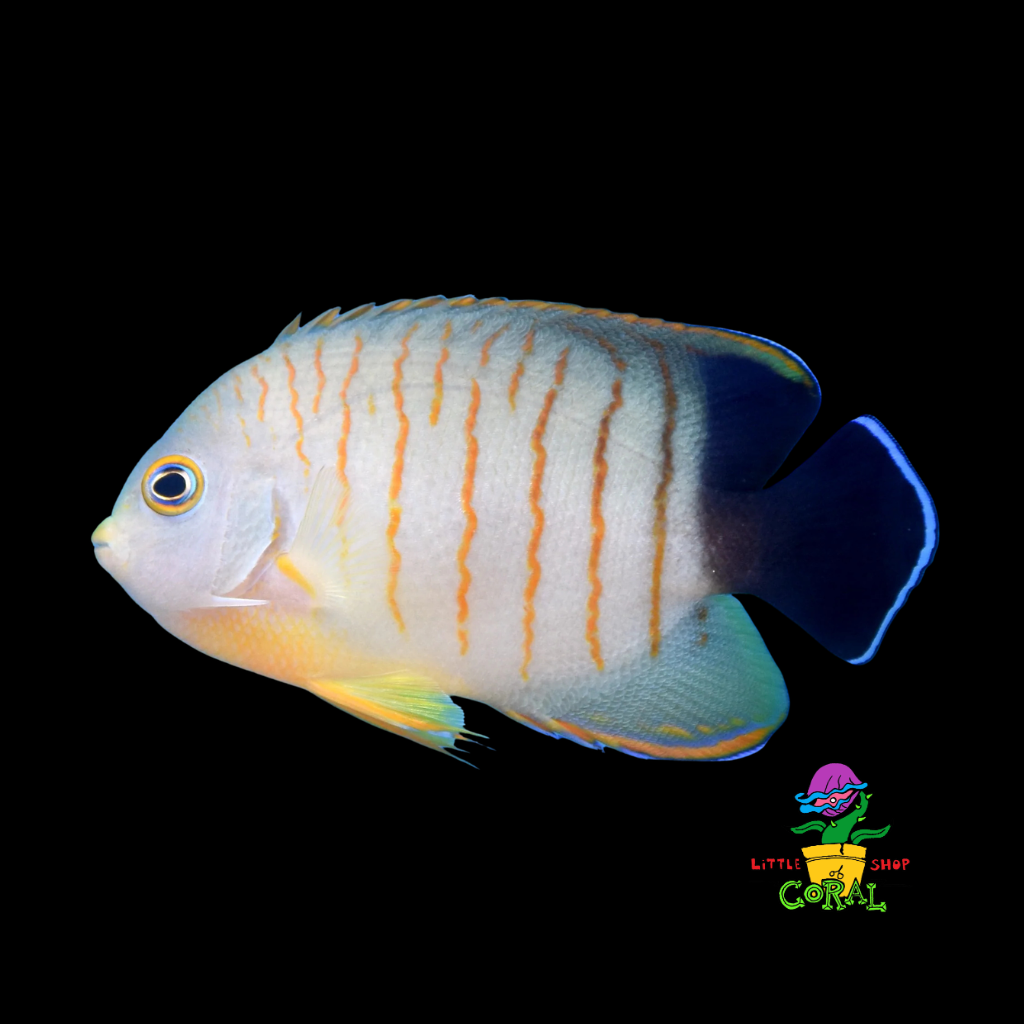
The Eibli Angelfish is one of the most elegantly patterned dwarf angels in the hobby, and one that tends to fly somewhat under the radar compared to more commonly kept Centropyge species. Its pearlescent silver-white body is highlighted with several evenly-spaced vertical orange to red stripes, the very back of the body and caudal fin are deep black, and a brilliant sapphire-blue stripe outlines the caudal fin edge, producing a combination of colours that is genuinely unique in the genus. Also known as the Red Stripe Angelfish, Blacktail Angelfish, Orangelined Angelfish, and Eibl's Pygmy Angelfish, this is a hardy and relatively forgiving dwarf angel that rewards experienced hobbyists with strong, enduring colour and a bold, curious personality.
Why we love it
- Striking and distinctive colour pattern unlike any other dwarf angel in the trade; the striped body with jet black tail and blue-edged caudal fin is immediately eye-catching
- Hardy and adaptable, with an inquisitive personality; specimens that settle well often become bold and regularly patrol the open rockwork
- Active grazer that spends much of the day working over live rock, adding constant natural movement to the display
- Can be kept with ornamental shrimp, crabs, and most invertebrates without issue, unlike many larger angelfish species
- One of the more forgiving dwarf angels for an experienced reef keeper willing to manage its coral compatibility carefully
Suggested parameters
- Temperature: 24 to 26°C (75 to 79°F)
- Salinity: 1.025 to 1.026 SG
- pH: 8.1 to 8.4
- Alkalinity: 8 to 10 dKH
- Calcium: 400 to 450 ppm
- Magnesium: 1250 to 1400 ppm
- Nitrate: 5 to 20 ppm
- Phosphate: 0.03 to 0.12 ppm
- Excellent water quality is non-negotiable for long-term health with this species
Care and temperament
- Difficulty: Moderate
- Temperament: Semi-aggressive; tends to be docile initially but can become more assertive once established; will fight with other dwarf angelfish in the home aquarium and should not be housed with other Centropyge species unless the system is 350 litres or larger and both are introduced simultaneously
- Reef safe: With caution; more likely to nip at corals and clam mantles than species such as the Coral Beauty or Flame Angel; LPS corals and large polyp stony corals are at the greatest risk; well-fed individuals in systems with ample live rock for grazing tend to show far less nipping behaviour
- Minimum tank size: 265 litres (70 gallons) with extensive live rock
- This species spends most of its time swimming in and out of rockwork, picking at marine algae, sponges, and small organisms; a rich, well-established aquascape provides both food and security
Diet
The Eibli Angel is an omnivore with a strong herbivorous component to its diet, and feeding variety is the most important factor in long-term health and colour.
- Spirulina-based frozen foods and algae-enriched preparations (staple)
- Marine algae and nori on a clip or tucked under rockwork to encourage natural grazing behaviour
- Frozen mysis shrimp and enriched brine shrimp for meaty nutrition
- Quality angelfish blend frozen foods
- High-quality marine pellets formulated for omnivores once accepted
- Two to three small feedings per day rather than one large meal; consistent access to algae between feedings is ideal, so having natural algae growth on live rock is strongly beneficial
- A well-fed Eibli is a better-behaved Eibli; consistent feeding significantly reduces the likelihood of coral nipping
Compatibility and tankmates
- Good with tangs, clownfish, wrasses, dartfish, blennies, gobies, and most peaceful to moderately assertive reef fish
- Should not be housed with other pygmy angelfish unless in a very large system; if keeping multiple Centropyge, introduce all individuals simultaneously
- Avoid large aggressive species such as triggers and dominant angelfish that may bully this fish out of its territory
- Compatible with ornamental shrimp, hermit crabs, and most reef invertebrates; clam mantles and large-polyp corals should be monitored
- Keep one per system unless a confirmed male-female pair in a larger aquarium
Health and acclimation notes
The Eibli Angel is one of the more robust dwarf angelfish available, but it still benefits from a well-established, stable system and a varied diet from the outset. Initial feeding can be slightly challenging; offering mysis shrimp is usually successful quickly, while acceptance of algae-based foods sometimes takes a little longer; placing dried seaweed under a small piece of rock rather than on a clip can encourage reluctant grazers to begin accepting it. Quarantine before introduction to a display is always a good practice, particularly in sensitive reef systems. This species is susceptible to common marine parasites and benefits from the stable parameters and low-stress environment of a mature, well-run tank.
What you are buying
- You will receive: 1 Eibli Angel (Centropyge eibli)
- There are no reliable external distinguishing characteristics between males and females in this species
- Colour intensity and stripe definition can vary slightly between individuals; the jet black tail and blue caudal edging are consistent identifying features
Slow acclimation is recommended. Quarantine before introduction to your display is encouraged, and a tight-fitting lid is advised.
Collapsible content
LIGHT
LOW: Place coral at the bottom of the tank. Depending on the type, coral may need to be placed off sand and therefore mounted on a ceramic disc of piece of rock.
MEDIUM: Place coral at mid-range of the tank. Best placed/glued on top of a rock scape at mid-range height.
HIGH: Place coral from mid range to just below water level. SPS coral are shallow growing so they require and are able to tolerate intense light.
FLOW
LOW: Most soft coral do well with a small, gentle pulse. There are certain corals that can even be placed in areas of indirect flow, meaning places aside a rock structure or set into a entrance to a cave style space.
MEDIUM: Many LPS types of coral prefer medium pulse current. Most Euphyllia or corals that have more tissue structure connected to their skeleton, don’t like to be in a high flow area like the direct flow of the wave pump.
HIGH: Similar to high light, SPS enjoy being in some heavy current. Most LPS and SPS that branch encrust or plate prefer high flow that simulates the top water waves.
SKILL
ENTRY: While some may say beginner level, "Entry" is a good term to be used when starting out in the world of corals and marine life. Prior to adding livestock, you want to ensure that your reef has the proper parameters including zero levels of ammonia and nitrite. Seeing traces of nitrate in your waters is a good sign - just keep them at a lower level of 2ppm to 10ppm. Maintaining correct temperature and salinity are a huge factor to stable parameters. Starting to monitor your PH, alkalinity, calcium and magnesium is a great habit to get into to keep a successful reef.
While some soft coral don’t require too much light, having a proper reef light that puts out the proper pars is very important. You'll also want to have a good amount of flow and protected rock areas, as placing corals in their happy spot is ideal for success.
ADVANCED: