

Little Shop of Coral
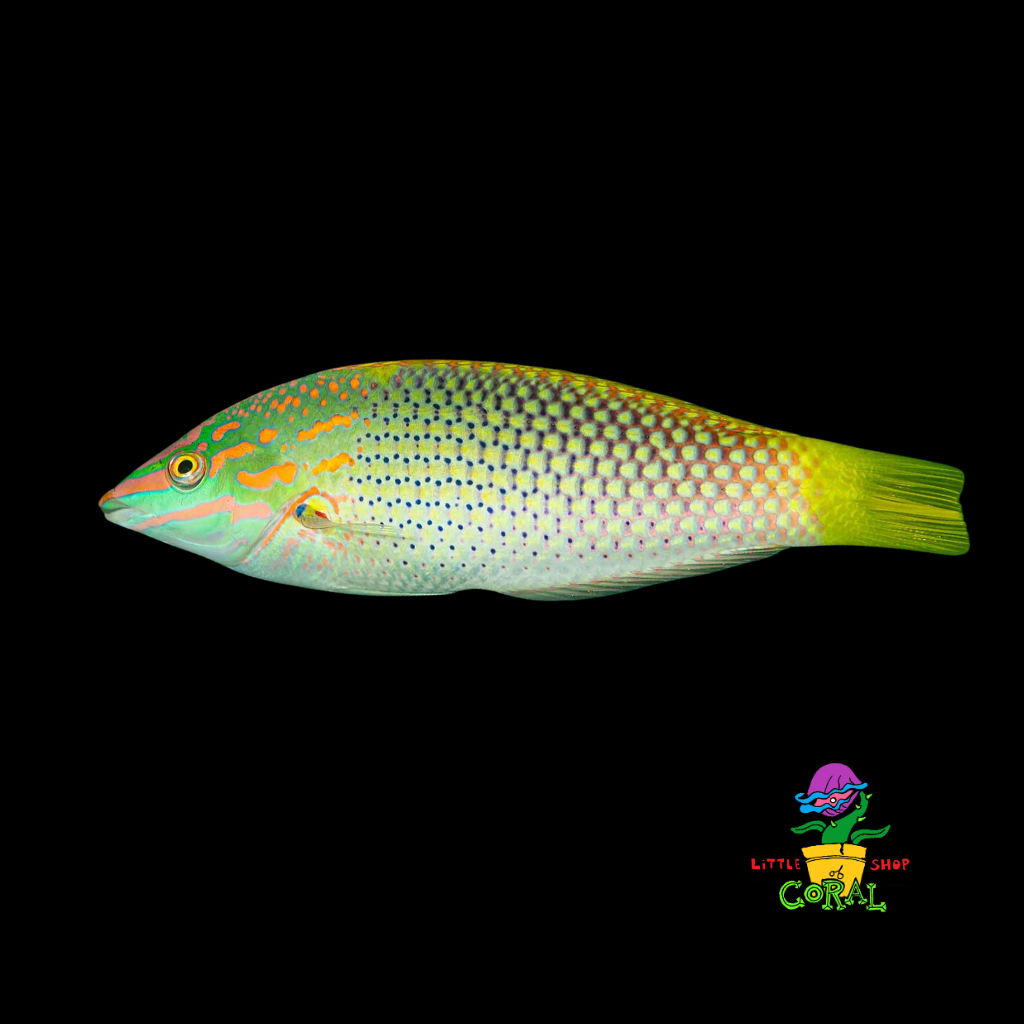
Checkerboard Wrasse (Halichoeres hortulanus)
Checkerboard Wrasse (Halichoeres hortulanus)
Couldn't load pickup availability
The Checkerboard Wrasse is one of the most visually striking members of a genus full of outstanding fish. Adult males carry a silvery white body overlaid with a bold black checkerboard pattern, a light green face with orange to pink striped markings, and a vivid yellow dorsal fin and tail, while the eyes shift from yellow to a brilliant red depending on the individual. But beyond its looks, this wrasse earns serious points for utility. The Checkerboard Wrasse is sought after for its incredible natural ability to control and eliminate nuisance red planaria flatworms and pyramidellid snails that sometimes hitchhike on corals or live rock, making it one of the most practically useful additions to any established reef system. Active, hardy, and full of personality, this is a wrasse that works as hard as it looks good.
Why we love it
- Stunning adult colouration with bold checkerboard patterning, green face, and yellow fins
- Natural flatworm and pyramidellid snail predator that provides genuine pest control in reef systems
- Also known to actively hunt and consume nuisance pyramid snails and planaria flatworms
- Hardy, adaptable, and an eager feeder once settled
- Fascinating life history with dramatic colour and pattern changes from juvenile to adult
Suggested parameters
- Temperature: 24 to 26°C (75 to 79°F)
- Salinity: 1.025 to 1.026 SG
- pH: 8.1 to 8.4
- Alkalinity: 8 to 10 dKH
- Calcium: 400 to 450 ppm
- Magnesium: 1250 to 1400 ppm
- Nitrate: 5 to 20 ppm
- Phosphate: 0.03 to 0.12 ppm
Care and temperament
- Difficulty: Easy to moderate
- Temperament: Peaceful toward most fish; can be territorial toward conspecifics and similar-looking wrasses in smaller systems
- Reef safe: With caution (will consume snails, tubeworms, small crustaceans, sea stars, and urchins; as it grows into adulthood it may also target smaller fish by bashing them against hard surfaces before consuming; ornamental shrimp and small decorative inverts are at risk)
- Minimum tank size: 90 to 100 gallons
- Requires a minimum 3 inch sandbed; newly introduced wrasses will often dive straight into the substrate upon release and will use it nightly for sleep and as a refuge when startled
- A fine sand bed of 0.5 to 2.0 mm grain size at least 4 inches deep is ideal, along with rocky crevices for hunting and open swimming areas
- A tight-fitting lid is essential; this species will jump
Diet
The Checkerboard Wrasse is a dedicated carnivore and active hunter throughout the day.
- Frozen mysis shrimp (staple)
- Frozen brine shrimp and enriched artemia
- Mixed meaty frozen foods including small crustacean blends
- Quality carnivore pellets once trained
- Soaking frozen foods in vitamin and fatty acid supplements is encouraged, as these wrasses have very high metabolisms
- Small pieces of rock placed in the aquarium give the wrasse objects to interact with and investigate during its daily hunt
- Multiple small feedings per day; this species grazes actively throughout the daylight hours
Compatibility and tankmates
- Good with clownfish, tangs, angelfish, gobies, dartfish, and most medium to large peaceful reef community fish
- Compatible with other peaceful wrasses including different Halichoeres species; best to introduce all wrasses simultaneously for the smoothest outcome
- Keep one male per system; a harem of one male and a couple of females can cohabitate well if introduced at the same time
- Caution is advised with small ornamental crustaceans, feather dusters, and very small fish as these may be hunted
- Avoid housing with very small fish such as neon gobies or small dartfish that may be mistaken for prey as the wrasse grows
Health and acclimation notes
The Checkerboard Wrasse is one of the hardier Halichoeres species and settles into aquarium life readily given the right setup. The sandbed is non-negotiable; without sufficient substrate depth this wrasse cannot sleep or take refuge properly, and stress levels will be chronically elevated. It is very common for a newly introduced wrasse to immediately bury itself upon release; this is completely normal and the fish will typically emerge and begin exploring within hours to a day or two. Care should be taken when sourcing this species to ensure it was not injured around the mouth during transport, as mouth injuries are a common issue with wrasses.
What you are buying
- You will receive: 1 Checkerboard Wrasse (Halichoeres hortulanus)
- Juveniles have a predominantly white body mottled in brown; the namesake checkerboard pattern develops clearly with maturity
- Colour and pattern vary depending on age, collection area, and breeding condition
A tight-fitting lid is essential, as this species will jump. Slow acclimation is recommended and a deep sandbed must be in place before introduction.
Collapsible content
LIGHT
LOW: Place coral at the bottom of the tank. Depending on the type, coral may need to be placed off sand and therefore mounted on a ceramic disc of piece of rock.
MEDIUM: Place coral at mid-range of the tank. Best placed/glued on top of a rock scape at mid-range height.
HIGH: Place coral from mid range to just below water level. SPS coral are shallow growing so they require and are able to tolerate intense light.
FLOW
LOW: Most soft coral do well with a small, gentle pulse. There are certain corals that can even be placed in areas of indirect flow, meaning places aside a rock structure or set into a entrance to a cave style space.
MEDIUM: Many LPS types of coral prefer medium pulse current. Most Euphyllia or corals that have more tissue structure connected to their skeleton, don’t like to be in a high flow area like the direct flow of the wave pump.
HIGH: Similar to high light, SPS enjoy being in some heavy current. Most LPS and SPS that branch encrust or plate prefer high flow that simulates the top water waves.
SKILL
ENTRY: While some may say beginner level, "Entry" is a good term to be used when starting out in the world of corals and marine life. Prior to adding livestock, you want to ensure that your reef has the proper parameters including zero levels of ammonia and nitrite. Seeing traces of nitrate in your waters is a good sign - just keep them at a lower level of 2ppm to 10ppm. Maintaining correct temperature and salinity are a huge factor to stable parameters. Starting to monitor your PH, alkalinity, calcium and magnesium is a great habit to get into to keep a successful reef.
While some soft coral don’t require too much light, having a proper reef light that puts out the proper pars is very important. You'll also want to have a good amount of flow and protected rock areas, as placing corals in their happy spot is ideal for success.
ADVANCED: