
Little Shop of Coral
Blue Eye Hermit Crab (Calcinus laevimanus)
Blue Eye Hermit Crab (Calcinus laevimanus)
Couldn't load pickup availability
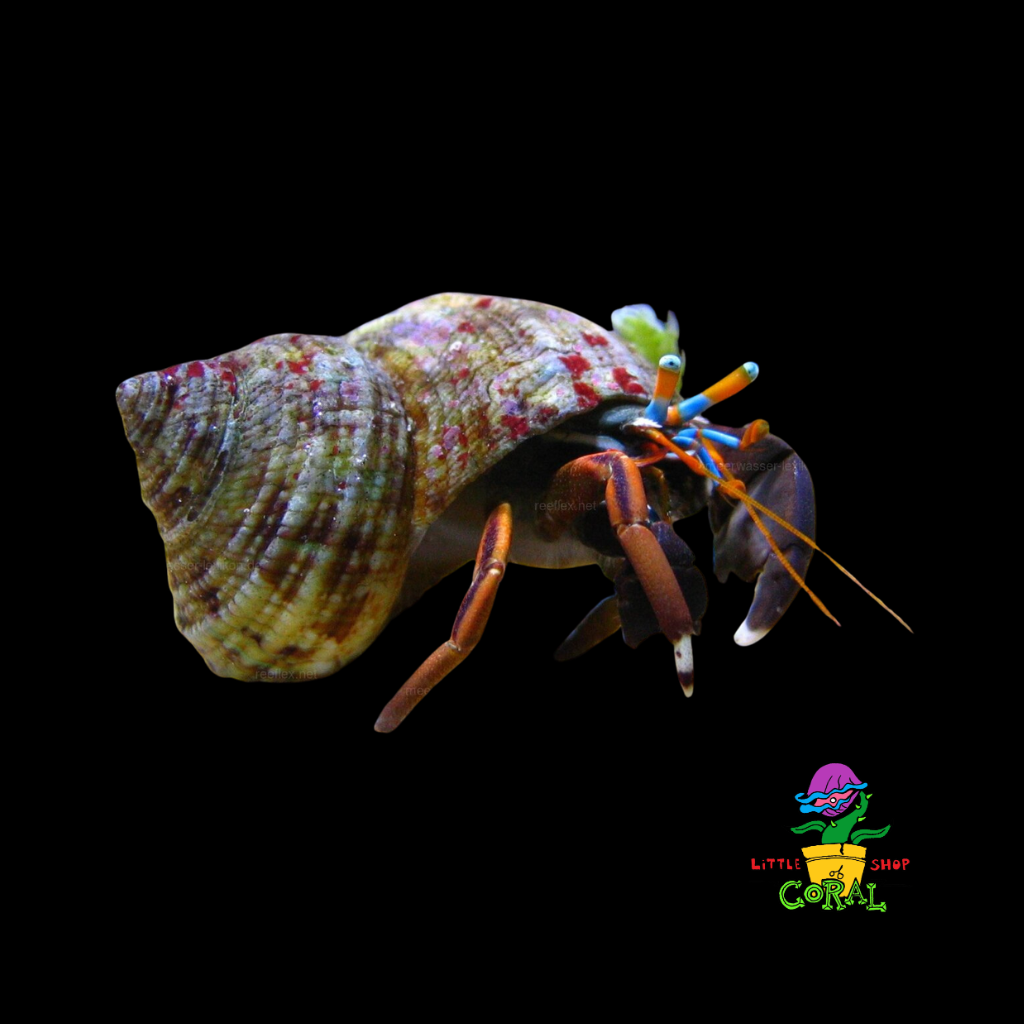
The Blue Eye Hermit Crab is one of the most attractive and useful small hermit crabs available for the reef aquarium. Its otherwise dark legs are dressed in white or orange bands, and its long eyestalks are a brilliant blue that fades into an orange-tinged upper half, giving this little crab a colour combination that punches well above its size. Also known as the Dwarf Zebra Hermit Crab, the Hawaiian Reef Hermit, and the Left-Handed Hermit Crab, this species has an enlarged left claw that it uses to block the entrance to its shell when threatened by a predator, a clever built-in defence mechanism that makes it hardier and more self-sufficient than many other small reef hermits. What it lacks in size it more than makes up for in cleaning performance and reef compatibility.
Why we love it
- Brilliant blue and orange eyestalks with boldly banded black and white legs make this one of the most visually striking small hermits in the hobby
- Consumes hair algae, film algae, detritus, uneaten fish food, and cyanobacteria, covering a broad range of common reef nuisances
- Fully reef safe and peaceful with corals, fish, and most ornamental invertebrates
- Small adult size makes it an excellent addition to nano aquariums as well as larger systems
- Hardy, active, and endlessly entertaining to watch as it explores the rockwork
Suggested parameters
- Temperature: 24 to 26°C (75 to 79°F)
- Salinity: 1.025 to 1.026 SG
- pH: 8.1 to 8.4
- Alkalinity: 8 to 10 dKH
- Calcium: 400 to 450 ppm
- Magnesium: 1250 to 1400 ppm
- Nitrate: 5 to 20 ppm
- Phosphate: 0.03 to 0.12 ppm
- Copper-based medications are toxic to all invertebrates and must never be used
Care and temperament
- Difficulty: Easy
- Temperament: Peaceful toward fish, corals, and most invertebrates; all hermit crabs are capable of killing snails for their shells, and this is something to be mindful of when stocking your cleanup crew
- Reef safe: Yes, fully compatible with corals and sensitive invertebrates
- Minimum tank size: 20 gallons; suitable for nano systems
- Best added to mature, well-established aquariums where a plentiful source of marine algae is already present
- Active among rocks and rubble, constantly exploring in search of organic matter
- A selection of empty shells in graduated sizes must always be available so this crab can move up as it grows
Diet
The Blue Eye Hermit Crab is primarily herbivorous with scavenging tendencies that make it a versatile and effective cleanup crew member.
- Grazes naturally on algae, biofilm, and cyanobacteria growing on rockwork and substrate throughout the day
- Scavenges detritus and uneaten fish food from the sandbed and rock surfaces
- If there is insufficient algae present in the aquarium, supplement with dried seaweed or nori to prevent starvation
- Will also accept quality sinking pellets and algae-based prepared foods as supplemental feeding
- No target feeding necessary in most established reef systems with healthy algae growth
Compatibility and tankmates
- Excellent with all reef fish, corals, and most ornamental invertebrates
- Avoid housing with larger crabs, aggressive hermit crabs, or fish with powerful jaws that might attack it or target its shell
- Can be kept in groups; multiple individuals work well together in a reef system provided sufficient space and food are available
- Avoid triggerfish, pufferfish, and large aggressive wrasses that may target small invertebrates
- Keep an eye on snail populations; provide plenty of empty shells to reduce the likelihood of snail predation
Health and acclimation notes
The Blue Eye Hermit Crab is a hardy, low-maintenance species that settles into reef systems quickly and gets to work almost immediately. Drip acclimation is recommended, as with all invertebrates, to avoid osmotic shock from rapid salinity changes. The most important ongoing care requirement is maintaining a supply of appropriately sized empty shells at all times. A hermit crab left without a suitable shell to move into during growth is a stressed and vulnerable animal. Regular water changes help maintain the mineral levels that support healthy exoskeleton development, and copper-based medications must never be used in any system housing this or any other invertebrate.
What you are buying
- You will receive: 1 Blue Eye Hermit Crab (Calcinus laevimanus)
- Shell colour and leg banding can vary slightly between individuals; the brilliant blue lower eyestalk and enlarged left claw are the key identifying features of this species
Drip acclimation is recommended. Empty shells in graduated sizes must be maintained in the system. Copper-based medications must never be used in any system housing this animal.
Collapsible content
LIGHT
LOW: Place coral at the bottom of the tank. Depending on the type, coral may need to be placed off sand and therefore mounted on a ceramic disc of piece of rock.
MEDIUM: Place coral at mid-range of the tank. Best placed/glued on top of a rock scape at mid-range height.
HIGH: Place coral from mid range to just below water level. SPS coral are shallow growing so they require and are able to tolerate intense light.
FLOW
LOW: Most soft coral do well with a small, gentle pulse. There are certain corals that can even be placed in areas of indirect flow, meaning places aside a rock structure or set into a entrance to a cave style space.
MEDIUM: Many LPS types of coral prefer medium pulse current. Most Euphyllia or corals that have more tissue structure connected to their skeleton, don’t like to be in a high flow area like the direct flow of the wave pump.
HIGH: Similar to high light, SPS enjoy being in some heavy current. Most LPS and SPS that branch encrust or plate prefer high flow that simulates the top water waves.
SKILL
ENTRY: While some may say beginner level, "Entry" is a good term to be used when starting out in the world of corals and marine life. Prior to adding livestock, you want to ensure that your reef has the proper parameters including zero levels of ammonia and nitrite. Seeing traces of nitrate in your waters is a good sign - just keep them at a lower level of 2ppm to 10ppm. Maintaining correct temperature and salinity are a huge factor to stable parameters. Starting to monitor your PH, alkalinity, calcium and magnesium is a great habit to get into to keep a successful reef.
While some soft coral don’t require too much light, having a proper reef light that puts out the proper pars is very important. You'll also want to have a good amount of flow and protected rock areas, as placing corals in their happy spot is ideal for success.
ADVANCED: