
Little Shop of Coral
Black Pencil Urchin (Eucidaris tribuloides)
Black Pencil Urchin (Eucidaris tribuloides)
Couldn't load pickup availability
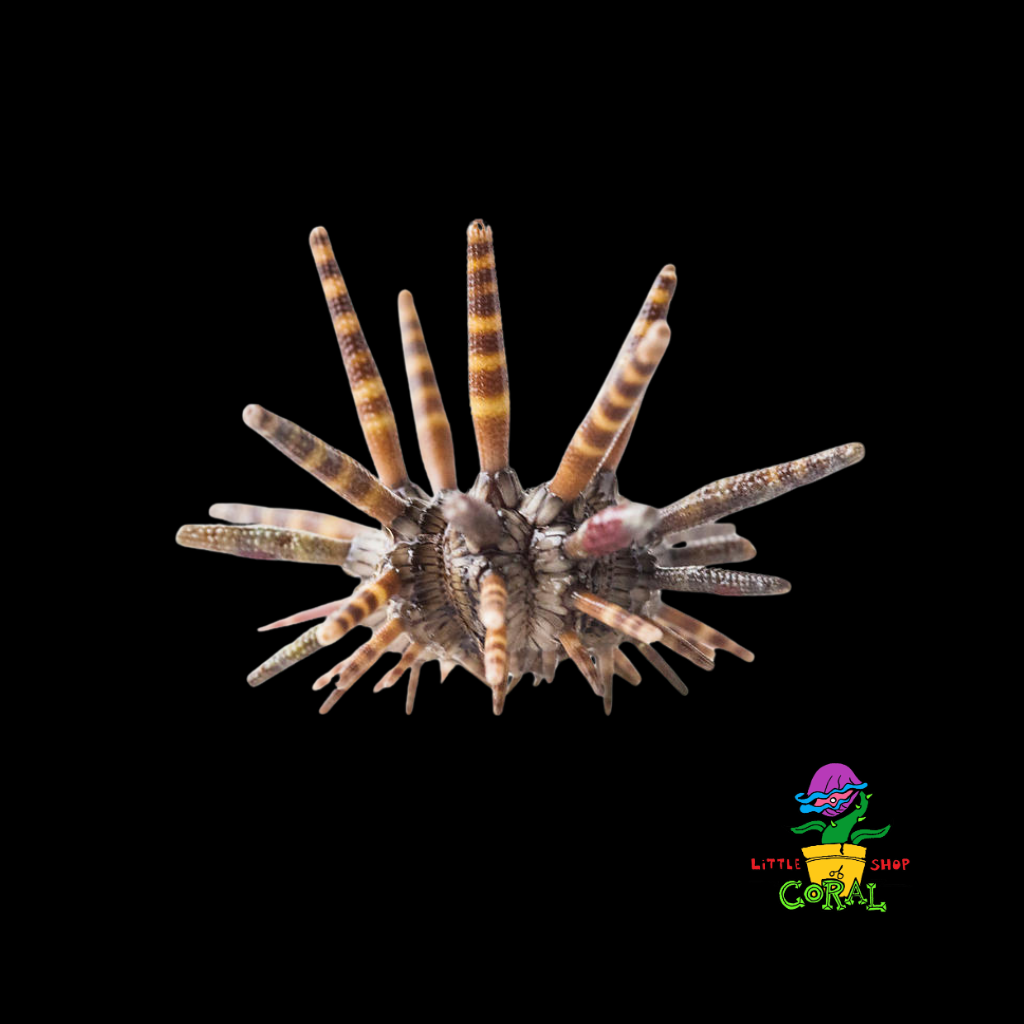
The Pencil Urchin is one of the most distinctive and prehistoric-looking invertebrates available in the marine hobby. Its brown to tan, sometimes mottled body is ringed by thick, blunt, stubby spines radiating outward in all directions, giving it a silhouette unlike any other urchin in the trade. Also known as the Mine Urchin and Slate Pencil Urchin, it is common for the spines of the Pencil Urchin to become encrusted with coralline algae, bryozoans, and sponges over time as this species remains stationary for most of the daylight hours, turning each individual into a living, growing piece of the aquascape. It is a hardy, characterful, and genuinely fascinating animal, but it comes with important caveats around reef compatibility that require full transparency before purchase. This is not the right urchin for every system, and choosing it for the right setup makes all the difference.
Why we love it
- One of the most visually distinctive urchin species available; the thick, crayon-like spine silhouette is immediately recognizable and unlike anything else in the cleanup crew
- Particularly effective against overgrown coralline algae on glass, overflows, and equipment; one of the only animals that will actively consume and control coralline growth in areas where it has become excessive
- Research suggests this species is technically a spongivore by preference, making it potentially useful in systems where encrusting sponge growth has become a nuisance on corals or rock
- Over time its spines become beautifully encrusted with coralline algae, sponges, and other growth, making each individual a unique and ever-changing part of the display
- Hardy, long-lived, easy to feed, and safe to handle; one of the more forgiving urchin species available for experienced hobbyists who plan the setup correctly
Suggested parameters
- Temperature: 24 to 26°C (75 to 79°F)
- Salinity: 1.025 to 1.026 SG; sensitive to sudden salinity changes and must be acclimated slowly
- pH: 8.1 to 8.4
- Alkalinity: 8 to 10 dKH
- Calcium: 400 to 450 ppm
- Magnesium: 1250 to 1400 ppm
- Nitrate: Low and stable; will not tolerate high nitrate levels; if water conditions are poor, it will shed its spines
- Phosphate: 0.03 to 0.12 ppm
- Copper-based medications are immediately fatal to all echinoderms and must never be used
Care and temperament
- Difficulty: Easy
- Temperament: Peaceful toward fish and most tankmates; will not actively attack anything
- Reef safe: With extreme caution; this is the most important section of this listing and must be read carefully before purchase
- Minimum tank size: 115 litres (30 gallons) with ample live rock
- This species spends most daylight hours sheltered in rocky crevices and moves actively at night; aquascaping must include stable, secure structures with accessible hiding spots and enough room for the urchin to navigate without constantly destabilizing rocks
- Sturdy, thoroughly secured rockwork is non-negotiable; this animal will dislodge rocks and unsecured items as it moves and this will not change with time
- Do not attempt to pry it out of a crevice or off of the rockwork; it will hold on so firmly that its spines will break before it releases its grip
Reef compatibility: be honest with yourself
This is where the Pencil Urchin requires the most careful consideration. The hobbyist community is genuinely divided on this species, and both experiences, reef-safe and not, are real and documented.
- By natural preference this species is a spongivore, but when preferred foods are unavailable it has been documented eating a very wide range of organic material; how reef-safe an individual proves to be depends heavily on how consistently well-fed it is
- Community reports suggest a preference for LPS corals when the urchin does eat coral tissue; SPS-dominant systems may be lower risk but are not guaranteed safe
- Even individuals that never eat coral tissue remain a physical risk to unsecured frags and corals due to bulldozing during nightly foraging
- Best suited to FOWLR systems, systems with soft corals only, or well-established reef systems where all corals are firmly glued, the urchin is consistently supplemental-fed, and the keeper is prepared to monitor its behaviour
- Not recommended for systems with prized LPS colonies or carefully maintained frag racks
Diet
The Pencil Urchin is primarily an omnivorous scavenger that will graze on algae covered areas and smaller invertebrates including sea squirts and sponges during its nightly forays.
- Grazes naturally on algae, coralline algae, biofilm, detritus, and sponge growth throughout the rockwork
- Nori sheets weighted with rubble or clipped near the rockwork as supplemental feeding
- Algae wafers and sinking herbivore pellets placed on or near the rockwork
- Clams and mussels on the half-shell and other meaty marine-origin foods are also accepted and should be offered periodically to a well-fed individual as part of a varied diet
- Consistent supplemental feeding is one of the most effective ways to reduce the likelihood of coral nipping behaviour; a well-fed Pencil Urchin has less motivation to investigate coral tissue
Compatibility and tankmates
- Compatible with most reef fish of all sizes; poses no threat through aggression
- Avoid triggerfish, pufferfish, and large predatory wrasses that can flip it over and attack its softer underside
- Use caution with small, slow-moving invertebrates that may be trampled or incidentally consumed during nightly foraging
- Keep one per system in most setups; multiple individuals increase physical disturbance and feeding pressure in the aquascape
Health and acclimation notes
Drip acclimation over at least 45 to 60 minutes is strongly recommended before introduction. The Pencil Urchin is very sensitive to high levels of copper-based medications and high nitrate levels; spine shedding is the primary visible indicator that water quality has deteriorated beyond acceptable levels. Once established in a stable, well-fed system with plenty of live rock and secure aquascaping, this is one of the hardier and more long-lived urchin species available in the trade.
What you are buying
- You will receive: 1 Pencil Urchin (Eucidaris tribuloides)
- Body colour ranges from light brown to reddish brown; spine colour varies and individual spines are frequently encrusted with coralline algae, sponge, and bryozoan growth in established systems
- Adult size reaches approximately 10 to 13 cm (4 to 5 inches) including spine span
Drip acclimation of at least 45 to 60 minutes is strongly recommended. All frags and rockwork must be firmly secured before introduction. This species is best suited to FOWLR or soft coral systems, or reef systems where all corals are glued and consistent supplemental feeding will be maintained. Copper-based medications must never be used in any system housing this animal.
Collapsible content
LIGHT
LOW: Place coral at the bottom of the tank. Depending on the type, coral may need to be placed off sand and therefore mounted on a ceramic disc of piece of rock.
MEDIUM: Place coral at mid-range of the tank. Best placed/glued on top of a rock scape at mid-range height.
HIGH: Place coral from mid range to just below water level. SPS coral are shallow growing so they require and are able to tolerate intense light.
FLOW
LOW: Most soft coral do well with a small, gentle pulse. There are certain corals that can even be placed in areas of indirect flow, meaning places aside a rock structure or set into a entrance to a cave style space.
MEDIUM: Many LPS types of coral prefer medium pulse current. Most Euphyllia or corals that have more tissue structure connected to their skeleton, don’t like to be in a high flow area like the direct flow of the wave pump.
HIGH: Similar to high light, SPS enjoy being in some heavy current. Most LPS and SPS that branch encrust or plate prefer high flow that simulates the top water waves.
SKILL
ENTRY: While some may say beginner level, "Entry" is a good term to be used when starting out in the world of corals and marine life. Prior to adding livestock, you want to ensure that your reef has the proper parameters including zero levels of ammonia and nitrite. Seeing traces of nitrate in your waters is a good sign - just keep them at a lower level of 2ppm to 10ppm. Maintaining correct temperature and salinity are a huge factor to stable parameters. Starting to monitor your PH, alkalinity, calcium and magnesium is a great habit to get into to keep a successful reef.
While some soft coral don’t require too much light, having a proper reef light that puts out the proper pars is very important. You'll also want to have a good amount of flow and protected rock areas, as placing corals in their happy spot is ideal for success.
ADVANCED: