

Little Shop of Coral
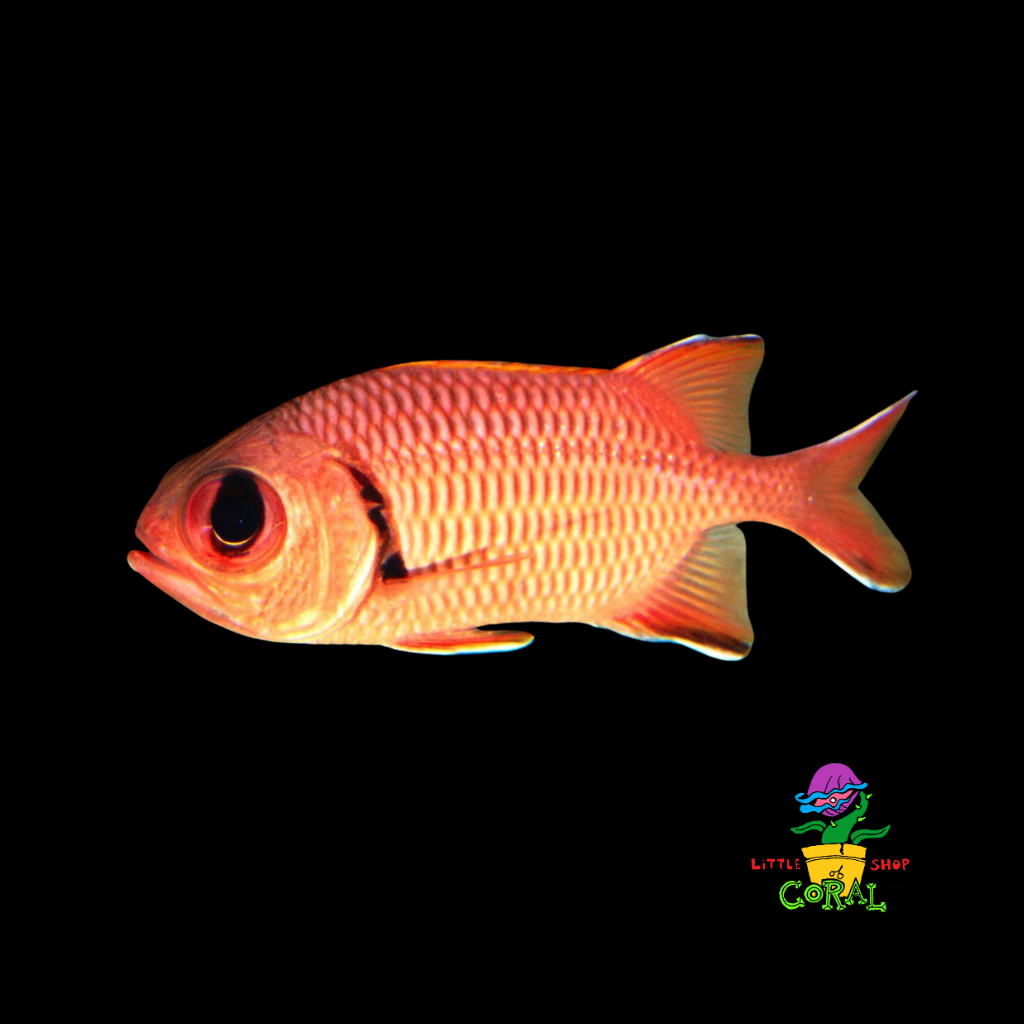
Big-Eye Squirrelfish (Myripristis amaena)
Big-Eye Squirrelfish (Myripristis amaena)
Couldn't load pickup availability
The Brick Soldierfish is a cave-dwelling, nocturnal predator from the reef flats and seaward slopes of the Pacific, and one of the more visually dramatic members of the Holocentridae family available in the trade. Its pale rose-pink body is defined by bold dark red scale margins that create a striking tile-like pattern across the flanks, a dark streak running behind the operculum to the pectoral base, and the genus' signature oversized eyes built for hunting in low-light conditions. Hardy, peaceful with appropriate tankmates, and genuinely rewarding to watch after the display lights dim, this is a fish that suits a patient keeper who appreciates what happens in a reef tank after hours.
Why we love it
- Striking tile-patterned brick-red and pink colouration with oversized eyes that look spectacular under blue-heavy or reduced lighting
- A genuinely nocturnal fish that brings life and active hunting behaviour to the tank during evening and night viewing hours
- Peaceful with all fish too large to be considered prey; can be kept in small groups in large enough systems
- Hardy and straightforward to maintain once feeding reliably on frozen foods
- An unusual and infrequently stocked species that stands out immediately in any large FOWLR display
Suggested parameters
- Temperature: 22–27°C (72–80°F)
- Salinity: 1.020–1.026 SG
- pH: 8.0–8.4
- Alkalinity: 8–12 dKH
- Ammonia/Nitrite: 0
- Nitrate: Under 20 ppm; stable, established water quality is important for long-term health
Care and temperament
- Difficulty: Moderate. Hardy once feeding, but transitioning off live food and managing its nocturnal feeding schedule requires patience
- Temperament: Peaceful toward fish too large to be prey; can become mildly territorial toward tankmates that enter its daytime cave if space is limited
- Reef safe: With caution. Corals are completely safe. Small fish, ornamental shrimp, small crabs, and other small crustaceans are at significant risk of predation
- Minimum tank size: 125 gallons, with extensive cave and overhang structure; this species grows quickly and needs space that matches its adult size
Diet
The Big-Eye Squirrelfish is a dedicated carnivore with a nocturnal feeding pattern that should be accommodated rather than ignored.
- Live saltwater feeder shrimp, grass shrimp, or ghost shrimp are often necessary to trigger an initial feeding response; weaning onto frozen foods should follow gradually
- Frozen mysis shrimp, krill, vitamin-enriched brine shrimp, and chopped meaty marine preparations once established
- Offer at least one feeding session after the display lights are off or significantly dimmed; this species feeds most actively and confidently in low light
- Target feeding with a feeding stick is helpful in community systems where faster tankmates may outcompete it
- Feed once to twice daily; soaking frozen foods in a quality vitamin supplement is recommended
Compatibility and tankmates
- Works well alongside larger, robust fish including tangs, angelfish, larger wrasses, hawkfish, groupers, and lionfish
- Will eat small fish, ornamental shrimp, small crabs, and any crustacean small enough to be taken; stock accordingly
- Can be kept in small groups of three or more in large systems with ample cave structure; pairs may bicker, making odd numbers preferable and simultaneous introduction essential
- Avoid highly assertive or boisterous species that will outcompete it at feeding time or prevent it from emerging comfortably at dusk
- Not suitable for tanks with small gobies, dartfish, firefish, or other small, slender species
Health and acclimation notes
The Big-Eye Squirrelfish has a large swim bladder that makes it sensitive to loud sounds and tapping on the glass; avoid unnecessary disturbances around the tank, particularly during the settling period. Because of this same anatomy, always use a container rather than a net when handling or transferring this fish: nets can easily damage the large eyes and become tangled in the fin spines, causing serious injury. Once established and feeding on frozen foods in a cave-rich system, this is a durable, long-lived animal. Its fast growth rate means a suitably large system from the start is strongly preferred over the approach of upgrading later. Quarantine before introduction to an established display is always recommended.
What you are buying
- You will receive: 1 Big-Eye Squirrelfish (Myripristis amaena)
- Colouring is a pale rose-pink to brick red with bold dark red scale margins, a dark opercular streak, and a dark blotch above the pupil; fin colouration is uniformly red without the white leading edges seen on related Myripristis species
- Size and exact colouring intensity may vary between individuals; please see size options at checkout
Collapsible content
LIGHT
LOW: Place coral at the bottom of the tank. Depending on the type, coral may need to be placed off sand and therefore mounted on a ceramic disc of piece of rock.
MEDIUM: Place coral at mid-range of the tank. Best placed/glued on top of a rock scape at mid-range height.
HIGH: Place coral from mid range to just below water level. SPS coral are shallow growing so they require and are able to tolerate intense light.
FLOW
LOW: Most soft coral do well with a small, gentle pulse. There are certain corals that can even be placed in areas of indirect flow, meaning places aside a rock structure or set into a entrance to a cave style space.
MEDIUM: Many LPS types of coral prefer medium pulse current. Most Euphyllia or corals that have more tissue structure connected to their skeleton, don’t like to be in a high flow area like the direct flow of the wave pump.
HIGH: Similar to high light, SPS enjoy being in some heavy current. Most LPS and SPS that branch encrust or plate prefer high flow that simulates the top water waves.
SKILL
ENTRY: While some may say beginner level, "Entry" is a good term to be used when starting out in the world of corals and marine life. Prior to adding livestock, you want to ensure that your reef has the proper parameters including zero levels of ammonia and nitrite. Seeing traces of nitrate in your waters is a good sign - just keep them at a lower level of 2ppm to 10ppm. Maintaining correct temperature and salinity are a huge factor to stable parameters. Starting to monitor your PH, alkalinity, calcium and magnesium is a great habit to get into to keep a successful reef.
While some soft coral don’t require too much light, having a proper reef light that puts out the proper pars is very important. You'll also want to have a good amount of flow and protected rock areas, as placing corals in their happy spot is ideal for success.
ADVANCED: