

Little Shop of Coral
Banded Longspine Urchin (Echinothrix calamaris)
Banded Longspine Urchin (Echinothrix calamaris)
Couldn't load pickup availability
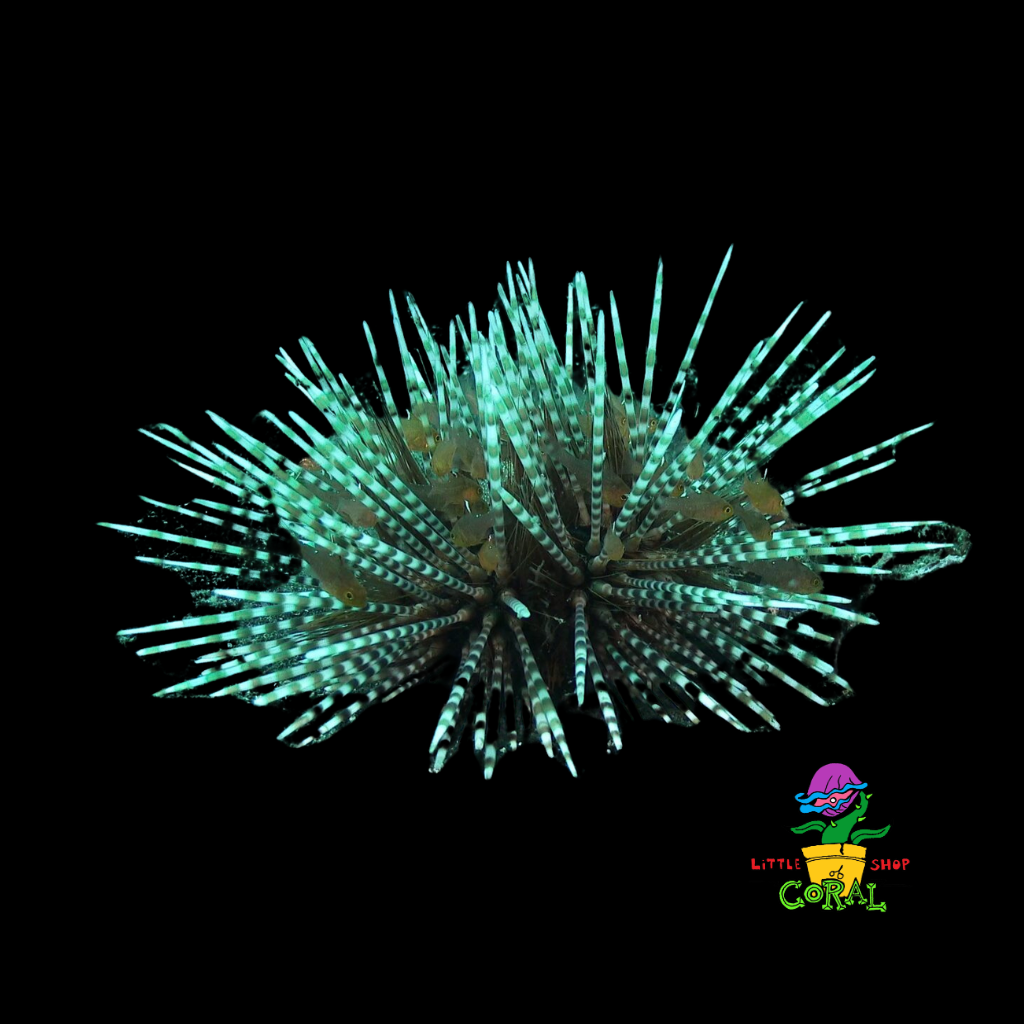
The Banded Longspine Urchin is one of the most visually dramatic invertebrates available in the reef hobby, and one that commands immediate attention in any system large enough to house it comfortably. Its black central body is ringed by long, sharp spines sometimes reaching 9 inches in length, covered in hundreds of alternating light and dark bands that give it a striking, graphic quality under reef lighting. Also known as the Hatpin Urchin and the Double-Spined Urchin, E. calamaris is found on reef flats and occasionally in tide pools throughout the Indo-Pacific, where it spends daylight hours tucked into rocky crevices and emerges at night to graze. It is a genuinely fascinating animal that brings serious display impact to the right system, but it requires honest and upfront transparency on two important points: its spines are venomous and must be respected during maintenance, and its diet shifts meaningfully from juvenile to adult in ways that affect long-term planning.
Why we love it
- One of the most visually striking urchin species available; the alternating banded spines and dark central body create a dramatic silhouette under any lighting
- Effective nocturnal algae grazer as a juvenile, making a genuine contribution to algae management in established systems
- Smaller fish, including Banggai Cardinals, will often seek shelter among its spines during the day, creating a fascinating and natural-looking symbiotic dynamic in the display
- Hardy and long-lived once established in a stable, well-run system
- A genuine conversation piece that nothing else in the cleanup crew category can match for sheer visual presence
Suggested parameters
- Temperature: 24 to 26°C (75 to 79°F)
- Salinity: 1.025 to 1.026 SG; sensitive to sudden salinity changes and must be acclimated slowly
- pH: 8.1 to 8.4
- Alkalinity: 8 to 10 dKH
- Calcium: 400 to 450 ppm
- Magnesium: 1250 to 1400 ppm
- Nitrate: Low and stable; will not tolerate chronically elevated nitrate levels
- Phosphate: 0.03 to 0.12 ppm
- Regular supplementation of calcium, magnesium, iodine, and trace elements through consistent water changes supports healthy spine and test condition
- Copper-based medications are immediately fatal to all echinoderms and must never be used
Care and temperament
- Difficulty: Moderate
- Temperament: Peaceful toward fish and corals; use caution with small invertebrates as the animal matures
- Reef safe: Yes with corals; with important caveats regarding invertebrate compatibility as adults (see below)
- Minimum tank size: 150 litres (40 gallons) given its potential spine span; larger is strongly preferred to provide adequate crevice hiding space and grazing territory
- The aquarium must have stable, secure rockwork with large enough crevices for this urchin to comfortably wedge itself into during daylight hours; shaded areas and caves are essential
- All frags and loose corals must be glued firmly in place; the long spines can easily dislodge unsecured items as the animal moves through the aquascape at night
- Pump intakes must be fully screened
Spine safety: what you need to know
Use care when handling the Banded Longspine Urchin; its spines are venomous and the sting is similar to that of a wasp. Spines can penetrate neoprene gloves. Always use long tongs or thick protective gloves when working in a tank housing this species, and never reach blindly into areas where it may be resting. The spines are hollow and can break off in skin, requiring careful removal. This is not a species to be casual about during maintenance; plan aquascape work with its resting location in mind before putting hands in the tank.
Diet: a critical distinction
This is the most important care consideration for long-term planning with this species and must be understood before purchase.
- Juveniles feed primarily on algae, foraging the reef during nighttime hours; adults shift to a carnivorous diet and will prey on small invertebrates
- Juvenile feeding: grazes naturally on hair algae, film algae, and filamentous algae; supplement with nori sheets and algae wafers if natural growth is limited
- Adult feeding: meaty foods including mussel or clam meat can be placed near or directly on the spines, which will transport the food to the mouth; feed adults meaty foods three to four times per week
- It is best to feed adults about an hour after the aquarium lights have been turned off, when the urchin is most active
- The dietary shift means that ornamental invertebrates including shrimp, small crabs, small snails, and tubeworms become increasingly at risk as this animal matures; plan the system accordingly
Compatibility and tankmates
- Compatible with most reef fish of all sizes; fish are not at risk
- Should be kept with care alongside other invertebrates as adults will attempt to prey on certain small species; ornamental shrimp, small hermit crabs, and similar animals may be targeted over time
- Avoid triggerfish, pufferfish, and large predatory wrasses that will target and eat urchins despite the spines
- The shelter dynamic with small fish such as Banggai Cardinals is natural and beneficial for both animals
Health and acclimation notes
Drip acclimation over at least 45 to 60 minutes is strongly recommended before introduction, as this species shares the echinoderm sensitivity to rapid salinity and parameter shifts. Banded Urchins can be sensitive to high nitrate levels and fluctuations in water parameters; stable, clean water is the foundation of long-term health with this species. Spine loss is the primary visible warning sign of water quality problems and should prompt an immediate parameter check. Copper-based medications must never be used in any system housing this or any other echinoderm.
What you are buying
- You will receive: 1 Banded Longspine Urchin (Echinothrix calamaris)
- In younger specimens the primary spines often appear clearly banded with alternating dark and white; spines of older individuals can become more bluish-black overall
- Size at time of sale can vary; total spine span can reach up to 23 cm (9 inches) at full maturity
Drip acclimation of at least 45 to 60 minutes is strongly recommended. Stable rockwork with accessible crevices must be in place before introduction. All frags and loose items must be glued firmly in place. Handle with extreme caution; spines are venomous. Copper-based medications must never be used in any system housing this animal.
Collapsible content
LIGHT
LOW: Place coral at the bottom of the tank. Depending on the type, coral may need to be placed off sand and therefore mounted on a ceramic disc of piece of rock.
MEDIUM: Place coral at mid-range of the tank. Best placed/glued on top of a rock scape at mid-range height.
HIGH: Place coral from mid range to just below water level. SPS coral are shallow growing so they require and are able to tolerate intense light.
FLOW
LOW: Most soft coral do well with a small, gentle pulse. There are certain corals that can even be placed in areas of indirect flow, meaning places aside a rock structure or set into a entrance to a cave style space.
MEDIUM: Many LPS types of coral prefer medium pulse current. Most Euphyllia or corals that have more tissue structure connected to their skeleton, don’t like to be in a high flow area like the direct flow of the wave pump.
HIGH: Similar to high light, SPS enjoy being in some heavy current. Most LPS and SPS that branch encrust or plate prefer high flow that simulates the top water waves.
SKILL
ENTRY: While some may say beginner level, "Entry" is a good term to be used when starting out in the world of corals and marine life. Prior to adding livestock, you want to ensure that your reef has the proper parameters including zero levels of ammonia and nitrite. Seeing traces of nitrate in your waters is a good sign - just keep them at a lower level of 2ppm to 10ppm. Maintaining correct temperature and salinity are a huge factor to stable parameters. Starting to monitor your PH, alkalinity, calcium and magnesium is a great habit to get into to keep a successful reef.
While some soft coral don’t require too much light, having a proper reef light that puts out the proper pars is very important. You'll also want to have a good amount of flow and protected rock areas, as placing corals in their happy spot is ideal for success.
ADVANCED: