
Little Shop of Coral
Arrow Crab (Stenorhynchus seticornis)
Arrow Crab (Stenorhynchus seticornis)
Couldn't load pickup availability
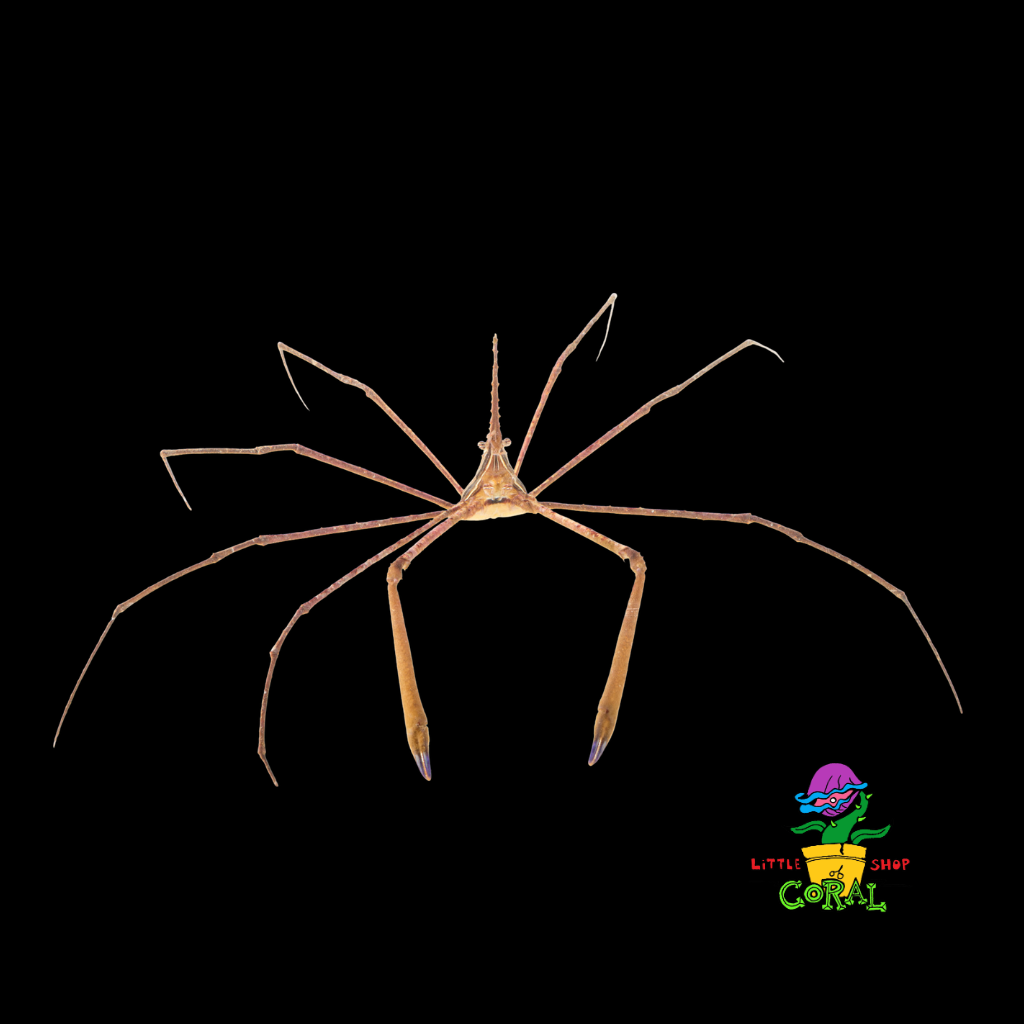
The Arrow Crab is one of the most visually alien and instantly recognizable invertebrates in the reef hobby, and one that generates a strong reaction from almost everyone who sees it for the first time. Its triangular, arrow-shaped body sits atop a set of impossibly long, spindly legs fringed with fine hairs, giving it a silhouette that looks more like something from a science fiction film than a Caribbean reef. Also known as the Yellowline Arrow Crab and Spider Crab, S. seticornis is native to shallow coral reef environments of the western Atlantic and Caribbean, where it spends its days hiding in crevices and among anemone tentacles and comes out at night to feed on feather duster worms and small reef invertebrates. It is a genuinely fascinating animal with real utility in the reef aquarium, particularly for hobbyists dealing with nuisance bristleworm populations, and one that rewards the keeper who plans its tankmates carefully.
Why we love it
- One of the most distinctive-looking invertebrates available in the hobby; its extraordinary body shape and movement style make it a permanent conversation piece in any system
- A natural predator of bristleworms and feather duster worms, providing targeted pest control that few other cleanup crew animals can match
- Hardy and long-lived in captivity with proper care; a well-established Arrow Crab is one of the more durable reef invertebrates available
- In the wild has been observed acting as a cleaner for large reef fish including species that would normally prey on crabs, picking parasites and dead tissue from willing clients
- Active, endlessly interesting to observe, and capable of navigating complex aquascapes with remarkable precision on its long legs
Suggested parameters
- Temperature: 24 to 26°C (75 to 79°F)
- Salinity: 1.025 to 1.026 SG
- pH: 8.1 to 8.4
- Alkalinity: 8 to 10 dKH
- Calcium: 400 to 450 ppm
- Magnesium: 1250 to 1400 ppm
- Nitrate: Under 20 ppm; stable, clean water quality is important for long-term health
- Phosphate: 0.03 to 0.12 ppm
- Copper-based medications are immediately fatal to all invertebrates and must never be used
Care and temperament
- Difficulty: Easy to moderate
- Temperament: Semi-aggressive; generally peaceful toward fish and corals but opportunistically predatory toward small invertebrates, particularly ornamental shrimp, small crabs, and slow-moving animals; a well-fed individual is significantly less likely to cause problems
- Reef safe: Yes with corals; use caution with small ornamental shrimp, small crustaceans, and very small fish
- Minimum tank size: 75 litres (20 gallons) with ample live rock
- Primarily nocturnal; spends daylight hours tucked into crevices, overhangs, and shaded areas of the aquascape, becoming active and foraging openly after lights dim
- Requires an aquarium with plenty of three-dimensional rockwork offering tunnels, ridges, ledges, and crevices to explore, hunt, and hide in; a sparse or open aquascape does not suit this species
- Keep one per system; Arrow Crabs are territorial and will fight with conspecifics except in very large systems where adequate territory exists for each
- Females remain significantly smaller than males; size at maturity varies, with males reaching a leg span approaching 20 cm in ideal conditions
Diet
The Arrow Crab is a carnivorous opportunist and scavenger with a particular appetite for worms and small invertebrate prey.
- Frozen mysis shrimp and frozen meaty marine foods (staple once established)
- Finely chopped shrimp, krill, clam, and squid
- Quality sinking carnivore pellets
- Will actively hunt and consume bristleworms and feather duster worms naturally present in the system
- Will scavenge uneaten fish food and detritus from the rockwork and substrate after lights out
- Target feeding every other day near the crab's established cave or crevice is the most reliable approach; a consistently well-fed Arrow Crab is a more peaceful and manageable tankmate
Compatibility and tankmates
- Compatible with most larger reef fish, tangs, angelfish, clownfish, gobies, and blennies
- Avoid housing with ornamental shrimp species including cleaner shrimp, fire shrimp, and peppermint shrimp, which are at risk of predation, particularly at night
- Avoid aggressive or large crustacean-eating species such as triggerfish, puffers, and large hawkfish that may target the crab
- Do not house with other Arrow Crabs unless the system is very large with well-separated territories
- Existing bristleworm and feather duster populations will be reduced; this is a benefit for hobbyists dealing with pest bristleworm infestations but a consideration for those who value their feather dusters
Health and acclimation notes
The Arrow Crab is hardy and adapts well to established aquarium systems given stable water quality and a suitable, cave-rich environment. Drip acclimation is recommended as with all invertebrates. It is possible for specimens to arrive with a missing claw or leg due to stress during collection and transport; this is not a cause for concern as full regeneration occurs naturally over the course of a few subsequent molts. Regular water changes maintain the mineral levels that support healthy exoskeleton development. Copper-based medications must never be used in any system housing this or any other invertebrate.
What you are buying
- You will receive: 1 Arrow Crab (Stenorhynchus seticornis)
- Body colour is a rusty brown to tan with thin yellow lines running over the legs and carapace; the long, pointed rostrum extends distinctively forward from the triangular body
- Size varies between individuals; females remain significantly smaller than males at maturity
Drip acclimation is recommended. Ample rockwork with caves and crevices must be in place before introduction. Copper-based medications must never be used in any system housing this animal.
Collapsible content
LIGHT
LOW: Place coral at the bottom of the tank. Depending on the type, coral may need to be placed off sand and therefore mounted on a ceramic disc of piece of rock.
MEDIUM: Place coral at mid-range of the tank. Best placed/glued on top of a rock scape at mid-range height.
HIGH: Place coral from mid range to just below water level. SPS coral are shallow growing so they require and are able to tolerate intense light.
FLOW
LOW: Most soft coral do well with a small, gentle pulse. There are certain corals that can even be placed in areas of indirect flow, meaning places aside a rock structure or set into a entrance to a cave style space.
MEDIUM: Many LPS types of coral prefer medium pulse current. Most Euphyllia or corals that have more tissue structure connected to their skeleton, don’t like to be in a high flow area like the direct flow of the wave pump.
HIGH: Similar to high light, SPS enjoy being in some heavy current. Most LPS and SPS that branch encrust or plate prefer high flow that simulates the top water waves.
SKILL
ENTRY: While some may say beginner level, "Entry" is a good term to be used when starting out in the world of corals and marine life. Prior to adding livestock, you want to ensure that your reef has the proper parameters including zero levels of ammonia and nitrite. Seeing traces of nitrate in your waters is a good sign - just keep them at a lower level of 2ppm to 10ppm. Maintaining correct temperature and salinity are a huge factor to stable parameters. Starting to monitor your PH, alkalinity, calcium and magnesium is a great habit to get into to keep a successful reef.
While some soft coral don’t require too much light, having a proper reef light that puts out the proper pars is very important. You'll also want to have a good amount of flow and protected rock areas, as placing corals in their happy spot is ideal for success.
ADVANCED: