
Little Shop of Coral
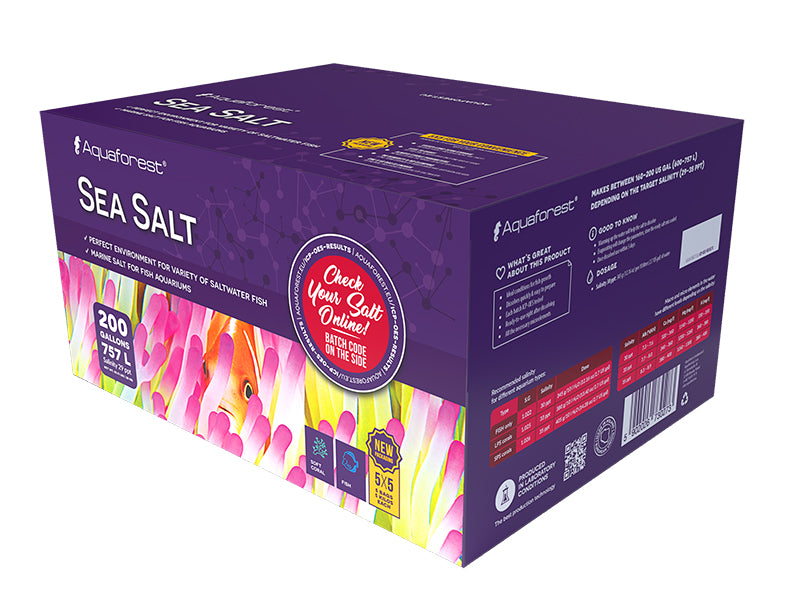
Aquaforest Sea Salt Box 5x5kg
Aquaforest Sea Salt Box 5x5kg
Couldn't load pickup availability
Laboratory-made marine salt for aquariums with fish and less delicate corals and invertebrates
Aquaforest Sea Salt is a premium quality product designed to provide optimal living conditions for fish, corals and other invertebrates in your aquarium. The salt formula was developed based on years of research and experience, as well as analysis of natural seawater, so that it resembles the natural habitat of underwater flora as much as possible. Aquaforest Sea Salt is safe for fish and less demanding corals, such as soft corals. It is easy to dissolve and prepare. It is ideal for so-called fish-only aquariums, i.e. aquariums where only fish are kept.
How to use Aquaforest Sea Salt
- Start with RODI water, which should have a temperature of about 24°C (75°F).
- For a salinity of 30 ppt (1.022 S.G.), add about 345 g (12.17 oz.) of salt to 10 L (2.7 US gal) of water.
- Stir vigorously for about 15 minutes until the salt dissolves completely and the water becomes clear.
- check the resulting salinity with a refractometer before use.
- ready! The salt water is ready for use.
Remember to store the salt in a dry and dark place.
After dissolving, the salt should be used within 3 days.
Evaporation can change the parameters of the water, so store freshly mixed saltwater in a tightly closed container if you don’t use it right away.
If you store the salt for several days, recheck the salinity before using it.
Safety data sheet available upon request
Good to know
The salt is produced in the EU under strict laboratory supervision to meet the highest quality standards. The new product formula ensures even higher quality. The highest quality ingredients, free from any contaminants, are used to produce the salt, which guarantees the safety of your pets. Each batch of salt is rigorously analyzed on two ICP-OES spectrometers – one for macronutrients and one for micronutrients. Thus offering unprecedented consistency of composition, quality and safety. Analysis results are available online for each customer.
The salt is ideal for aquariums with fish, simple corals and invertebrates, providing them with optimal conditions for life and growth. By choosing Aquaforest Sea Salt, you provide your charges with healthy and comfortable living conditions, and yourself with a beautiful and healthy aquarium.
How is our marine salt product range tested?
We mix our salt and take 3 samples from each 600 kilo batch to test. Each of these samples is dissolved in 15 liters of RO water. Checking whether the composition is uniform and excluding undesirable contaminants is what our team does with the ICP-OES analysis. The credibility of the results is ensured by two individually calibrated top-notch spectrometers.
Collapsible content
LIGHT
LOW: Place coral at the bottom of the tank. Depending on the type, coral may need to be placed off sand and therefore mounted on a ceramic disc of piece of rock.
MEDIUM: Place coral at mid-range of the tank. Best placed/glued on top of a rock scape at mid-range height.
HIGH: Place coral from mid range to just below water level. SPS coral are shallow growing so they require and are able to tolerate intense light.
FLOW
LOW: Most soft coral do well with a small, gentle pulse. There are certain corals that can even be placed in areas of indirect flow, meaning places aside a rock structure or set into a entrance to a cave style space.
MEDIUM: Many LPS types of coral prefer medium pulse current. Most Euphyllia or corals that have more tissue structure connected to their skeleton, don’t like to be in a high flow area like the direct flow of the wave pump.
HIGH: Similar to high light, SPS enjoy being in some heavy current. Most LPS and SPS that branch encrust or plate prefer high flow that simulates the top water waves.
SKILL
ENTRY: While some may say beginner level, "Entry" is a good term to be used when starting out in the world of corals and marine life. Prior to adding livestock, you want to ensure that your reef has the proper parameters including zero levels of ammonia and nitrite. Seeing traces of nitrate in your waters is a good sign - just keep them at a lower level of 2ppm to 10ppm. Maintaining correct temperature and salinity are a huge factor to stable parameters. Starting to monitor your PH, alkalinity, calcium and magnesium is a great habit to get into to keep a successful reef.
While some soft coral don’t require too much light, having a proper reef light that puts out the proper pars is very important. You'll also want to have a good amount of flow and protected rock areas, as placing corals in their happy spot is ideal for success.
ADVANCED: