

Little Shop of Coral
Aquaforest Lab ICP-OES 2 Test (RO & Aquarium Water)
Aquaforest Lab ICP-OES 2 Test (RO & Aquarium Water)
Couldn't load pickup availability
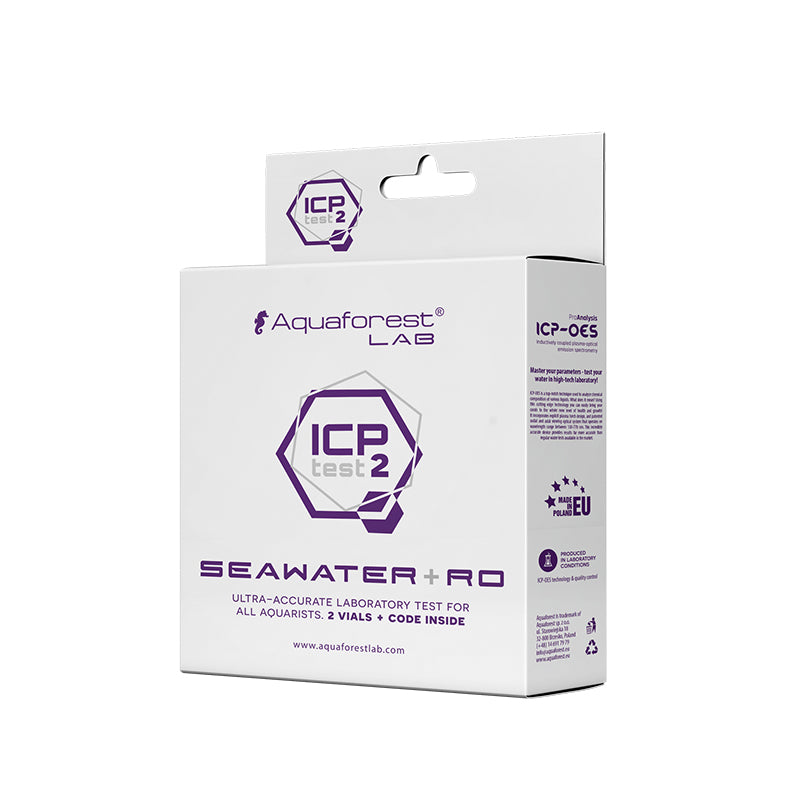
ICP-OES test designed to thoroughly analyze parameters of saltwater from your tank and your RO water. The set contains 2 test vials, individual test code and an envelope for shipping the test to our laboratory. Single ICP-OES test provides accurate results of 39 parameters analysis. In our laboratory we examine: Li, Si, I, Ba, Mo, Ni, Mn, Be, Cr, Co, Fe, V, Zn, Hg, Se, Cd, Sn, Sb, As, Al, Pb, Ti, Cu , La, Sc, W, Na, Ca, Mg, K, Br, B, Sr, S, P, PO4 + salinity, KH and NO3!
What is ICP-OES test?
ICP-OES (Inductively Coupled Plasma Optical Emission Spectrometry) is a technique used to analyze the composition of many different types of liquid samples, e.g. drinking water, brine or sea water. The Aquaforest Lab owns the highest resolution spectrometer on the market with plasma excitation with a unique, patented optical system made with horizontal and vertical plasma. Wavelength range 130-770 nm. The analysis and processing of the entire spectral spectrum takes only 2 seconds. Thanks to the fast reading system, elemental analysis possible with a sampling frequency of up to 10 Hz.
Why Aquaforest Lab?
We own not one, but two of these highly advanced ICP-OES spectrometers meaning that we can perform water tests faster and provide results and solutions for aquarists almost immediately after receiving the sample.
Usage:
- Use your RO water intended for analysis to rinse the red test vial twice, before collecting the actual sample. Use the aquarium water intended for analysis to rinse the blue test vial twice, before collecting the actual sample. Fill the vials and make sure they’re closed tightly.
- Sign up and log in www.aquaforestlab.com. Use the vial code to register your sample.
- Fill in the sender details on the enclosed envelope and mail the samples to our lab for analysis.
- We will notify you by email once the results are available. Please log on www.aquaforestlab.com website in order to receive your reports.
Collapsible content
LIGHT
LOW: Place coral at the bottom of the tank. Depending on the type, coral may need to be placed off sand and therefore mounted on a ceramic disc of piece of rock.
MEDIUM: Place coral at mid-range of the tank. Best placed/glued on top of a rock scape at mid-range height.
HIGH: Place coral from mid range to just below water level. SPS coral are shallow growing so they require and are able to tolerate intense light.
FLOW
LOW: Most soft coral do well with a small, gentle pulse. There are certain corals that can even be placed in areas of indirect flow, meaning places aside a rock structure or set into a entrance to a cave style space.
MEDIUM: Many LPS types of coral prefer medium pulse current. Most Euphyllia or corals that have more tissue structure connected to their skeleton, don’t like to be in a high flow area like the direct flow of the wave pump.
HIGH: Similar to high light, SPS enjoy being in some heavy current. Most LPS and SPS that branch encrust or plate prefer high flow that simulates the top water waves.
SKILL
ENTRY: While some may say beginner level, "Entry" is a good term to be used when starting out in the world of corals and marine life. Prior to adding livestock, you want to ensure that your reef has the proper parameters including zero levels of ammonia and nitrite. Seeing traces of nitrate in your waters is a good sign - just keep them at a lower level of 2ppm to 10ppm. Maintaining correct temperature and salinity are a huge factor to stable parameters. Starting to monitor your PH, alkalinity, calcium and magnesium is a great habit to get into to keep a successful reef.
While some soft coral don’t require too much light, having a proper reef light that puts out the proper pars is very important. You'll also want to have a good amount of flow and protected rock areas, as placing corals in their happy spot is ideal for success.
ADVANCED: