
Little Shop of Coral
Porcelain Anemone Crab (Neopetrolisthes sp.)
Porcelain Anemone Crab (Neopetrolisthes sp.)
Couldn't load pickup availability
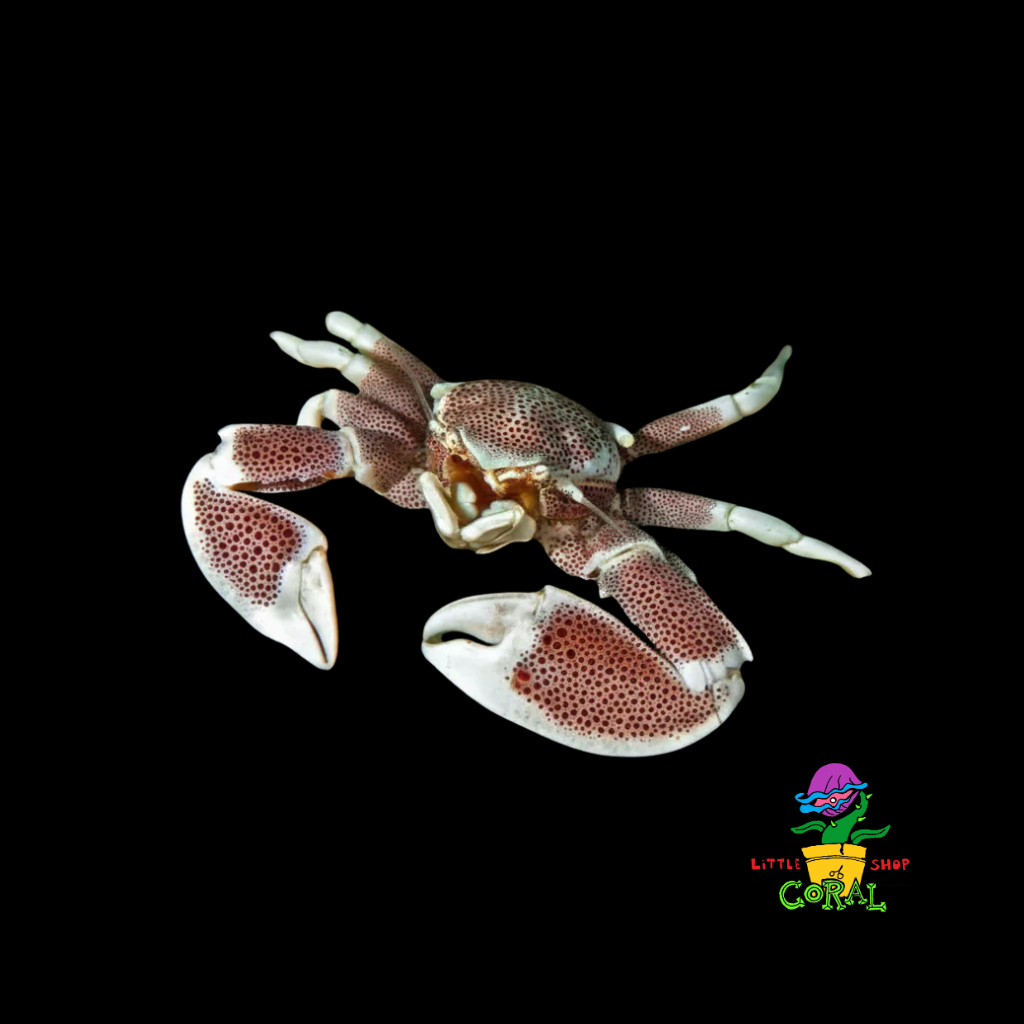
The Anemone Crab, also widely known as the Porcelain Anemone Crab, is one of the most charming and beginner-friendly invertebrates available for the reef aquarium. Its patterned white carapace is covered in vivid reddish-brown or orange spots, and it carries disproportionately large front claws that it uses to fend off potential threats, giving it a look that is simultaneously delicate and bold. Despite the imposing claws, this is a thoroughly peaceful filter feeder that spends the vast majority of its life tucked inside a host anemone, waving feathery fan-like mouthparts through the water column to catch passing food. The taxonomy of Neopetrolisthes can be confusing, with both N. maculatus and N. ohshimai commonly sold under the same common name; differing spot patterns alone are not sufficient to reliably distinguish them, and care requirements are identical across the genus. What is not confusing is what makes these animals special: they are one of the reef hobby's most captivating symbiotic partnerships, rivalling the clownfish and anemone relationship in sheer visual and behavioural appeal.
Why we love them
- Stunning spotted porcelain white colouration with oversized claws and a genuinely unique silhouette
- Active filter feeders that use fan-like bristled appendages to sweep plankton and particulate food from the water column, a fascinating and endlessly watchable feeding behaviour
- Peaceful and fully reef safe, posing no threat to corals, fish, or ornamental invertebrates
- Naturally found in pairs sharing a single host anemone, making them one of the few invertebrates that can be kept and displayed as a bonded couple
- Contribute to anemone health by keeping the host clean of detritus and debris
Suggested parameters
- Temperature: 24 to 26°C (75 to 79°F)
- Salinity: 1.025 to 1.026 SG
- pH: 8.1 to 8.4
- Alkalinity: 8 to 10 dKH
- Calcium: 400 to 450 ppm
- Magnesium: 1250 to 1400 ppm
- Nitrate: 5 to 20 ppm
- Phosphate: 0.03 to 0.12 ppm
- Copper-based medications are toxic to all crustaceans and must never be used
Care and temperament
- Difficulty: Easy
- Temperament: Peaceful toward all fish and invertebrates; may attempt to defend its anemone territory from clownfish, though the clownfish generally prevails; aggressive toward conspecifics of the same sex if competing for the same host
- Reef safe: Yes, completely safe with corals and ornamental invertebrates
- Minimum tank size: 10 gallons for a pair with a suitable host anemone
- A host anemone is not simply preferred but genuinely essential for the long-term wellbeing of this species; without one these crabs experience chronic stress and have significantly shorter lifespans even in otherwise well-maintained systems
- Suitable host anemones include Stichodactyla carpet anemones, Entacmaea quadricolor (bubble tip), and Heteractis magnifica; always ensure the host anemone is established and healthy before adding the crab
Diet
Neopetrolisthes species are active filter feeders, using plume-like bristled appendages to extract suspended particles, plankton, and organic matter from the water column; they also consume mucus produced by their host anemone and scavenge detritus from nearby surfaces.
- In a well-established, plankton-rich system supplemental feeding may be minimal
- Liquid or fine powdered planktonic foods broadcast into the water column are ideal and will trigger active fan feeding behaviour
- Phytoplankton and zooplankton-based liquid foods such as Coral Frenzy, Reef Roids, or similar fine reef foods are excellent
- Tablet or sinking foods placed directly next to the host anemone are also accepted
- Feed small amounts multiple times per week; strong flow in the tank helps distribute food particles for filter feeding
Compatibility and tankmates
- Excellent with clownfish, peaceful reef fish, corals, shrimp, and most ornamental invertebrates
- Will share a host anemone with clownfish, though minor territorial skirmishes are common; the clownfish typically establishes dominance
- Can be kept as a mated pair in the same host anemone; two individuals of the same sex may fight
- Avoid aggressive crabs, triggerfish, pufferfish, and large predatory wrasses that may target small crustaceans
- Do not house with larger, aggressive crab species that may attack or outcompete them
Health and acclimation notes
Neopetrolisthes species are sensitive to sudden changes in water quality; maintaining consistent, stable conditions is the foundation of long-term success with this animal. Drip acclimation is strongly recommended. These crabs are capable of autotomy, voluntarily dropping a claw or leg when threatened as an escape strategy; lost appendages typically regenerate at the next moult, which is normal and not a cause for concern. Copper-based medications must never be used in any system housing this or any other crustacean.
What you are buying
- You will receive: 1 Anemone Crab (Neopetrolisthes sp.)
- Spot pattern, density, and colouration can vary between individuals and collection regions; all Neopetrolisthes species sold under this name share identical care requirements
- A suitable, established host anemone must be present in the system before introduction
Drip acclimation is strongly recommended. A host anemone is required for the long-term health of this animal. Copper-based medications must never be used in any system housing this crab.
Collapsible content
LIGHT
LOW: Place coral at the bottom of the tank. Depending on the type, coral may need to be placed off sand and therefore mounted on a ceramic disc of piece of rock.
MEDIUM: Place coral at mid-range of the tank. Best placed/glued on top of a rock scape at mid-range height.
HIGH: Place coral from mid range to just below water level. SPS coral are shallow growing so they require and are able to tolerate intense light.
FLOW
LOW: Most soft coral do well with a small, gentle pulse. There are certain corals that can even be placed in areas of indirect flow, meaning places aside a rock structure or set into a entrance to a cave style space.
MEDIUM: Many LPS types of coral prefer medium pulse current. Most Euphyllia or corals that have more tissue structure connected to their skeleton, don’t like to be in a high flow area like the direct flow of the wave pump.
HIGH: Similar to high light, SPS enjoy being in some heavy current. Most LPS and SPS that branch encrust or plate prefer high flow that simulates the top water waves.
SKILL
ENTRY: While some may say beginner level, "Entry" is a good term to be used when starting out in the world of corals and marine life. Prior to adding livestock, you want to ensure that your reef has the proper parameters including zero levels of ammonia and nitrite. Seeing traces of nitrate in your waters is a good sign - just keep them at a lower level of 2ppm to 10ppm. Maintaining correct temperature and salinity are a huge factor to stable parameters. Starting to monitor your PH, alkalinity, calcium and magnesium is a great habit to get into to keep a successful reef.
While some soft coral don’t require too much light, having a proper reef light that puts out the proper pars is very important. You'll also want to have a good amount of flow and protected rock areas, as placing corals in their happy spot is ideal for success.
ADVANCED: